Pip
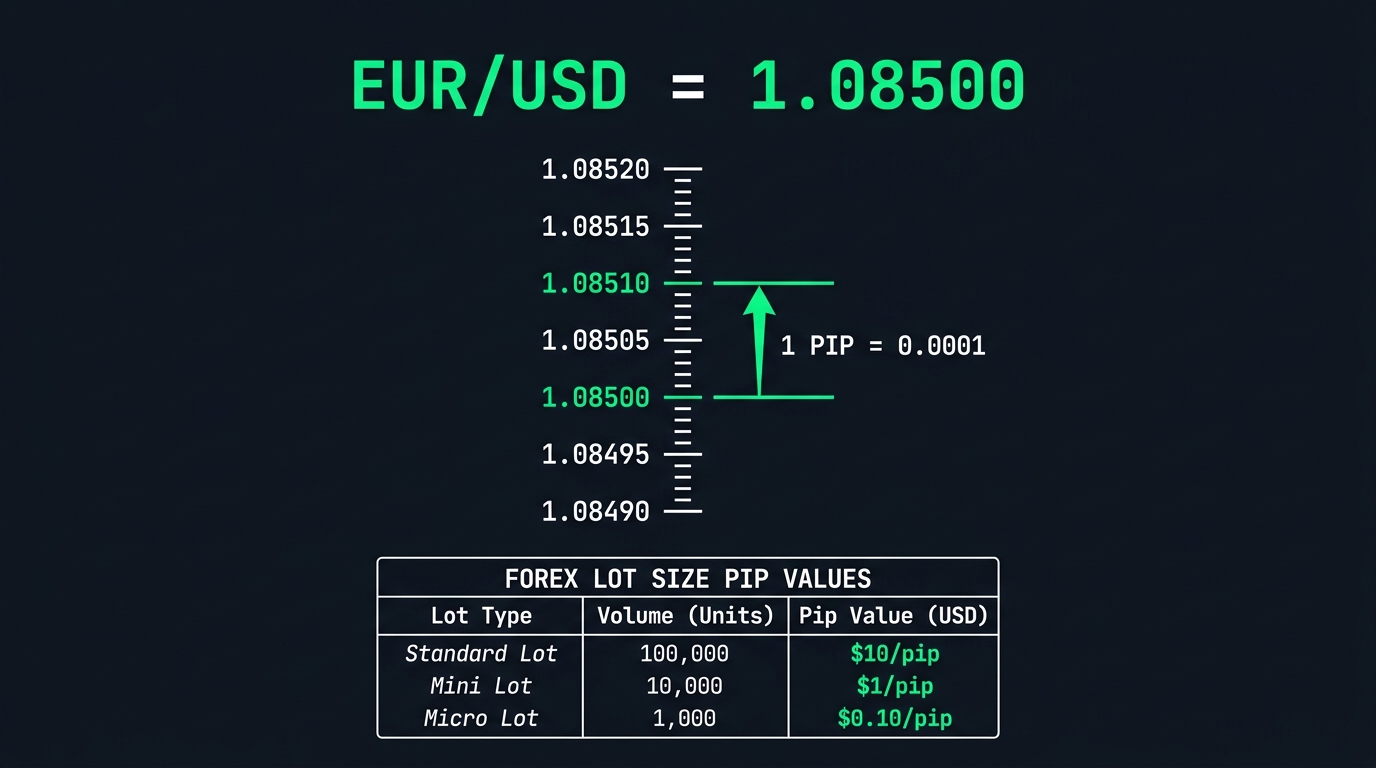
A pip is the smallest standardized price movement in a forex currency pair. For most pairs, one pip equals 0.0001 — the fourth decimal place. It is the universal unit traders use to measure profit, loss, and spread.
What Is a Pip in Forex?
A pip is the basic unit of measurement in forex trading. For the vast majority of currency pairs — EUR/USD, GBP/USD, USD/CHF, and most others — one pip equals 0.0001, which is the fourth decimal place in the quoted price. If EUR/USD moves from 1.0850 to 1.0855, that is a five-pip move. Simple as that sounds, understanding pip value precisely is what separates disciplined traders from those who blow up accounts.
The word itself is an acronym: Price Interest Point (some sources say Percentage In Point, and both are in common use). Either way, it refers to the same standardized increment that the entire forex market uses to quote price changes.
The Exception: Japanese Yen Pairs
JPY crosses break the standard rule. Because the yen is quoted at lower nominal values, pairs like USD/JPY and EUR/JPY are priced to only two decimal places — so one pip there equals 0.01, not 0.0001. A move from 149.85 to 149.92 in USD/JPY represents seven pips.
Worth noting: many brokers now quote to five decimal places (or three for yen pairs). That fifth digit is called a pipette or fractional pip — one-tenth of a standard pip. It gives you finer precision when comparing spreads across brokers, but your core calculations still center on the fourth decimal.
How to Calculate Pip Value
Pip value depends on three things: the lot size you’re trading, the currency pair, and your account currency. The formula is straightforward:
Pip Value = (Pip in decimal form × Trade Size) / Current Exchange Rate
Take a standard lot of EUR/USD (100,000 units). One pip = 0.0001. So:
- Pip value = (0.0001 × 100,000) / 1.0850 ≈ $9.22 per pip
On a mini lot (10,000 units), that drops to roughly $0.92 per pip. On a micro lot (1,000 units), you’re looking at about $0.09 per pip. These numbers shift slightly as the exchange rate moves, which is why most traders use their broker’s built-in pip calculator rather than running the math manually every time.
For pairs where the USD is the quote currency (EUR/USD, GBP/USD), the calculation is even cleaner — pip value stays close to $10 per standard lot regardless of the current rate, which is one reason beginners often start with these pairs.
Why Pip Counting Matters in Practice
Traders talk in pips because it strips away the dollar confusion. “I made 45 pips on that EUR/USD trade” means the same thing whether you traded a micro lot or a full standard lot — the pip count describes the quality of the trade, while the dollar outcome reflects position size.
This abstraction is genuinely useful. When you’re reviewing a trading system’s performance, looking at pip results lets you compare trades across different pair setups without account-size distortions. A system averaging +30 pips per trade with a 60% win rate tells you something concrete about its edge.
Brokers also quote the spread in pips. A typical EUR/USD spread of 1.2 pips means that when you enter a trade, you start 1.2 pips in the red. Understanding how many pips the spread costs you relative to your average trade targets is essential for evaluating whether a broker is eating your edge.
Pip Risk and Position Sizing
Every serious forex risk management framework starts with pip risk. Before entering a trade, you define two things: where your stop-loss sits (in pips from entry) and how much of your account you’re willing to lose on that trade (typically 1–2%).
The calculation runs backward from there:
Position Size = (Account Risk in $) / (Stop-Loss in Pips × Pip Value)
Say you have a $10,000 account, you’re risking 1% ($100), your stop is 25 pips away, and pip value is $10 per standard lot. That gives you:
- 100 / (25 × 10) = 0.4 standard lots
You trade 0.4 lots. Not a round number, but an honest one — sized to actual risk rather than gut feel. This is how professional prop traders and fund managers think. Pip counting is the foundation; position sizing is what it enables.
Key Takeaways
- One pip = 0.0001 for most pairs; 0.01 for JPY pairs
- Pip value on a standard lot is approximately $10 for USD-quoted pairs
- Pipettes (fractional pips) are one-tenth of a pip, used mainly to quote spreads
- Pip-based position sizing is the core of professional risk management
FAQ
Does pip value change as the market moves? Yes, slightly. For pairs where USD is not the quote currency (like EUR/GBP), pip value in USD shifts with the exchange rate. Most trading platforms recalculate this automatically.
What’s the difference between a pip and a tick? In forex, “tick” and “pip” are often used interchangeably, but technically a tick is the minimum price increment a market can move — which on a five-decimal broker is actually a pipette. In futures markets, the distinction is more formalized.
Ready to trade forex?
Open a free demo account with a regulated broker. Practice with virtual funds before risking real money.