Short Position
An open market commitment that profits from the price decline of an underlying asset and incurs losses when the price advances, established by selling borrowed securities or selling the base currency in a foreign exchange pair.
What Is a Short Position?
A short position (commonly called “being short” or holding a “short”) is an open market exposure engineered to generate positive financial returns when the price of the underlying asset depreciates. Conversely, if the market price rises, a short position suffers financial losses.
In traditional equity markets, an investor initiates a short position by borrowing shares from a broker or institutional custodian, selling them into the open market at current prices, and assuming the legal obligation to repurchase and return identical shares at a later date.
In the foreign exchange market, where transactions always involve the reciprocal exchange of two currencies, a short position simply means the trader has sold the base currency while simultaneously buying the quote currency (e.g., shorting EUR/USD means selling Euros and purchasing US Dollars).
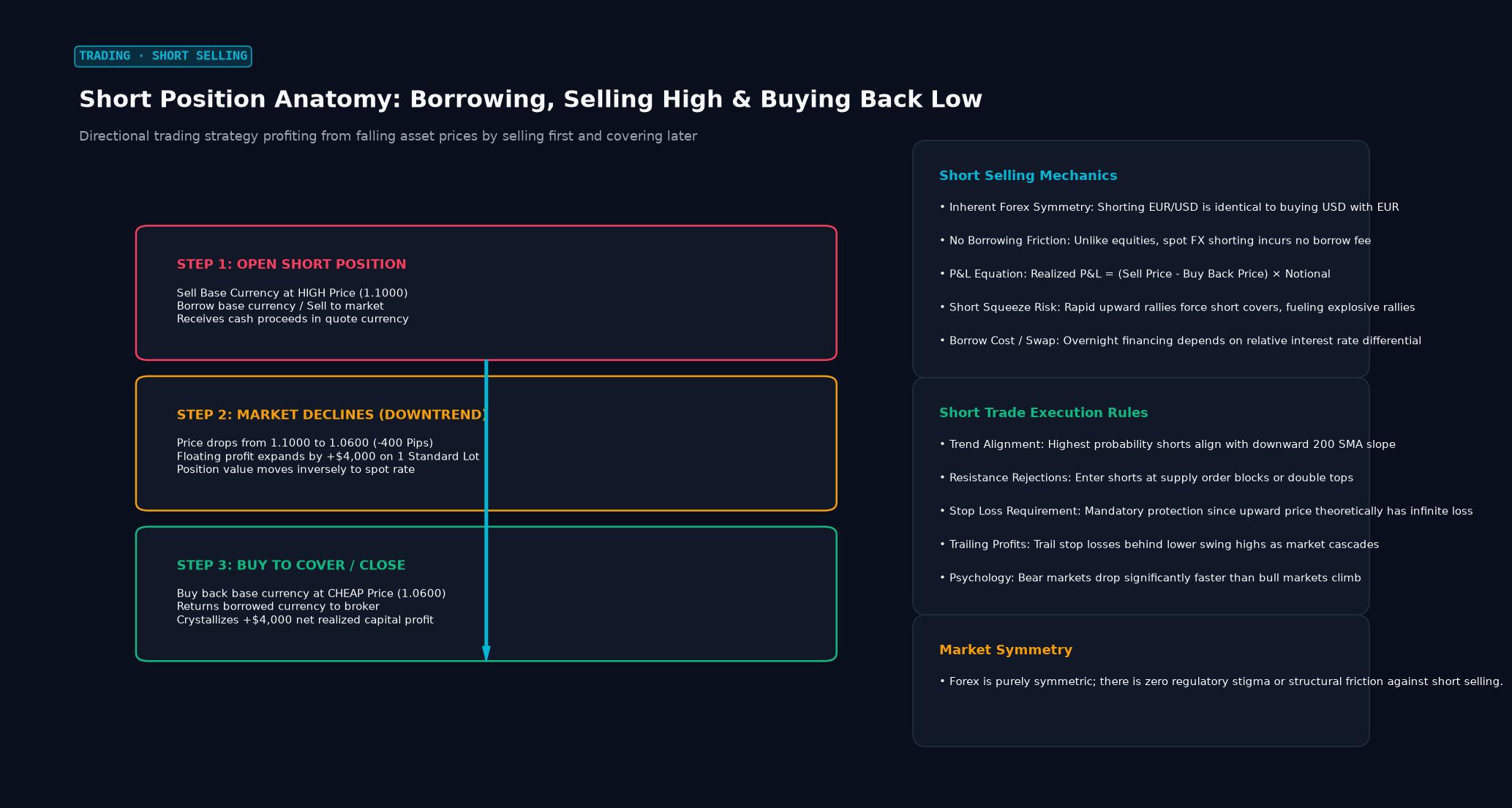 Figure: Directional trading strategy profiting from falling asset prices by selling first and covering later
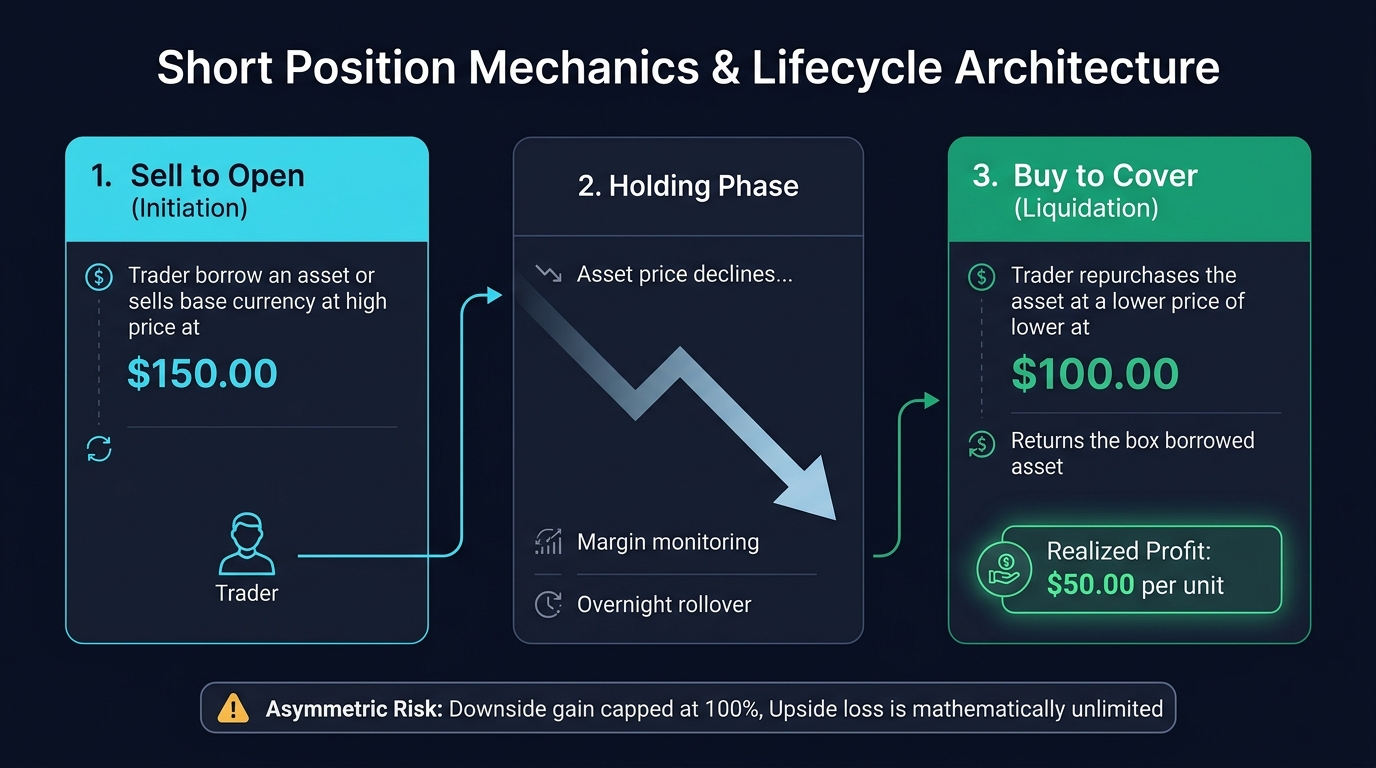
Anatomy of Short Positions Across Different Asset Classes
While the directional objective remains identical, the operational mechanics of maintaining a short position depend entirely on the market structure:
| Market | How the Short Is Established | Carrying Costs / Drag | Maximum Upside Risk |
|---|---|---|---|
| Foreign Exchange (Spot FX) | Selling the base currency against the quote currency | Overnight Tom-Next rollover rate (can be debit or credit) | Effectively unlimited if base currency hyper-appreciates |
| Equities (Stocks) | Borrowing physical shares from custodian and selling on exchange | Annualized borrow fee (0.3% to 50%+), mandatory dividend payout | Theoretically Unlimited (Stock price has no mathematical ceiling) |
| Futures Contracts | Entering a short futures contract (legal commitment to deliver) | Futures basis / roll yield when rolling expiring contracts | Unlimited until contract expiration or stop-out |
| Options (Puts & Calls) | Buying a Put Option or Selling a Call Option | Time decay ($\Theta$) on long puts; unlimited risk on naked short calls | Capped at premium paid for long puts; unlimited on naked short calls |
The Asymmetric Payoff Mathematics of a Short Position
Short positions possess a fundamentally skewed payoff structure compared to long positions:
$$\text{Net Realized P&L} = (\text{Opening Price} - \text{Closing Price}) \times \text{Position Size} - \text{Total Carrying Costs}$$
                PAYOFF COMPARISON: LONG VS. SHORT POSITION

    Price Scale       Long Position ($100 Entry)     Short Position ($100 Entry)
   ─────────────────────────────────────────────────────────────────────────────
    Asset to $250:    +$150 Profit (+150%)           -$150 Loss (-150%)
    Asset to $500:    +$400 Profit (+400%)           -$400 Loss (-400% - DEVASTATING)
Asset to $0: -$100 Loss (-100% - Capped) +$100 Profit (+100% - CAPPED)- Capped Upside Gain: The absolute best outcome for an equity short position is for the company to go bankrupt and the stock price to hit $0.00. Therefore, the maximum possible profit is mathematically capped at 100% of the entry price.
- Unlimited Downside Exposure: Because there is no theoretical ceiling on how high a stock, commodity, or currency can appreciate, an unhedged short position faces theoretically infinite loss potential. If an investor shorts a stock at $10 and it experiences a speculative mania to $200, the short seller loses 1,900% of their capital.
Short Position vs. Long Position vs. Synthetic Short
| Operational Metric | Short Position | Long Position | Synthetic Short (Options Box) |
|---|---|---|---|
| Market Outlook | Bearish (Anticipates decline) | Bullish (Anticipates advance) | Bearish (Mimics spot short) |
| Trade Execution | Sell to Open / Buy to Cover | Buy to Open / Sell to Close | Buy ATM Put + Sell ATM Call |
| Account Requirement | Margin account mandatory | Cash or Margin account | Margin approval for multi-leg options |
| Dividend Exposure | Must pay dividends to share lender | Receives dividends from issuer | Neutralized through option strike parity |
| Short Squeeze Vulnerability | Severe | Zero | Minimal (Covered by option contract rights) |
Real-World Institutional Case Study: Michael Burry’s Subprime Short (2005–2008)
The most lucrative and analytically rigorous short position in financial history was constructed by Dr. Michael Burry, founder of Scion Capital, between 2005 and 2008.
       SCION CAPITAL SUBPRIME HOUSING SHORT (2005–2008)

 2005: Burry analyzes thousands of subprime mortgage pools; identifies systemic
       fraud, teaser-rate resets, and zero-down lending.

 2005–2006: Burry purchases Credit Default Swaps (CDS) against BBB-rated subprime
            mortgage tranches from Wall Street banks (Goldman Sachs, Deutsche Bank).

 The Negative Carry Ordeal:
 - Scion Capital pays millions in monthly CDS insurance premiums ("carrying cost").
 - Housing prices continue to rise; investors threaten lawsuits and demand withdrawals.
 - Burry endures massive unrealized drawdowns while holding the short.

 2007–2008: Subprime delinquencies surge; subprime mortgage bonds collapse to zero.

 Outcome: Scion Capital extracts $720 Million in net profit for investors,
          with Burry personally earning over $100 Million.
Burry’s ordeal highlighted the defining challenge of running a macroeconomic short position: being fundamentally correct on the thesis is not enough. A short seller must survive the negative carry (cost of holding) and have sufficient institutional staying power to avoid being forced out before the market collapses.
Critical Institutional Risks When Holding Short Positions
Professional risk officers enforce strict protocols to insulate funds against the unique hazards of short positions:
- The Short Squeeze: When heavily shorted assets rise unexpectedly, short sellers scramble to buy back shares simultaneously to cap losses. This self-reinforcing buying wave drives prices vertically, triggering automatic broker margin stop-outs.
- Buy-In Risk (Forced Recall): In stock markets, the institutional share lender retains the legal right to recall their lent shares at any time. If the broker cannot locate alternative shares to borrow, the short seller is subjected to an involuntary “buy-in,” forcing the position closed at the prevailing market price regardless of current loss.
- Negative Carry Drag: In foreign exchange, holding a short position in a higher-yielding currency (e.g., short USD/CHF during a Fed rate peak) drains equity every night via rollover debits, steadily eroding the trade’s profit margin.
Frequently Asked Questions
Can an investor hold a short position indefinitely?
In theory, an investor can hold a short position as long as they maintain sufficient maintenance margin in their account to satisfy broker requirements. However, in practice, equity short positions can be terminated prematurely if the share lender recalls the stock, or if cumulative borrow fees and dividend liabilities render the position economically unviable.
Can a short position in forex earn positive interest?
Yes. If an investor shorts a currency pair where the base currency has a lower interest rate than the quote currency (e.g., short EUR/USD when U.S. interest rates exceed European rates), the trade is effectively borrowing low-yielding Euros to hold high-yielding US Dollars, generating a nightly positive rollover credit.
What does “covering a short position” mean?
“Covering” (or buying to cover) is the operational act of repurchasing the identical amount of an asset previously sold short. Executing a buy-to-cover order offsets the short liability, closes the trade, establishes the final realized profit or loss, and returns any borrowed shares or currency balances to the lender.
Ready to trade forex?
Open a free demo account with a regulated broker. Practice with virtual funds before risking real money.