ABC Agreement
An ABC Agreement is a specialized contractual agreement between a brokerage firm and an employee wherein the firm finances the employee's stock exchange membership (seat), establishing three distinct contractual options (A, B, or C) governing seat ownership upon termination of employment.
What Is an ABC Agreement?
In securities brokerage operations and exchange governance history, an ABC Agreement is a tripartite legal contract between a member brokerage firm, an individual employee (typically a floor broker, specialist, or market maker), and a securities exchange (such as the New York Stock Exchange, NYSE).
Historically, securities exchanges required exchange memberships (commonly referred to as seats) to be legally registered in the name of an individual human being rather than a corporate entity. Because purchasing an exchange seat required substantial capital—often running into hundreds of thousands or millions of dollars—brokerage firms financed the acquisition for their floor traders. To protect the firm’s capital investment in the event that the employee resigned, retired, or was terminated, the parties executed an ABC Agreement defining three explicit contractual remedies.
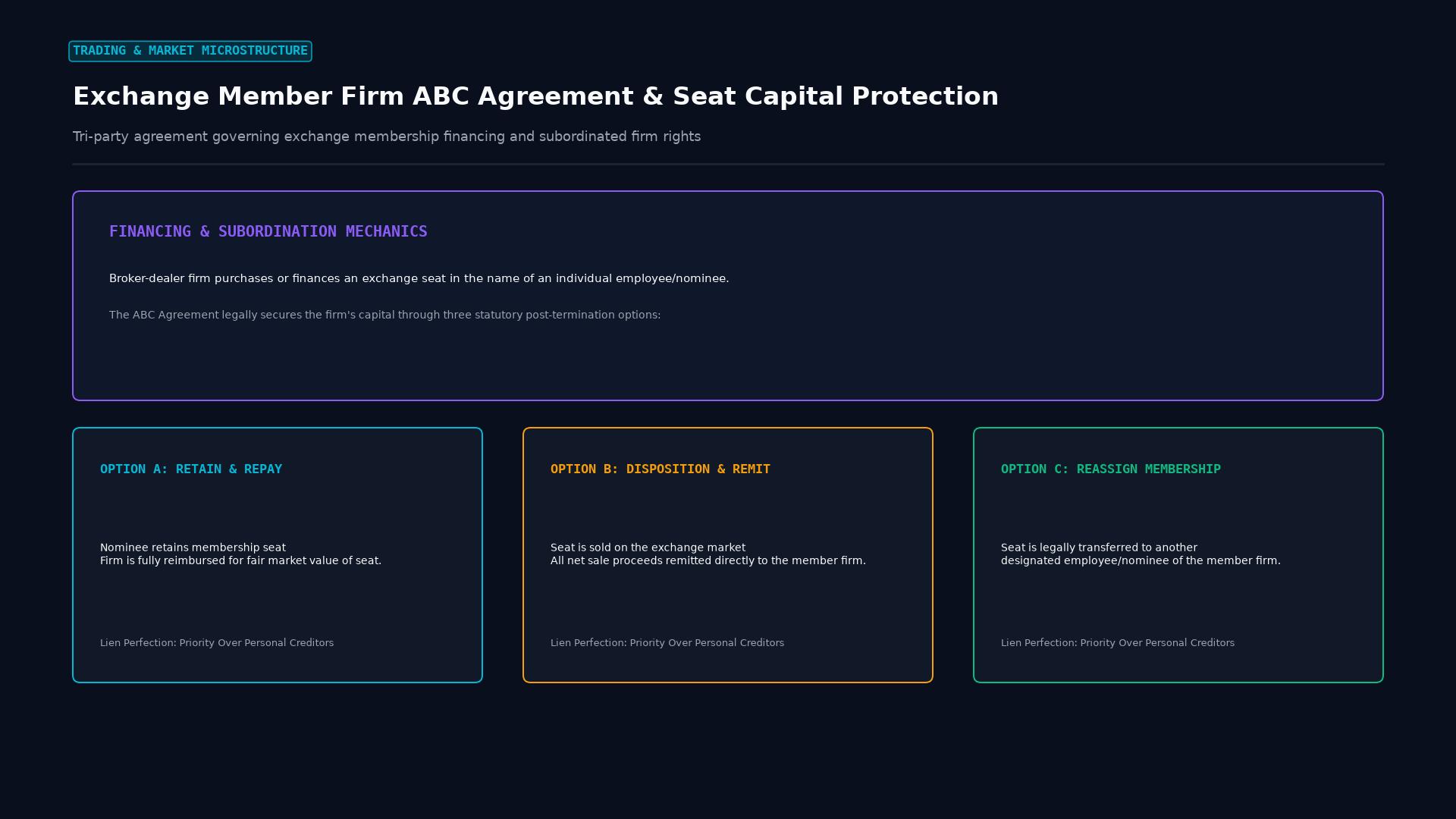 Figure: Tri-party regulatory agreement protecting brokerage firm capital: three statutory post-termination options for exchange membership seat ownership and proceeds.
The Three Contractual Remedies Explained
When employment terminates, the ABC Agreement dictates that the registered employee must execute one of three options at the firm’s direction:
Option A: Transfer to a Designated Successor
The outgoing employee retains zero equity or ownership in the seat and must immediately transfer and re-register legal title to the exchange seat to another employee designated by the member firm, with the firm covering any administrative transfer fees.
Option B: Open Market Sale and Remittance
The seat is sold on the open exchange market to an approved outside buyer. All net cash proceeds from the sale—less exchange transfer taxes and administrative costs—are paid directly to the brokerage firm to reimburse its initial capital outlay.
Option C: Outright Employee Purchase
If the departing broker wishes to retain exchange floor trading privileges and operate as an independent floor broker or join another organization, they may purchase the seat outright by paying the firm the prevailing market price or an agreed contractual book-value balance.
Comparative Matrix: ABC Options Breakdown
| Remedy Option | Who Retains the Seat? | Financial Flow | When Applied? |
|---|---|---|---|
| Option A | Transferred to another firm broker | No cash changes hands; firm retains economic control | Standard employee turnover; firm maintains full trading desk capacity |
| Option B | Sold to an unrelated third party | Sale proceeds remitted 100% to brokerage firm | Firm downsizing operations, closing desk, or liquidating capital |
| Option C | Retained by departing employee | Employee pays full cash purchase price to firm | High-producing trader going independent or joining competitor |
Evolution: Demutualization and Electronic Trading
While the physical “seat” was the dominant paradigm of 20th-century American financial exchanges, the structural foundation of ABC Agreements evolved dramatically with the digital revolution:
- Peak Seat Values: In late 2005, prior to the modernization wave, an individual NYSE membership seat traded for a historic peak of $4,000,000.
- Demutualization (2006): The NYSE converted from an exclusive member-owned mutual club into a publicly traded, for-profit corporation (NYSE Group, Inc., later acquired by Intercontinental Exchange, ICE).
- From Seats to Trading Licenses: Individual seats were converted into corporate shares and annual trading licenses. Modern brokerage firms no longer buy physical seats under ABC Agreements; instead, they lease digital direct market access (DMA) licenses directly from exchange operators.
- Legacy Importance: Despite electronic demutualization, ABC Agreement principles remain the direct legal precedent for contemporary proprietary trading firm employment covenants, non-competes, and equipment/IP ownership agreements.
Real-World Case Study: The 2006 NYSE Demutualization Windfall
During the December 2005 NYSE member vote to merge with Archipelago Holdings and convert into a publicly traded entity, hundreds of millions of dollars were at stake regarding who had rights to the transaction proceeds:
- The Conflict: Several legacy floor brokers whose seats were funded decades prior argued that as legal registered seat holders, the merger shares and cash windfalls ($300,000 cash plus 80,177 NYSE Group common shares per seat) belonged to them.
- The ABC Defense: Major Wall Street clearing houses and investment banks (including Merrill Lynch, Morgan Stanley, and Bear Stearns) presented enforceable ABC Agreements signed by the floor traders.
- The Ruling: Courts and exchange arbitration panels unanimously upheld the validity of the ABC Agreements, determining that beneficial economic ownership rested exclusively with the financing brokerages. Over $1.5 billion in equity and cash was successfully remitted to the member firms under the contractual protections first laid down in the ABC Agreement.
Frequently Asked Questions (FAQ)
What regulatory bodies recognized ABC Agreements?
ABC Agreements were formally recognized and regulated under NYSE Rule 301 and similar rules across regional American exchanges (such as the Chicago Board of Trade, Chicago Mercantile Exchange, and American Stock Exchange).
Why couldn’t a brokerage firm simply hold the exchange seat in its own corporate name?
Under original exchange charters dating back to the 1792 Buttonwood Agreement, exchanges were private unincorporated associations of individual gentleman traders. Only living natural persons could be held personally liable for ethical infractions, bad debts, and trade disputes on the floor; hence, corporate entities could not legally hold seat titles until corporate memberships were legalized in the late 20th century.
What happened if a seat’s market value dropped below the firm’s financing amount?
Under Option B, if market seat values collapsed, the firm absorbed the capital loss unless the ABC Agreement included personal indemnification or recourse clauses against the employee. In practice, the firm bore full market price risk in exchange for capturing all trading revenue generated by the seat.
Ready to trade forex?
Open a free demo account with a regulated broker. Practice with virtual funds before risking real money.