Abeyance
Abeyance is a legal and financial condition of temporary suspension, dormancy, or undetermined title, occurring when the ultimate ownership of property, estate rights, trust funds, or corporate securities cannot be legally vested until a specific future event, condition precedent, or judicial ruling occurs.
What Is Abeyance?
In property law, corporate governance, and fiduciary asset management, abeyance (derived from the Old French abeance, meaning “gaping expectation”) describes an indefinite or temporary state of suspension where legal ownership, rights, or claims to an asset are not presently assigned to any living person or legal entity.
When an asset is in abeyance, ownership rights are dormant. The underlying title has departed from the prior owner, but because a condition precedent has not yet been satisfied—or because legal heirs or claimants have not been formally confirmed by a court—the title exists in legal limbo, waiting to vest once the ambiguity is resolved.
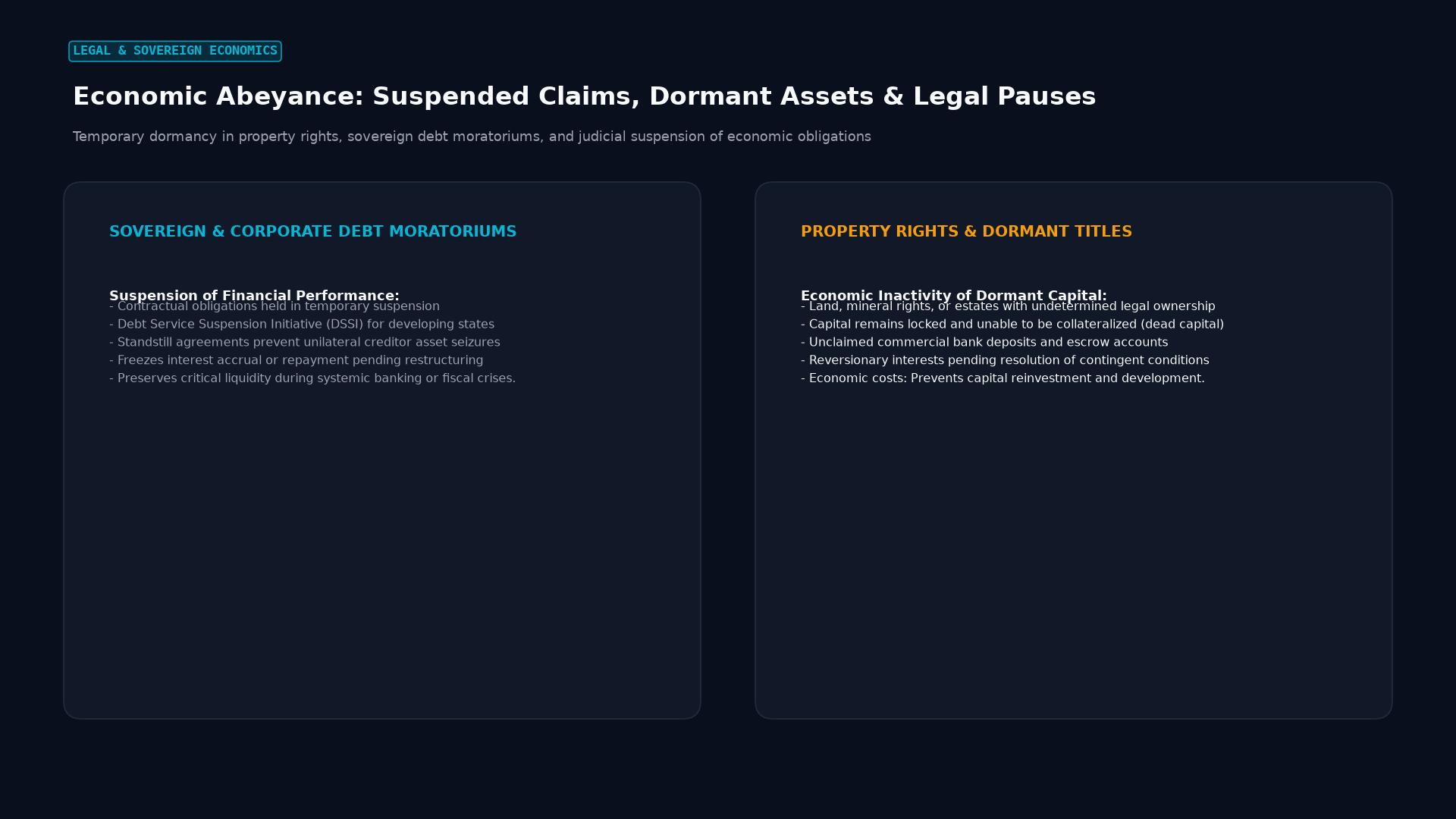 Figure: Temporary dormancy in property rights, sovereign debt moratoriums, and judicial suspension of economic obligations
Financial Applications of Abeyance
While originating in feudal property law, the doctrine of abeyance is critically relevant in modern institutional finance:
1. Corporate Equities & Dividends
When the beneficial ownership of corporate shares is tied up in international litigation, marital dissolution, or sanctions enforcement (such as freezing assets of sanctioned individuals under OFAC or EU regulations), voting rights and dividend distributions are held in abeyance. The corporation deposits dividends into an interest-bearing escrow account, and the shares are barred from voting at annual shareholder meetings until title is validated.
2. Trust Administration & Contingent Remainders
In testamentary trust drafting, a grantor may stipulate that capital distributions remain in abeyance until a beneficiary satisfies explicit milestones (e.g., attaining an advanced degree or reaching age 30). During the intervening years, ownership remains in abeyance, managed by the institutional trustee.
3. Regulatory Proceedings
In securities litigation and antitrust oversight, the Securities and Exchange Commission (SEC) or Federal Trade Commission (FTC) frequently agrees to hold enforcement proceedings in abeyance while civil settlement terms, restitution programs, or parallel Department of Justice criminal proceedings are finalized.
Comparative Matrix: States of Inactive Legal Rights
| Legal / Financial State | Legal Title Assigned? | Trigger for Re-Activation | Asset Custody / Management | Typical Timeline |
|---|---|---|---|---|
| Abeyance | No (dormant/undetermined) | Satisfaction of condition precedent or judicial decree | Court-appointed executor or fiduciary trustee | Months to years |
| Moratorium | Yes (ownership clear) | Expiration of temporary statutory or contractual halt | Original owner retains title | Days to months |
| Escrow | Yes (contingent on closing) | Completion of mutual contractual obligations | Neutral third-party escrow agent | 30 to 90 days |
| Escheatment | Reverts to State | Unclaimed property abandoned for statutory period | State unclaimed property division | Permanent unless reclaimed |
Real-World Case Study: Contested Controlling Equity in Cross-Border Succession
In 2019, the founder and majority shareholder (holding 54% voting equity) of an international logistics conglomerate passed away suddenly without an updated multi-jurisdictional will:
- The Conflict: Competing testamentary claims were lodged simultaneously in the United Kingdom, Switzerland, and Singapore by children from two marriages and a former business partner citing an unrecorded buy-sell covenant.
- Shares Held in Abeyance: Because a deadlocked shareholder meeting could paralyze operations or lead to asset stripping, the commercial chancery court ruled that the 54% controlling block was held in abeyance.
- Fiduciary Intervention: The court appointed an independent forensic accounting firm as temporary administrator with limited authority to sign payroll checks and maintain ongoing operations, while all strategic voting resolutions and dividend cash flows were frozen in abeyance.
- Resolution: After three years of mediation, the heirs executed a global settlement agreement. The court dissolved the abeyance order, distributing the equity into liquidating trust units and averting corporate insolvency.
Frequently Asked Questions (FAQ)
What happens to income generated by assets held in abeyance?
Income generated by assets in abeyance—such as bond coupon payments, stock cash dividends, or commercial real estate rental revenues—is not lost. It is collected and reinvested by the court-appointed trustee or escrow agent into risk-free government securities, accumulating for the benefit of the ultimate lawful owner once title vests.
How does the Rule Against Perpetuities relate to abeyance?
The common-law Rule Against Perpetuities was established specifically to prevent property titles from remaining in abeyance indefinitely. The rule mandates that any contingent interest or title must vest (or fail) no later than 21 years after the death of some life in being at the time the interest was created, preventing deceased testators from controlling wealth across centuries from the grave.
What does “held in abeyance” mean in corporate employment contracts?
When an executive is subject to an internal investigation, compensation and equity vesting rights may be “held in abeyance.” If cleared of wrongdoing, all back pay and vested stock options are released retroactively; if terminated for cause, the abeyance concludes with immediate forfeiture.
Ready to trade forex?
Open a free demo account with a regulated broker. Practice with virtual funds before risking real money.