Fair Market Value
Fair market value (FMV) is the hypothetical price at which a property, asset, or business would exchange hands between a willing and knowledgeable buyer and a willing and knowledgeable seller, neither under compulsion to transact, in an open and competitive market.
What Is Fair Market Value?
Fair market value (FMV) is a legally and financially defined standard of value representing the hypothetical price at which an asset — whether a business, real estate property, publicly traded security, or tangible personal property — would transfer ownership between a hypothetical willing buyer and a hypothetical willing seller in an arm’s-length transaction, with both parties having reasonable access to all relevant information, neither subject to duress, undue pressure, or forced liquidation.
This precise definition is enshrined across US federal law. The Internal Revenue Service (IRS) formally defines FMV in Revenue Ruling 59-60 as:
“The price at which the property would change hands between a willing buyer and a willing seller, neither being under any compulsion to buy or sell and both having reasonable knowledge of relevant facts.”
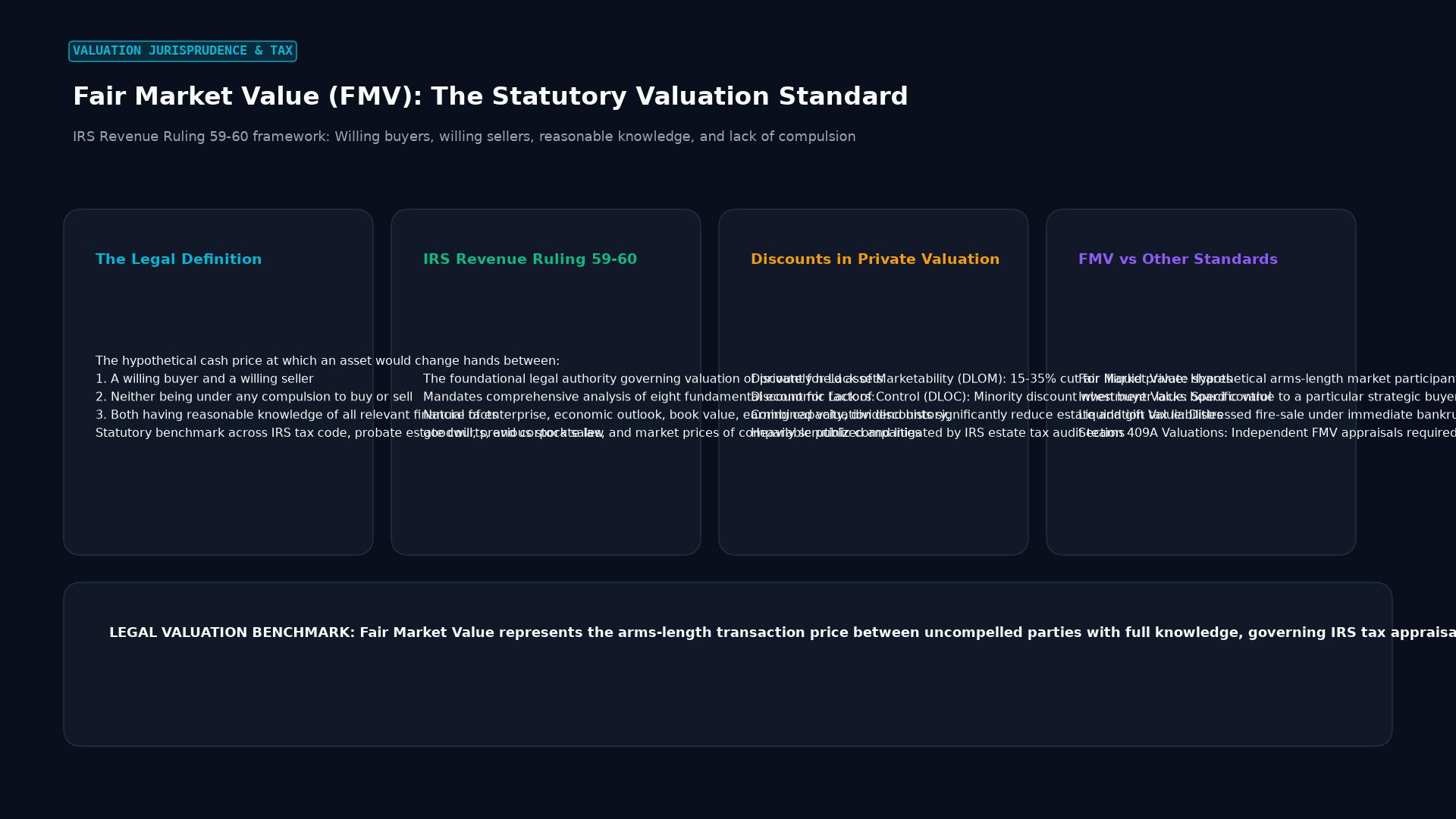 Figure: IRS Revenue Ruling 59-60 framework: Willing buyers, willing sellers, reasonable knowledge, and lack of compulsion
The Three Standard Valuation Approaches
Professional certified appraisers use three primary methodologies to determine FMV:
1. The Market (Sales Comparison) Approach
$$\text{FMV} \approx \text{Comparable Transaction Price} \times \left(1 + \text{Adjustments for Differences}\right)$$
Most reliable for actively traded assets (public stocks, real estate in liquid markets) where abundant arm’s-length transaction data exists.
2. The Income (DCF) Approach
$$\text{FMV} = \sum_{t=1}^{n} \frac{\text{FCF}_t}{(1 + \text{WACC})^t} + \frac{\text{Terminal Value}}{(1 + \text{WACC})^n}$$
Appropriate for income-producing assets — businesses, rental properties, intellectual property portfolios.
3. The Cost (Asset) Approach
$$\text{FMV} = \text{Replacement Cost} - \text{Physical Depreciation} - \text{Functional Obsolescence} - \text{Economic Obsolescence}$$
Applied for specialized assets where comparable sales are rare (utilities, specialized manufacturing plants).
FMV in Legal and Tax Contexts
| Context | Governing Authority | Consequence of Misstating FMV |
|---|---|---|
| Estate & Gift Taxation | IRS Rev. Rul. 59-60 | Penalties up to 40% for gross undervaluation |
| M&A Fairness Opinions | Delaware Court of Chancery | Fiduciary duty lawsuits, deal injunctions |
| Property Tax Assessment | State/County Assessors | Over/under-taxation of real property |
| Insurance Claims | State Insurance Commissions | Denial of coverage, fraud penalties |
| Eminent Domain | US Constitution (5th Amendment) | Government must pay “just compensation” (FMV) |
Real-World Case Study: Apple vs. The European Commission (State Aid, 2016)
One of the highest-stakes FMV disputes in global regulatory history arose when the European Commission ruled that Ireland had granted Apple an illegal tax arrangement equivalent to state aid.
The FMV Transfer Pricing Dispute:
1. The Structure: Apple allocated the intellectual property rights for its non-US products to an Apple subsidiary in Ireland, which paid Irish corporate taxes based on an artificially low "arm's-length" transfer price for the use of Apple's iOS and App Store IP.
2. The EC Allegation: The European Commission determined that the agreed transfer prices did not reflect fair market value — the correct FMV of Apple's IP rights (given the billions in profits generated) was vastly higher than the amounts taxed.
3. The Ruling: The EC ordered Apple to repay €13 billion in back taxes to Ireland (August 2016), calling it an effective tax rate of 0.005% — "illegal under EU state aid rules."
4. The Appeals: Apple contested the ruling, and the European Court of Justice ultimately ruled in Apple's favor in November 2024, annulling the €13 billion recovery order.
Frequently Asked Questions (FAQ)
How does fair market value differ from intrinsic value?
Fair market value is a market-based, transaction-price standard — the price a hypothetical arms-length market would assign at a specific point in time, regardless of the analyst’s personal opinion. Intrinsic value is a fundamental investor’s estimate of what the asset should be worth based on its discounted future cash flows. A stock’s fair market value is its current market price ($150 per share); its intrinsic value — per a DCF model — might be estimated at $200 (implying it is undervalued by 25%).
Can fair market value change significantly over short time periods?
Absolutely — particularly for volatile asset classes. A publicly traded stock’s FMV changes every millisecond as continuous buyer-seller transactions update the market-clearing price. Commercial real estate FMV can shift 20% to 40% during macroeconomic cycles as interest rates and capitalization rates fluctuate. Private businesses without liquid markets may see FMV change dramatically following earnings announcements, management changes, or industry disruption events.
What qualifications does a fair market value appraiser need in the United States?
Real property appraisers must hold a state-issued Certified Appraiser license (Certified Residential or Certified General). Business valuation appraisers typically hold credentials including the Accredited Senior Appraiser (ASA) from the American Society of Appraisers, the Accredited in Business Valuation (ABV) designation from the AICPA, or the Chartered Business Valuator (CBV) designation in Canada. IRS regulations under Section 170(f)(11) require qualified appraisals from credentialed professionals for charitable contribution deductions exceeding $5,000.
Ready to trade forex?
Open a free demo account with a regulated broker. Practice with virtual funds before risking real money.