Abatement
Abatement is the formal reduction, temporary suspension, or complete elimination of a financial liability, penalty, or demand, most frequently utilized in corporate and property taxation, environmental regulation, commercial real estate leasing, and probate estate law.
What Is Abatement?
In law, public finance, and corporate taxation, abatement denotes the diminution, cancellation, or rebate of an established monetary obligation, fee, or penalty. Rather than representing an arbitrary waiver, an abatement is granted pursuant to statutory authority, administrative dispute resolution, or contractual negotiation.
Abatement plays a central role across four major financial domains:
- Municipal & Corporate Tax Abatements: Local and state governments grant developers multi-year property or sales tax reductions to stimulate capital investment, job creation, and urban redevelopment.
- Commercial Real Estate Lease Abatements: Landlords grant incoming commercial tenants “free rent” periods (rent abatement) during interior construction fit-outs to preserve higher nominal face rental rates.
- Environmental Economics: The reduction or cleanup of industrial emissions, quantified through Marginal Abatement Cost (MAC) curves in carbon credit markets.
- Probate & Estate Law: The proportional reduction of testamentary gifts when a deceased person’s estate lacks sufficient assets to satisfy both debts and all named beneficiaries.
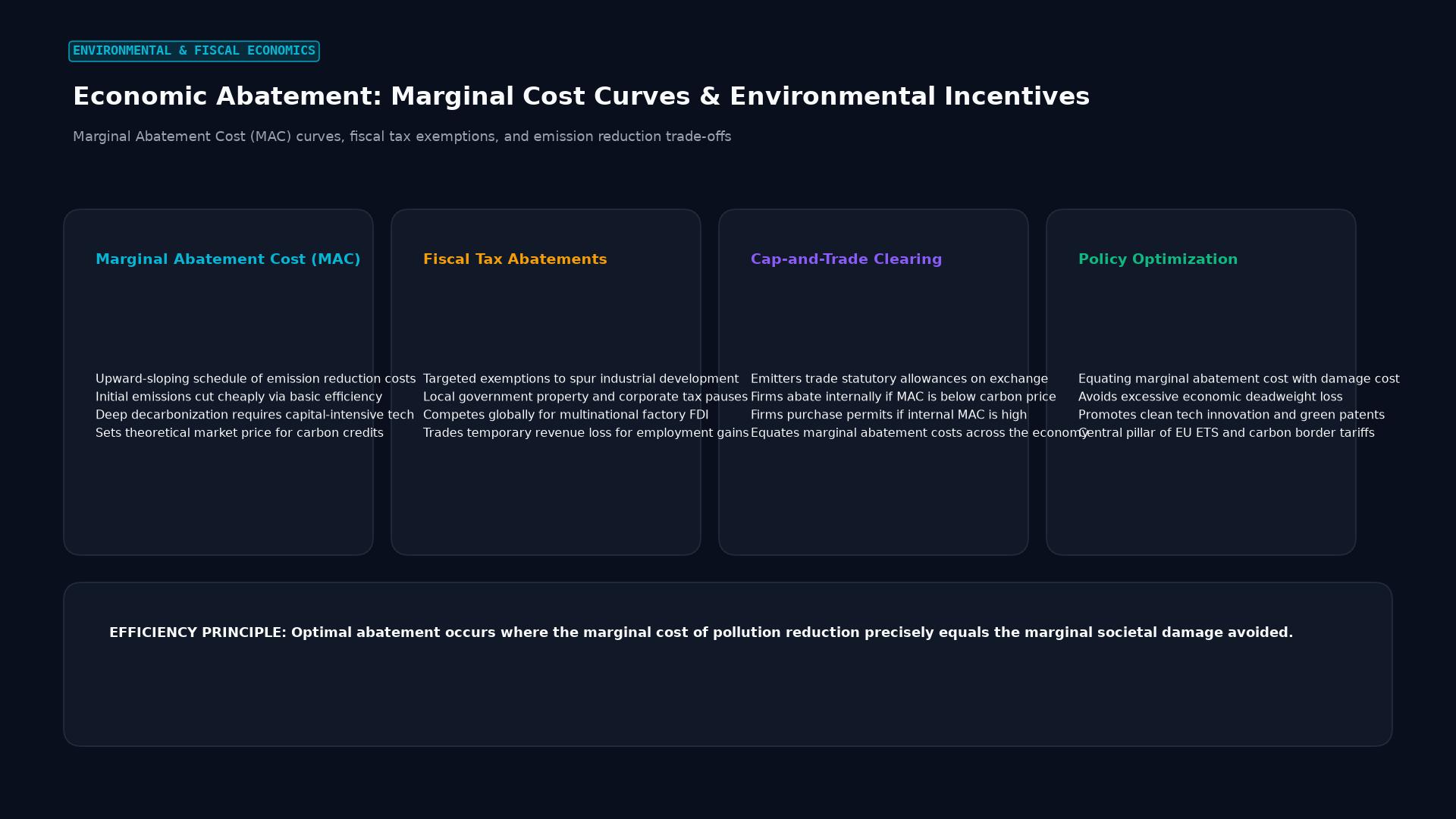 Figure: Marginal Abatement Cost (MAC) curves, fiscal tax exemptions, and emission reduction trade-offs
Technical Mechanics Across Key Sectors
1. Municipal Tax Abatements & PILOT Agreements
Governments frequently structure property tax abatements via Payments in Lieu of Taxes (PILOT) programs. An industrial manufacturing facility that would normally owe $2,000,000 annually in municipal real estate taxes might receive an abatement structure:
$$\text{Net Tax Liability}_t = \text{Assessed Property Value}_t \times \text{Mill Rate} \times (1 - \text{Abatement Percentage}_t)$$
In exchange, the corporation commits contractually to creating a minimum threshold of permanent local jobs and funding public infrastructure improvements. If the firm defaults on employment covenants, municipalities enforce “clawback” provisions to revoke prior abatements.
2. Environmental Marginal Abatement Cost (MAC)
In carbon emissions trading and environmental finance, the Marginal Abatement Cost curve plots the incremental cost of eliminating one additional metric ton of carbon dioxide equivalent ($\text{CO}_2\text{e}$):
$$\text{MAC} = \frac{\Delta \text{Total Abatement Cost}}{\Delta \text{Emissions Reduced}}$$
If carbon emission allowances in the EU Emissions Trading System (EU ETS) trade at €80/ton, industrial operators will invest in internal abatement technologies whenever the project’s MAC is below €80, selling surplus carbon credits into the compliance market.
Comparative Matrix: Tax Relief Terminology
| Fiscal Mechanism | Definition | Balance Sheet Impact | Primary Policy Purpose | Example |
|---|---|---|---|---|
| Abatement | Reduction/forgiveness of an existing assessed tax or penalty | Lowers specific assessed tax bill or waives late fee | Economic stimulus, administrative relief | 10-year property tax holiday on a new logistics center |
| Tax Exemption | Complete statutory exclusion from tax liability | Removes entity or income entirely from tax base | Non-profit/religious status, sovereign immunity | Municipal bond interest exempt from federal tax |
| Tax Credit | Dollar-for-dollar direct reduction of final tax bill | Direct reduction of bottom-line tax liability | Encouraging targeted investments | R&D tax credit, solar installation investment tax credit |
| Tax Deduction | Reduction of gross taxable income before rate application | Lowers the taxable base; value equals deduction $\times$ marginal tax rate | Accounting for costs of doing business | Mortgage interest deduction, corporate depreciation |
Real-World Case Study: The New York 421-a Real Estate Tax Abatement
New York City’s historic Section 421-a Affordable New York Housing Program represents one of the largest property tax abatement initiatives in the world:
- The Economic Challenge: Exorbitant land acquisition and union construction costs rendered multi-family residential construction economically infeasible without government subsidies.
- The Abatement Structure: Developers building new multi-family residential properties were granted a 100% property tax exemption during a 3-year construction period, followed by up to 35 years of full or partial post-completion property tax abatements.
- The Quid Pro Quo: In exchange for billions of dollars in abated municipal property tax obligations, developers were legally mandated to reserve 25% to 30% of all constructed residential units as permanently affordable housing for low-to-middle income families.
- Market Impact: Over several decades, the 421-a program catalyzed the construction of over 100,000 residential apartments in Manhattan, Brooklyn, and Queens, serving as the financial bedrock of New York multi-family real estate underwriting and securitized commercial mortgage-backed securities (CMBS).
Frequently Asked Questions (FAQ)
What is penalty abatement with the Internal Revenue Service (IRS)?
The IRS provides First-Time Penalty Abatement (FTA) administrative relief for taxpayers facing late-filing or late-payment failure penalties. To qualify, the taxpayer must demonstrate a clean compliance history for the preceding three tax years, have filed all required returns, and paid or arranged to pay any outstanding tax balances.
How does rent abatement work in commercial office leasing?
Commercial landlords often offer incoming tenants 3 to 12 months of rent abatement (“free rent”) at the commencement of a long-term lease. This allows the tenant to build out office interiors without paying rent, while enabling the landlord to maintain a higher contractual face rent on the lease, which preserves the building’s capital valuation for bank refinancing.
What is the order of abatement in estate probate?
When an estate has more debts than assets to satisfy all bequests, probate courts reduce bequests in a strict statutory sequence:
- Intestate property (assets not specifically mentioned in a will).
- Residuary gifts (“everything else left over”).
- General bequests (e.g., cash sums).
- Specific bequests (e.g., a designated family heirloom or named parcel of land).
Ready to trade forex?
Open a free demo account with a regulated broker. Practice with virtual funds before risking real money.