Ability to Pay
The ability-to-pay principle is an economic and public finance doctrine stating that the tax burden should be distributed according to an individual's or corporation's financial capacity, serving as the theoretical foundation for progressive income taxation and credit underwriting regulations.
What Is the Ability-to-Pay Principle?
In fiscal economics, public finance, and credit underwriting, the ability-to-pay principle asserts that entities with greater financial resources, higher net wealth, and larger incomes should contribute a disproportionately higher share of taxes to fund public goods and social infrastructure.
First articulated conceptually by Adam Smith in The Wealth of Nations (1776) under his first canon of taxation, the principle posits that taxes should be levied not according to the specific quantity of public services an individual consumes, but in proportion to their economic capacity to sacrifice resources without impairing basic sustenance. In modern finance, this doctrine underpins two fundamental pillars:
- Progressive Tax Systems: The implementation of tiered marginal income tax brackets and wealth transfer taxes.
- Prudential Credit Underwriting: The statutory obligation of financial institutions to verify a borrower’s capacity to service debt before originating consumer mortgages or commercial credit facilities.
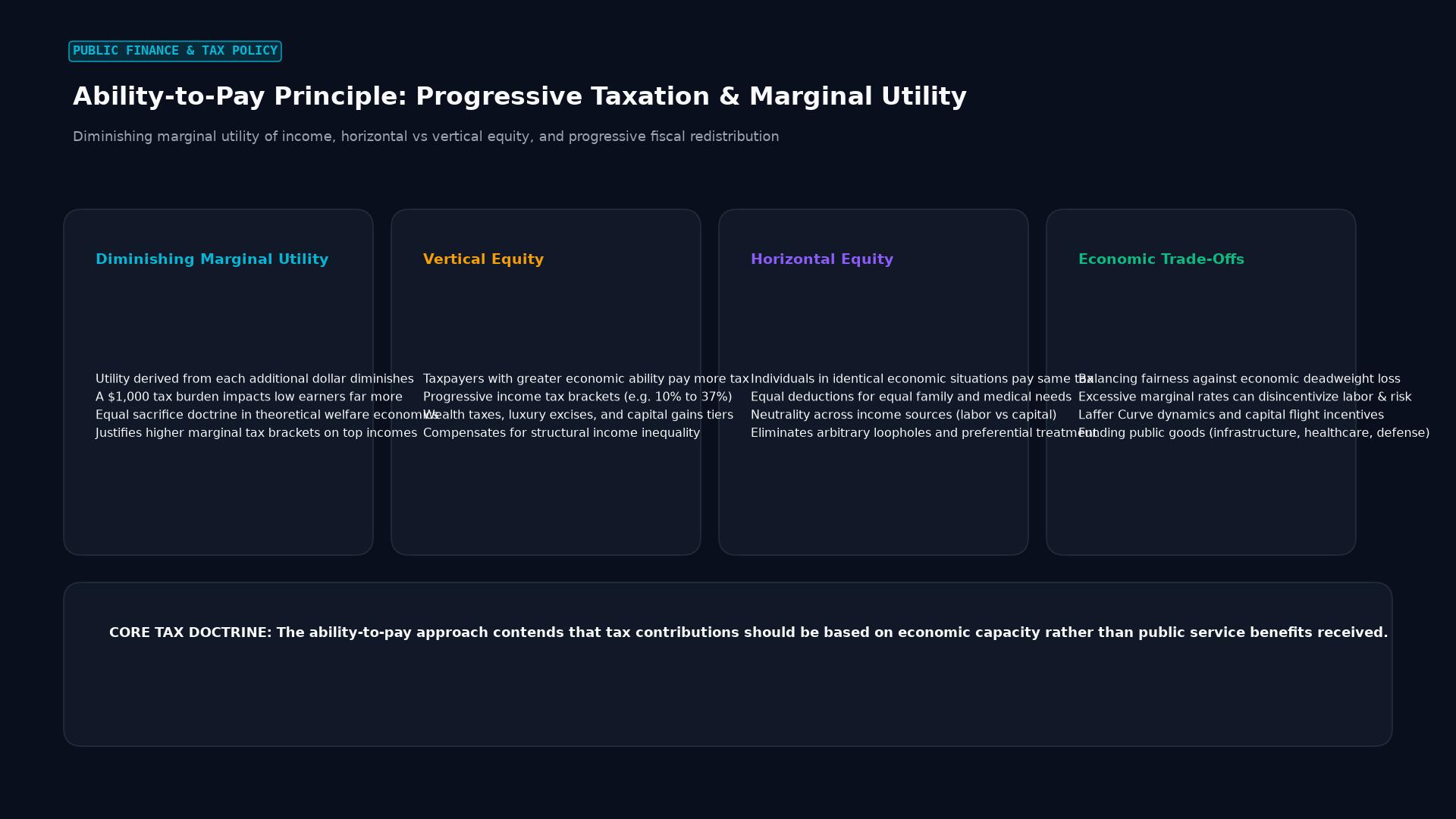 Figure: Diminishing marginal utility of income, horizontal vs vertical equity, and progressive fiscal redistribution
Theoretical Foundations: Vertical vs. Horizontal Equity
Public finance economists evaluate the fairness of taxation through two core dimensions of equity grounded in ability-to-pay:
1. Vertical Equity
Vertical equity mandates that taxpayers with unequal economic capabilities should pay unequal taxes. Because the marginal utility of money diminishes as wealth expands, taking a dollar from an individual earning $1,000,000 causes far less subjective welfare loss than taking a dollar from an individual earning $25,000. This justifies progressive marginal tax brackets, where tax rates rise progressively with income ($10% \to 22% \to 37%$).
2. Horizontal Equity
Horizontal equity requires that individuals with identical economic capacity should be assessed equal tax liabilities. If two individuals each earn $100,000, they should face identical tax burdens—unless justifiable deductions (such as high medical expenses or dependent children) reduce their true disposable ability to pay.
Banking Regulations: The Ability-to-Repay (ATR) Rule
In post-2008 banking regulation, the ability-to-pay doctrine transitioned from public taxation into consumer lending law:
- The Dodd-Frank Act & CFPB Rule: Following the subprime mortgage crisis, the Consumer Financial Protection Bureau (CFPB) instituted the statutory Ability-to-Repay (ATR) Rule under the Truth in Lending Act (TILA).
- Mandatory Underwriting Verification: Lenders are strictly prohibited from issuing “no-doc” or “stated-income” residential mortgages. Underwriters must independently document and verify eight underwriting factors: $$\text{Debt-to-Income (DTI)} = \frac{\text{Total Monthly Debt Obligations}}{\text{Gross Verified Monthly Income}} \le 43%$$
- Legal Liability: If a bank fails to verify ability-to-pay prior to issuing a mortgage, the borrower can assert lender violation as a defense to foreclosure and seek statutory damages.
Comparative Matrix: Tax Policy Philosophies
| Fiscal Principle | Core Mechanism | Distribution of Burden | Economic Argument | Common Implementation |
|---|---|---|---|---|
| Ability-to-Pay Principle | Progressive tax rates | Higher earners pay a higher percentage of income | Equalizes marginal sacrifice across society | Federal graduated income taxes, capital gains brackets |
| Benefit Principle | User-pays framework | Those who use public services pay for them | Allocative market efficiency | Highway tolls, gasoline excise taxes, national park entry fees |
| Flat Tax System | Single proportional rate | Everyone pays the exact same percentage (e.g., 15%) | Simplicity, eliminates economic disincentives to earn | Corporate flat tax regimes, select Eastern European states |
| Regressive Tax | Fixed dollar or flat consumption rate | Lower earners pay a higher percentage of their total income | Stable revenue generation | Retail sales taxes, excise taxes on tobacco and alcohol |
Real-World Case Study: Marginal vs. Effective Tax Rates
A common misconception among retail investors is that entering a higher tax bracket reduces take-home pay. Consider an investor whose income increases from $85,000 to $95,000 under a simplified progressive system:
- Marginal Rate Structure:
- Tier 1: $0 to $15,000 taxed at 10%
- Tier 2: $15,001 to $60,000 taxed at 15%
- Tier 3: Above $60,000 taxed at 25%
- The New Marginal Dollar: The additional $10,000 earned is taxed at the 25% marginal rate ($2,500 tax), retaining $7,500 in net cash.
- Effective (Average) Tax Rate Calculation: $$\text{Total Tax} = ($15,000 \times 0.10) + ($45,000 \times 0.15) + ($35,000 \times 0.25) = $1,500 + $6,750 + $8,750 = \mathbf{$17,000}$$ $$\text{Effective Tax Rate} = \frac{$17,000}{$95,000} = \mathbf{17.89%}$$
- Key Takeaway: The ability-to-pay model ensures the earner still keeps 75% of every additional dollar earned, maintaining work incentives while increasing the overall revenue contribution to the sovereign treasury.
Frequently Asked Questions (FAQ)
What is the primary economic criticism of the ability-to-pay principle?
Supply-side economists argue that excessively progressive tax rates penalize productive labor, capital accumulation, and entrepreneurship. When top marginal tax rates rise too high, capital owners may reduce business investment, utilize aggressive offshore tax havens, or relocate to low-tax jurisdictions (tax flight).
How does inflation distort ability-to-pay taxation?
Without statutory inflation indexation, bracket creep occurs: general inflation pushes workers into higher marginal tax brackets even though their real purchasing power has not increased. To prevent this, most modern treasuries adjust tax bracket thresholds annually to match Consumer Price Index (CPI) increases.
Does the ability-to-pay principle apply to corporate taxation?
Yes, though debated. Some jurisdictions implement tiered corporate tax rates where small businesses pay lower corporate income tax rates than multinational conglomerates. However, many economists argue that corporations are legal pass-through entities, and the ultimate tax burden is borne by employees (lower wages), consumers (higher prices), or shareholders (reduced dividends).
Ready to trade forex?
Open a free demo account with a regulated broker. Practice with virtual funds before risking real money.