ABIP
ABIP stands for Asset-Based Income Product, a structured financial vehicle that generates regular cash yield for investors by collateralizing pools of income-producing assets such as commercial leases, equipment loans, or trade receivables.
What Does ABIP Stand For?
ABIP stands for Asset-Based Income Product. In institutional asset management and structured credit markets, an ABIP represents an investment vehicle engineered to distribute recurring, yield-focused income to investors backed directly by a discrete pool of cash-flowing assets.
Unlike traditional corporate bonds that depend on the general operating solvency and credit rating of a corporate issuer, an Asset-Based Income Product isolates specific tangible or financial revenue streams. These streams can include industrial machinery leases, commercial fleet rentals, trade receivables, or solar energy contracts. By ring-fencing these cash flows inside a bankruptcy-remote Special Purpose Vehicle (SPV), the product isolates investors from the direct operational bankruptcy risk of the originating company.
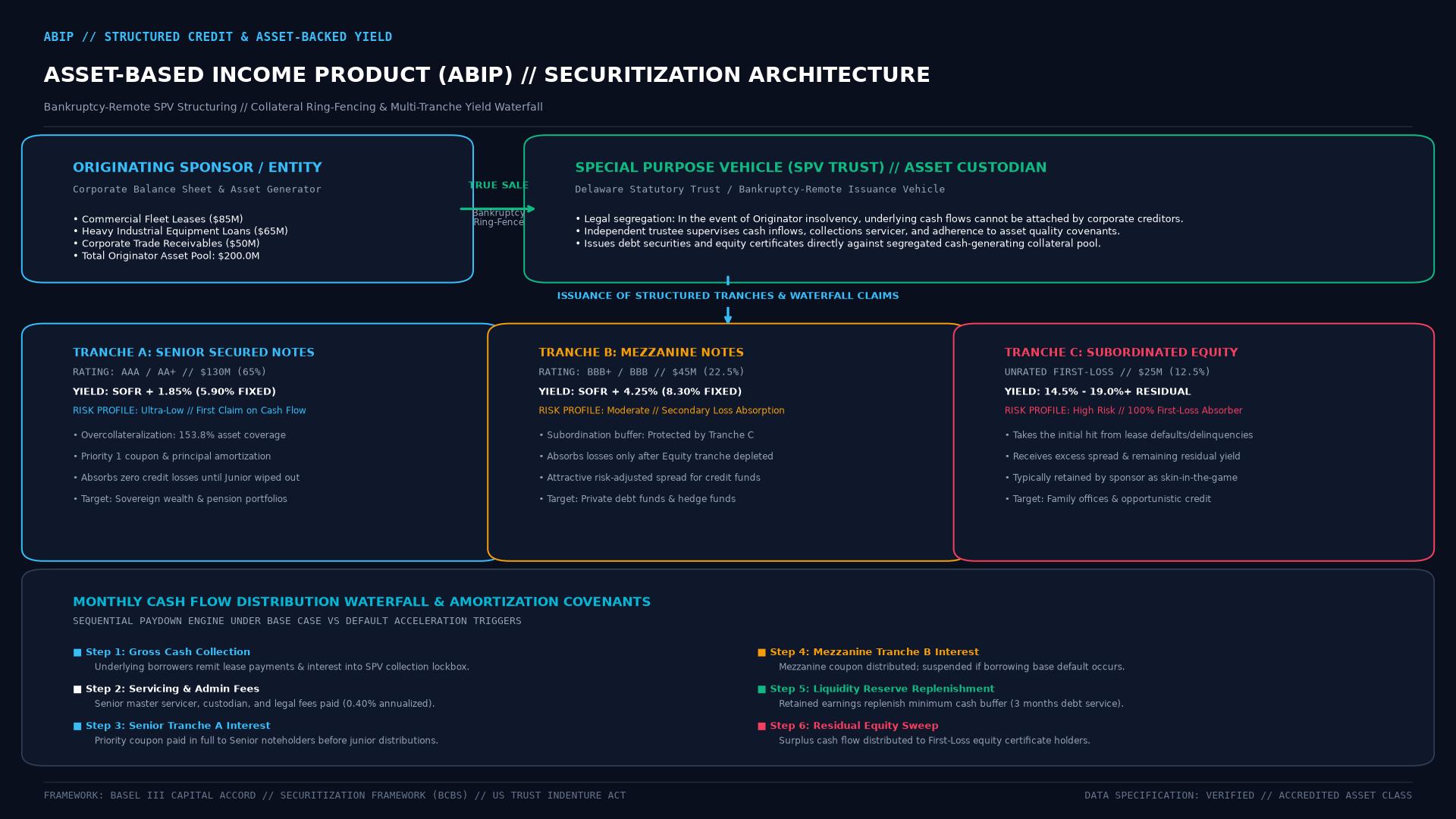 Figure: Structural mechanics of an Asset-Based Income Product (ABIP) detailing the true sale asset transfer to a bankruptcy-remote Special Purpose Vehicle (SPV), credit enhancement, and sequential tranche payment waterfall.
Technical Mechanics of an Asset-Based Income Product
An ABIP relies on three distinct structural layers to convert illiquid physical or financial assets into marketable, yield-bearing securities:
1. Collateral Ring-Fencing and True Sale
The issuing corporation executes a legally binding “true sale” of its income-generating contracts to the SPV. If the operating company files for Chapter 11 bankruptcy or liquidates, the creditors of the operating firm cannot seize the assets inside the SPV. The cash flow belongs strictly to the ABIP certificate holders.
2. Cash Waterfall and Credit Enhancement
Cash flows generated by underlying assets pass through a predetermined distribution hierarchy, commonly termed the waterfall:
- Senior Servicing Fees: Operational fees paid to the asset manager or servicer collecting customer payments.
- Senior Tranche Yield: Priority distributions made to senior bondholders with the lowest risk tolerance.
- Mezzanine Debt Service: Secondary interest payments distributed to intermediate risk tranches.
- Overcollateralization Reserve: Retained earnings directed into a cash reserve account to absorb defaults or delayed collections.
- Equity / Subordinated Residual: Surplus cash flow paid to the sponsor or junior investors who took initial first-loss risk.
3. Monitoring Covenants and Borrowing Bases
ABIP managers must adhere to strict borrowing base formulas. If default rates on the underlying leases rise past agreed thresholds (for instance, exceeding 3.5% of total receivables), automatic cash-sweep mechanisms redirect all surplus yield to amortize principal for senior noteholders until reserve ratios normalize.
Comparative Matrix: ABIP vs. Alternative Yield Instruments
| Dimension | Asset-Based Income Product (ABIP) | Corporate Debenture | Real Estate Investment Trust (REIT) |
|---|---|---|---|
| Collateral Backing | Specific ring-fenced contractual asset pool | General unpledged corporate assets | Physical commercial or residential real estate |
| Bankruptcy Risk | Isolated from originator default | Subject to issuer default and debt restructuring | Subject to REIT corporate balance sheet health |
| Income Cadence | Monthly or quarterly contractual pass-through | Semi-annual fixed coupon | Quarterly dividends driven by taxable rental profit |
| Credit Rating Basis | Quality of underlying asset contracts | Enterprise creditworthiness of parent firm | Balance sheet leverage and portfolio occupancy |
| Secondary Liquidity | Moderate to low (private placements) | High (public exchange debt markets) | High (listed public equities) |
Real-World Case Study: Logistics Equipment Securitization
In October 2024, a major North American logistics firm sought to finance $180 million of new electric delivery vans without overburdening its corporate credit facility. The firm established an SPV named FleetFlow Income Trust and transferred five-year commercial lease contracts from 42 corporate delivery partners into the entity.
The trust issued $140 million of Senior ABIP Notes yielding 6.85% (rated A by credit agencies) and retained $40 million in subordinated equity. Over a 36-month period, monthly lease collections generated $4.1 million on average. Even when two regional logistics clients terminated operations during early 2025 causing a 4.2% default dip, the credit enhancement reserve absorbed the losses completely. Senior noteholders received 100% of their promised yield on schedule, demonstrating the protective design of ring-fenced income structures.
Frequently Asked Questions (FAQ)
What distinguishes an ABIP from an Asset-Backed Security (ABS)?
An Asset-Backed Security is the broad financial category encompassing all securitized debt, including credit card receivables, home equity loans, and auto debt. An Asset-Based Income Product is a targeted commercial variant designed specifically for wealth management and institutional private credit markets, emphasizing regular yield distribution rather than capital appreciation.
What happens if the originating company managing the assets goes out of business?
The SPV structure ensures that the underlying income streams remain legally separate from the failed originator. A backup servicer named in the original trust indenture steps in to collect monthly payments from customers, manage maintenance, and distribute cash flow directly to investors without interruption.
How do macroeconomic interest rate changes affect ABIP returns?
Most modern ABIP issues feature floating-rate coupon structures tied to benchmark rates like the Secured Overnight Financing Rate (SOFR) plus a fixed spread. When benchmark rates rise, the yield paid to investors adjusts upward, protecting holders against inflation and fixed-income duration risk.
Ready to trade forex?
Open a free demo account with a regulated broker. Practice with virtual funds before risking real money.