ABS
ABS stands for Asset-Backed Security, a collateralized fixed-income instrument created through securitization where pools of non-mortgage debt assets such as auto loans, credit card balances, or equipment leases are packaged into tradable interest-bearing tranches.
What Does ABS Stand For?
ABS stands for Asset-Backed Security. In international capital markets and fixed-income investing, an Asset-Backed Security is a financial instrument whose value and cash-flow distributions are derived from and collateralized by a specified pool of underlying consumer or commercial debt obligations.
Unlike traditional corporate bonds, which depend on the ongoing enterprise earnings and operational solvency of a single corporate issuer, an ABS relies on the scheduled debt repayments of thousands of individual borrowers. Common collateral pools include auto loans, credit card receivables, student loans, solar equipment leases, and small business financing lines.
To execute an ABS transaction, the financial institution that originates the loans (such as a commercial bank, captive auto finance arm, or fintech lender) pools these receivables and sells them to a bankruptcy-remote Special Purpose Vehicle (SPV). The SPV then issues interest-bearing securities to institutional investors across prioritized risk layers known as tranches.
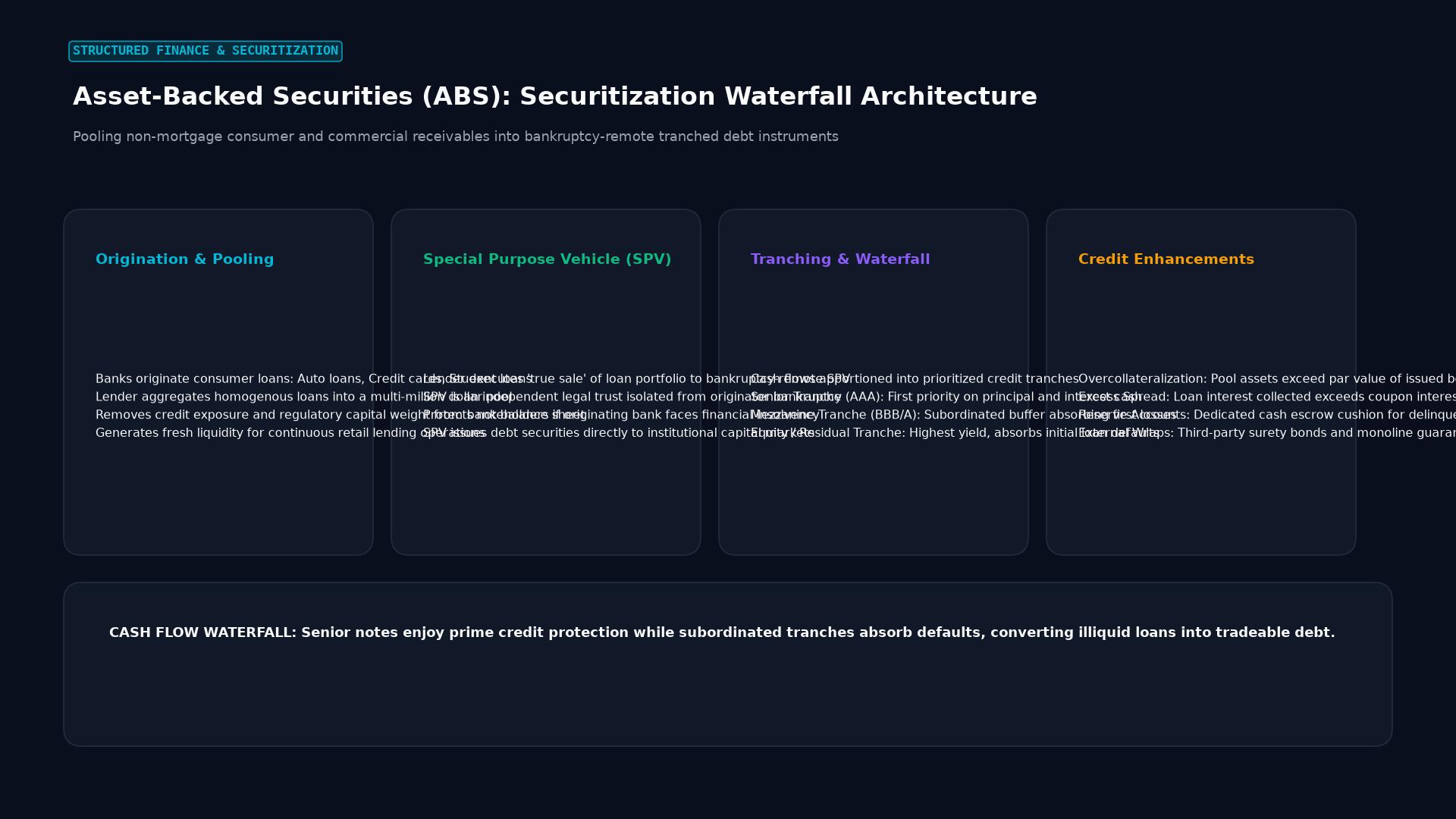 Figure: Pooling non-mortgage consumer and commercial receivables into bankruptcy-remote tranched debt instruments
Technical Mechanics of an Asset-Backed Security
The transformation of illiquid loans into liquid capital market instruments relies on structured credit engineering:
1. Tranching and the Cash-Flow Waterfall
Securitization employs a structural seniority hierarchy. Cash receipts from principal and interest payments on the underlying loan portfolio flow sequentially:
- Senior Tranches (AAA/Aaa): Receive principal and interest payments first. They are protected against default by the credit enhancement layers below them.
- Mezzanine Tranches (AA down to BBB): Absorb losses after the equity tranche is exhausted, yielding a higher credit spread.
- Equity / First-Loss Tranche: Receives residual cash flow only after all senior and mezzanine obligations are fulfilled. If borrowers in the pool default, the equity tranche absorbs the initial losses until its balance is reduced to zero.
2. Credit Enhancement Techniques
Lenders utilize internal and external mechanisms to secure investment-grade credit ratings for senior ABS notes:
- Overcollateralization: The total par value of the underlying loan pool exceeds the face value of the securities issued (for example, issuing $90 million of notes backed by $100 million of collateral).
- Subordination: Structuring lower tranches to absorb losses before senior tranches suffer principal impairments.
- Excess Spread: The net interest rate earned on the underlying loans (e.g., 9%) exceeds the interest rate paid to ABS bondholders plus administrative servicing fees (e.g., 5.5%), creating a 3.5% recurring cash reserve buffer.
- Reserve Accounts: Cash funded at closing to cover temporary liquidity shortfalls.
3. Prepayment and Extension Risk
Unlike corporate debentures with fixed maturity schedules, ABS instruments experience fluctuating cash flows driven by consumer prepayment behavior. When interest rates drop, consumers refinance loans early, returning principal to investors sooner than anticipated (prepayment risk). Conversely, during economic downturns, prepayment speeds decline, extending the bond duration (extension risk).
Comparative Matrix: ABS vs. MBS vs. Corporate Bonds
| Structural Dimension | Asset-Backed Securities (ABS) | Mortgage-Backed Securities (MBS) | Senior Corporate Bonds |
|---|---|---|---|
| Underlying Collateral | Auto loans, credit cards, equipment, student debt | Residential or commercial real estate mortgages | Full faith and credit of corporate issuer |
| Average Loan Duration | Short to medium (1 to 5 years) | Long (15 to 30 years) | Medium to long (5 to 30 years) |
| Credit Risk Driver | Consumer default rates, unemployment, underwriting standards | Housing market prices, mortgage default rates | Company EBITDA, operational health, market leverage |
| Bankruptcy Remoteness | Yes; insulated via SPV trust | Yes; insulated via SPV or agency guarantee | No; direct claim against bankrupt corporation |
| Prepayment Behavior | Low sensitivity (credit cards) to moderate (auto) | High sensitivity to benchmark interest rate cycles | None (unless bond has an active call option) |
Real-World Case Study: Prime Auto Loan Securitization
In August 2024, a major automotive manufacturer’s financing subsidiary launched a $1.25 billion prime auto loan ABS transaction designated Auto Trust 2024-B. The collateral pool consisted of 54,200 retail vehicle installment sale contracts with an average weighted borrower FICO score of 762.
The trust structured the offering into four primary tranches:
- Class A-1 to A-4 Notes ($1.05 billion): Rated AAA, carrying coupons between 4.95% and 5.20% (spread of 45 to 65 basis points over SOFR).
- Class B Notes ($75 million): Rated AA, carrying a 5.65% coupon.
- Class C Notes ($62.5 million): Rated A, carrying a 6.20% coupon.
- Class D / Retained Equity ($62.5 million): Retained by the captive lender to satisfy Dodd-Frank credit risk retention rules.
Through 4.0% initial overcollateralization, a 0.50% cash reserve account, and 11% structural subordination, the senior Class A notes achieved widespread institutional oversubscription from pension funds and sovereign wealth entities, enabling the auto manufacturer to unlock balance sheet liquidity and finance new vehicle originations.
Frequently Asked Questions (FAQ)
What is the difference between an ABS and an MBS?
Mortgage-Backed Securities (MBS) are secured exclusively by real estate debt (residential home mortgages or commercial real estate loans). Asset-Backed Securities (ABS) encompass all non-mortgage securitizations, covering automotive installment loans, credit card balances, personal installment debt, and corporate trade receivables.
What are Dodd-Frank Risk Retention rules (“skin in the game”)?
Enacted following the 2008 financial crisis, US and European securitization regulations mandate that loan originators must retain at least 5% of the economic credit risk of any securitized asset pool they bring to market. This prevents lenders from originating reckless, poor-quality loans simply to offload 100% of the default risk to third-party investors.
How are credit card ABS structured differently from auto loan ABS?
Auto loans are amortizing installment contracts where the balance steadily decreases each month. Credit card receivables are revolving lines of credit. Credit card ABS employ a revolving period (typically 2 to 5 years) during which principal collections from cardholders are used to buy newly generated card balances rather than repaying bondholders, switching to an amortization phase only at the end of the term.
Ready to trade forex?
Open a free demo account with a regulated broker. Practice with virtual funds before risking real money.