Accrued Interest
Accrued Interest is the coupon interest earned on a fixed-income security since its last scheduled payment date, which the buyer must pay to the seller at trade settlement as part of the bond's total dirty price.
What Is Accrued Interest?
In bond markets, loan servicing, and institutional fixed-income trading, Accrued Interest represents the dollar amount of interest that has accumulated on a debt instrument since the most recent coupon payment date, but has not yet been disbursed to the bondholder.
Most corporate, sovereign, and municipal bonds distribute interest semi-annually (every six months). When an investor sells a bond between these scheduled coupon distribution dates, the seller has earned the interest for the exact number of days they held the bond during that cycle.
Because the bond issuer will eventually pay the entire six-month coupon to whoever owns the bond on the next scheduled payment date (the holder of record), market trading conventions mandate that the buyer must reimburse the seller for the interest accrued up to the trade settlement date.
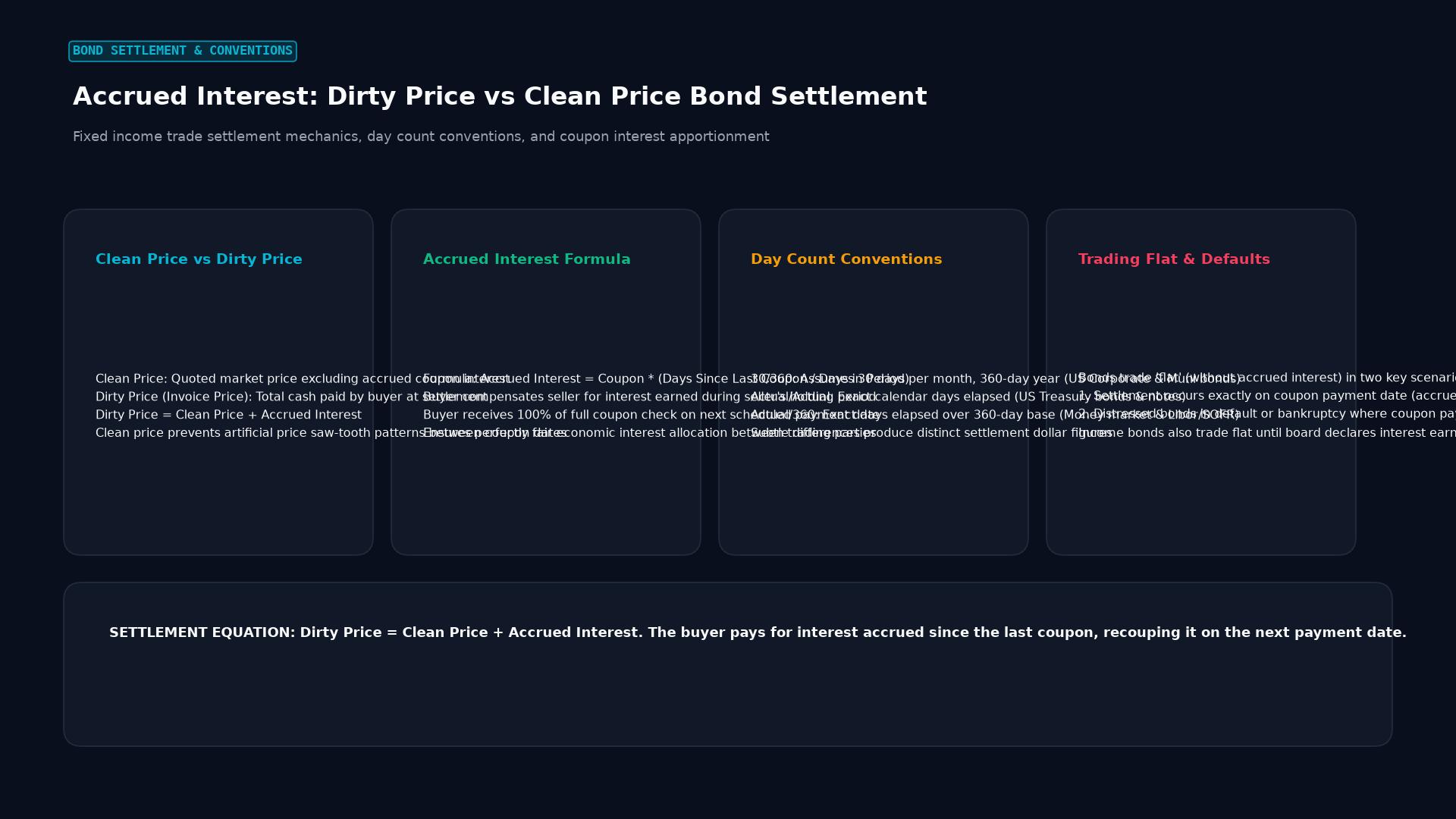 Figure: Fixed income trade settlement mechanics, day count conventions, and coupon interest apportionment
Clean Price vs. Dirty Price
Financial market participants distinguish sharply between the quoted price of a bond and the actual cash required to complete the trade:
1. Clean Price (Flat Price)
The Clean Price is the price quoted on financial terminal screens (such as Bloomberg or Tradeweb) and in financial media. It reflects the bond’s value based strictly on prevailing interest rates, inflation expectations, and issuer credit risk, completely stripping out the daily accrual of interest. Quoting bonds clean prevents artificial daily price sawtooth distortions between payment dates.
2. Dirty Price (Invoice or Settlement Price)
The Dirty Price (or Invoice Price) is the actual amount of liquid cash transferred from the buyer to the seller on the settlement date:
Dirty Price = Clean Price + Accrued InterestWhen evaluating fixed-income portfolio cash requirements, risk models and portfolio management systems always calculate portfolio valuation and cash settlements using dirty prices.
Technical Mechanics & Day Count Conventions
Calculating accrued interest requires knowing the exact day count convention specified in the bond’s legal indenture:
Accrued Interest = (Face Value × Annual Coupon Rate) × (Days Elapsed / Days in Year)Global bond markets use four primary day count conventions:
| Day Count Convention | Standard Market Application | Mechanics & Rules |
|---|---|---|
| 30/360 | US Corporate Bonds, US Municipal Bonds | Assumes each month has 30 days and the year has 360 days. |
| Actual/Actual (ICMA) | US Treasury Notes & Bonds, Sovereign Gilts | Uses the exact calendar days elapsed divided by exact days in the coupon period. |
| Actual/360 | US Money Markets, Commercial Paper, Repo, SOFR | Uses exact calendar days divided by a standardized 360-day commercial year. |
| Actual/365 | UK Money Markets, Australian & NZ Government Bonds | Uses exact calendar days divided by a 365-day year (or 366 in leap years). |
Real-World Case Study: Corporate Bond Secondary Market Settlement
On Tuesday, October 8, 2024, an institutional investment fund purchased $5,000,000 par value of an investment-grade corporate bond carrying a 5.40% semi-annual coupon. The bond’s coupon dates are March 15 and September 15, and it trades under the standard 30/360 convention with standard T+1 settlement (settling Wednesday, October 9):
- Calculate Elapsed Days from Last Coupon (Sept 15 to Oct 9):
- September days remaining: 30 - 15 = 15 days.
- October days elapsed: 9 days.
- Total Days Elapsed = 15 + 9 = 24 days.
- Calculate Daily Coupon Income:
Annual Coupon Amount = $5,000,000 × 0.054 = $270,000
Semi-Annual Coupon = $270,000 / 2 = $135,000
Daily Accrual Rate (30/360) = $270,000 / 360 = $750.00 per day- Calculate Total Accrued Interest:
Accrued Interest = 24 days × $750.00 = $18,000.00If the bonds were quoted at a Clean Price of 99.25% ($4,962,500), the buyer transferred a total Dirty Price of $4,980,500 ($4,962,500 clean principal + $18,000 accrued interest) into the clearing agent’s account on settlement day. On the subsequent payment date (March 15, 2025), the buyer received the full $135,000 semi-annual coupon, perfectly recouping the $18,000 advanced to the seller.
Frequently Asked Questions (FAQ)
What does it mean when a bond trades “flat”?
A bond trades “flat” when it trades without accrued interest added to the purchase price. This occurs when an issuer has defaulted on its interest payments or filed for bankruptcy, or in zero-coupon bonds and income bonds where interest payments are contingent upon corporate earnings.
How does the ex-dividend date affect accrued interest on bonds?
In European and UK gilt markets, bonds trade ex-dividend for a brief window (typically 7 to 10 days) prior to the coupon payment date. If an investor buys a bond during the ex-dividend period, the seller retains the upcoming coupon check from the issuer, and the buyer receives a deduction for negative accrued interest, paying less than the clean price at settlement.
Is accrued interest taxable to the buyer or seller?
Tax authorities tax the seller on the accrued interest received at settlement as ordinary interest income. When the buyer subsequently receives the full coupon payment from the issuer, the buyer reports the gross coupon minus the accrued interest previously paid to the seller, ensuring that each party pays income tax strictly on the interest earned during their respective ownership period.
Ready to trade forex?
Open a free demo account with a regulated broker. Practice with virtual funds before risking real money.