Above Par
Above par refers to a fixed-income instrument, preferred share, or debt security trading in secondary markets at a price higher than its face value (nominal par value), occurring when the asset's contractual coupon rate is higher than prevailing market interest rates.
What Does Above Par Mean?
In fixed-income markets, debt capital markets, and corporate securities, above par (also referred to as trading at a premium) describes a financial security whose secondary market trading price is higher than its stated face value (nominal or par value).
For the vast majority of corporate and sovereign bonds, par value is established at $1,000 per bond (or quoted on a standardized index base of 100.00). When market conditions shift and a bond trades at $1,065.00 (or a quote of 106.50), the bond is trading above par.
A bond trades above par primarily due to the inverse relationship between bond prices and benchmark interest rates: when broader central bank or macroeconomic interest rates decline after a bond is issued, its fixed contractual coupon payments become more valuable than newly issued debt, driving investors to bid up its price in the secondary market.
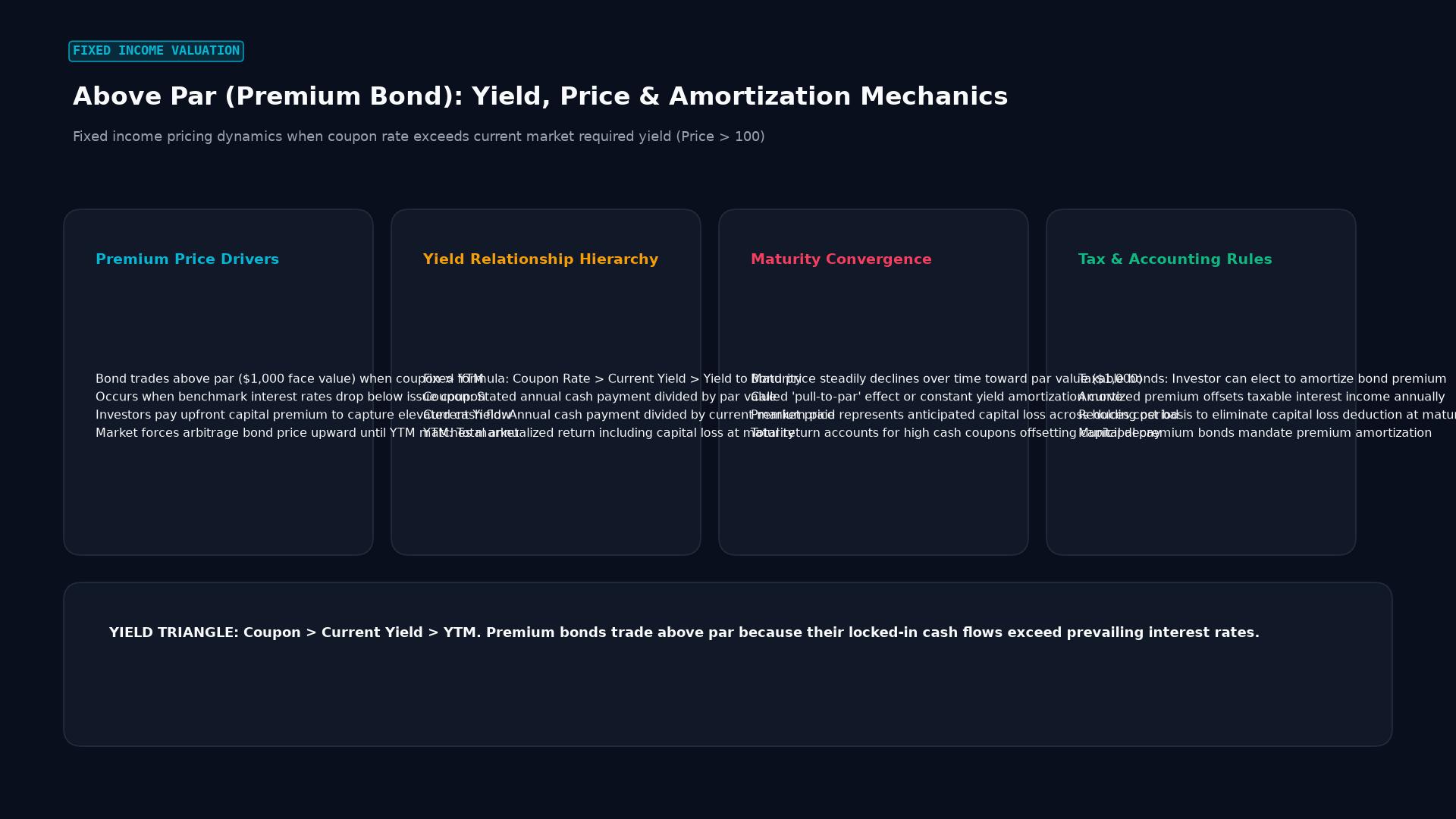 Figure: Fixed income pricing dynamics when coupon rate exceeds current market required yield (Price > 100)
Technical Mechanics & Yield Relationships
When an investor acquires a bond trading above par, the financial relationship between its yield metrics is strictly ordered:
$$\text{Coupon Rate} > \text{Current Yield} > \text{Yield to Maturity (YTM)}$$
1. The Bond Pricing Formula
The market price of a fixed-rate bond is the discounted sum of its future coupon cash flows and the final par repayment:
$$P = \sum_{t=1}^n \frac{C}{(1 + r)^t} + \frac{F}{(1 + r)^n}$$
Where:
- $P$ = Market price of the bond
- $C$ = Periodic coupon payment
- $r$ = Prevailing market discount rate / required yield
- $F$ = Par / face value ($1,000)
- $n$ = Number of compounding periods to maturity
If $r < \text{Coupon Rate}$, then $P > F$, and the bond prices above par.
2. Premium Amortization & Capital Drag
Investors purchasing above-par bonds must account for capital loss at maturity. If an investor buys a bond for $1,100, the issuer will still only return the $1,000 par value at maturity. This $100 premium must be amortized over the remaining life of the bond using the constant yield method, which provides an annual tax deduction against gross coupon income.
Comparative Matrix: Bond Pricing Environments
| Pricing State | Secondary Price vs. Par | Coupon vs. Market Yield | Yield to Maturity (YTM) vs. Coupon | Premium / Discount Tax Treatment |
|---|---|---|---|---|
| Above Par (Premium) | Price > $1,000 (Quote > 100) | Coupon Rate > Market Yield | YTM < Coupon Rate | Annual premium amortization offsets taxable interest |
| At Par | Price = $1,000 (Quote = 100) | Coupon Rate = Market Yield | YTM = Coupon Rate | No amortization or accretion required |
| Below Par (Discount) | Price < $1,000 (Quote < 100) | Coupon Rate < Market Yield | YTM > Coupon Rate | Original Issue Discount (OID) accretes as ordinary income |
Real-World Case Study: The 2020 Sovereign Yield Collapse
In March 2020, in response to pandemic dislocations, the Federal Reserve slashed the federal funds rate to 0.00%–0.25%, and global central banks launched unprecedented quantitative easing:
- The Pre-Crisis Instrument: An institutional pension fund held a 30-year US Treasury bond issued in 2014 bearing a fixed 3.375% coupon maturing in May 2044, originally purchased at par ($100.00).
- The Secondary Market Surge: By mid-2020, benchmark 30-year Treasury yields collapsed to an all-time low of approximately 1.20%.
- Above Par Revaluation: Because new 30-year bonds paid only 1.20%, institutional buyers aggressively bid up the 3.375% Treasury. The bond’s secondary price surged to 148.50 ($1,485 per $1,000 bond)—trading 48.5% above par.
- Portfolio Rebalancing: The pension fund executed a tactical sale of their above-par bonds, harvesting a massive 48.5% capital gain to lock in returns ahead of future rate hikes.
Frequently Asked Questions (FAQ)
Is buying a bond above par a bad investment?
Not necessarily. While an investor experiences a capital loss from the purchase price down to the $1,000 par value at maturity, this is directly compensated by receiving above-market coupon cash flows throughout the bond’s life. The Yield to Maturity (YTM) fully factors in this capital drag, providing an accurate measure of total return.
What is “Yield to Call” (YTC) on an above-par bond?
When a bond trades above par and contains a call provision allowing the issuer to redeem it early at par, investors evaluate Yield to Call (YTC) rather than YTM. Issuers have a strong incentive to call high-coupon bonds and refinance at lower interest rates, cutting off future high interest payments.
How are bond premiums amortized for taxation?
Under US Internal Revenue Code Section 171, an investor who buys a taxable bond at a premium can elect to amortize the bond premium annually. The amortized amount offsets the taxable interest received, reducing the investor’s current tax liability and stepping down the bond’s cost basis.
Ready to trade forex?
Open a free demo account with a regulated broker. Practice with virtual funds before risking real money.