Face-Amount Certificate
A face-amount certificate is a regulated investment contract offered by a specialized investment company under the Investment Company Act of 1940, in which an investor makes periodic installment payments over a fixed term and receives the contract's stated face-amount value at maturity.
What Is a Face-Amount Certificate?
A face-amount certificate is a specialized investment contract issued by a legally registered face-amount certificate company — one of only three formally recognized categories of regulated investment companies defined under the Investment Company Act of 1940 (alongside mutual funds and closed-end funds).
Under a face-amount certificate arrangement, an investor enters a contractual agreement to make periodic installment payments (monthly, quarterly, or annually) over a designated accumulation period. At the end of the fixed investment term, the issuing company guarantees the delivery of the certificate’s stated face amount — regardless of the investment returns generated by the underlying asset pool.
The product structurally resembles a hybrid between a bank savings plan (offering guaranteed capital returns) and a whole life insurance contract (featuring mandatory periodic premiums in exchange for a guaranteed future payout):
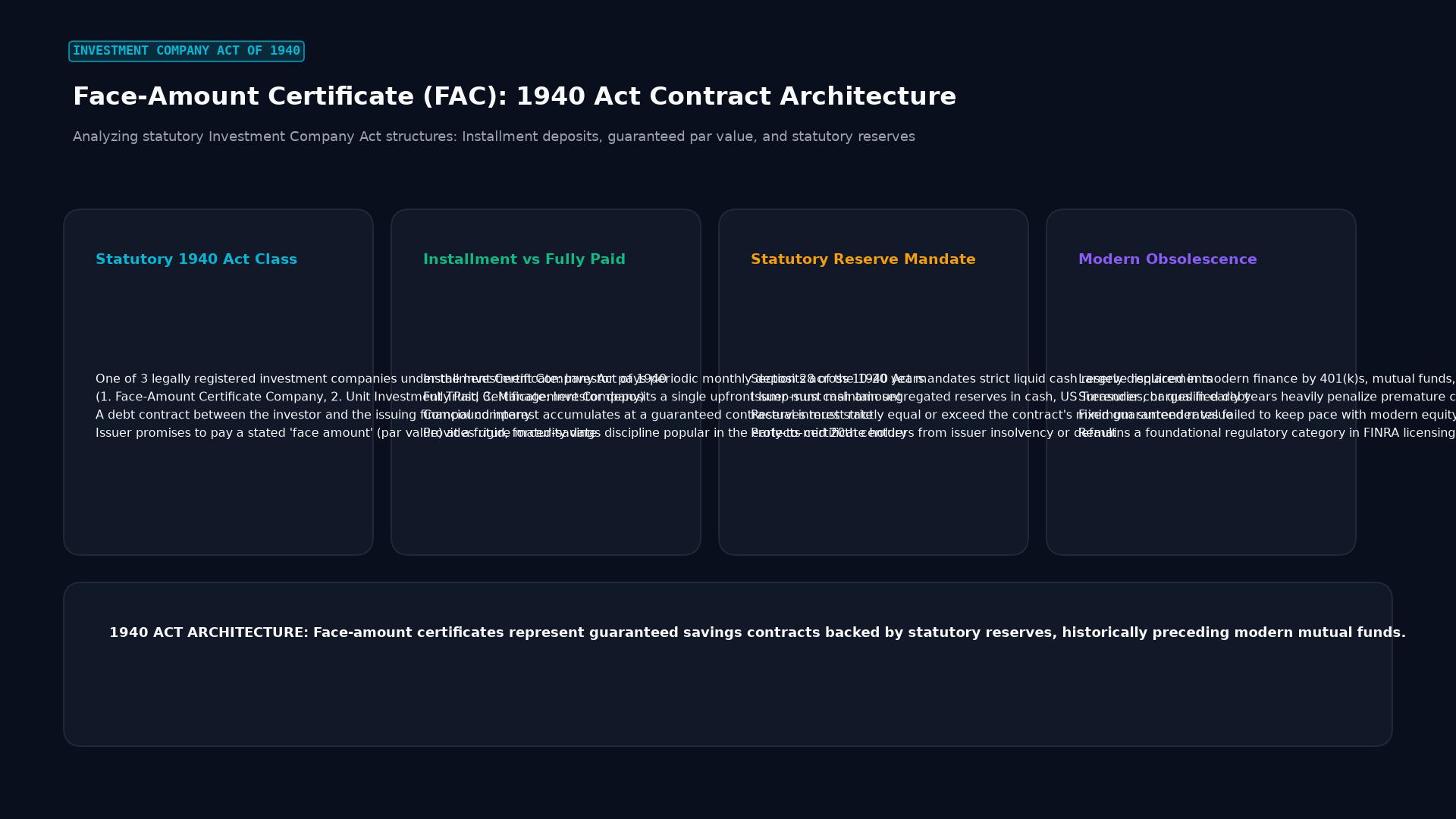 Figure: Analyzing statutory Investment Company Act structures: Installment deposits, guaranteed par value, and statutory reserves
Regulatory Framework & 1940 Act Classification
Face-amount certificate companies occupy a distinct regulatory category within US securities law:
Legal Definitions Under the Investment Company Act of 1940
Under Section 4(1) of the Act, a face-amount certificate company is formally defined as an investment company that:
- Issues debt securities representing contractual obligations to pay face amounts at maturity.
- Requires installment payments rather than lump-sum purchases.
- Backs certificates with a segregated portfolio of eligible assets (historically US government securities or first-lien real estate mortgages).
Asset Maintenance Requirements
Companies must maintain a minimum asset coverage ratio against outstanding certificate obligations:
$$\text{Required Asset Coverage} \geq \text{Total Outstanding Face-Amount Obligations} \times (1 + \text{Regulatory Buffer Rate})$$
The SEC mandates that for every dollar of outstanding face-amount certificates issued, the company must hold qualified reserve assets to ensure guaranteed payoff capacity at maturity.
Comparative Matrix: Fixed-Return Investment Products
| Product | Guaranteed Return? | Regulatory Oversight | Primary Risk | FDIC / SIPC Protected? |
|---|---|---|---|---|
| Face-Amount Certificate | Yes (Contractual Face Value) | SEC (1940 Act registered) | Issuer insolvency | SIPC (limited) |
| Bank CD | Yes (Principal + APY) | FDIC / OCC | Bank failure | FDIC (up to $250K) |
| US Savings Bond (EE/I) | Yes (Guaranteed by Treasury) | US Treasury Department | None (sovereign backed) | Fully guaranteed |
| Equity Mutual Fund | No (Market-linked) | SEC (1940 Act) | Market losses | SIPC (for fraud only) |
Real-World Context: The Historical Decline of Face-Amount Companies
Face-amount certificate companies dominated the American retail savings market during the 1920s and 1930s, offering working-class households a disciplined, contractual savings mechanism with a guaranteed end value.
Historical Arc of the Face-Amount Certificate Market:
1. Depression-Era Popularity (1930s): The Investors Syndicate and similar companies attracted millions of small savers during the Great Depression, offering guaranteed returns when banks were collapsing and equity markets were in freefall.
2. Regulatory Response (1940): The catastrophic failures of several certificate companies during the Depression — caused by insufficient asset backing — prompted Congress to include face-amount certificate companies as a formal regulatory category in the Investment Company Act of 1940.
3. Post-War Decline: Rising standards of living, FDIC deposit insurance (1933), and the introduction of mutual funds offering equity market participation made face-amount certificates increasingly uncompetitive.
4. Near Extinction: By the 1970s and 1980s, the face-amount certificate industry had collapsed to a handful of remaining issuers. As of today, only a tiny number of face-amount certificate companies remain registered with the SEC.
Frequently Asked Questions (FAQ)
What happens if an investor stops making installment payments before maturity?
If an investor discontinues periodic installment payments before the face-amount certificate reaches its contractual maturity date, they typically have three options: (1) Surrender the certificate for its current reduced cash surrender value (which may be significantly less than total premiums paid if surrendered early); (2) Convert the certificate to a paid-up certificate with a reduced face amount proportional to premiums paid; or (3) Request a contractual loan against the surrender value of the certificate.
Are face-amount certificates suitable for modern investors?
In today’s investment landscape, face-amount certificates are largely obsolete compared to more flexible alternatives. US Treasury I-Bonds offer government-guaranteed returns with inflation protection. FDIC-insured bank certificates of deposit provide comparable safety with far greater liquidity. Roth IRA accounts invested in low-cost index funds offer superior long-term wealth accumulation potential. The primary remaining value of face-amount certificates lies in their contractual discipline mechanism for investors who lack the willpower to maintain voluntary savings programs.
How does the SEC regulate face-amount certificate companies today?
Face-amount certificate companies must register with the US Securities and Exchange Commission under the Investment Company Act of 1940, file annual audited financial reports (Form N-CEN), maintain prescribed minimum asset backing ratios against outstanding certificate obligations, and obtain shareholder approval for any changes to fundamental operating policies. The SEC’s Division of Investment Management maintains oversight authority for all remaining registered companies.
Ready to trade forex?
Open a free demo account with a regulated broker. Practice with virtual funds before risking real money.