Account History
A permanent chronological audit log and financial ledger maintained by a broker or trading platform documenting every completed event on a trading account, including filled orders, realized profits and losses, rollover swap fees, commissions, deposits, and withdrawals.
What is an Account History?
An account history is the official, immutable chronological ledger of all finalized financial events that have occurred within a trading account since its inception. While active trading terminals—such as MetaTrader 4/5, cTrader, or institutional FIX engines—display live open positions and fluctuating unrealized equity, the account history records only closed, settled transactions.
Far more than a simple receipt of past trades, an account history serves as the primary forensic data source for quantitative performance evaluation, tax compliance, broker dispute resolution, and trading psychology audits. Every credit, debit, execution fill, rollover swap, and commission is stamped with a permanent, unique identifier to ensure structural transparency between broker and client.
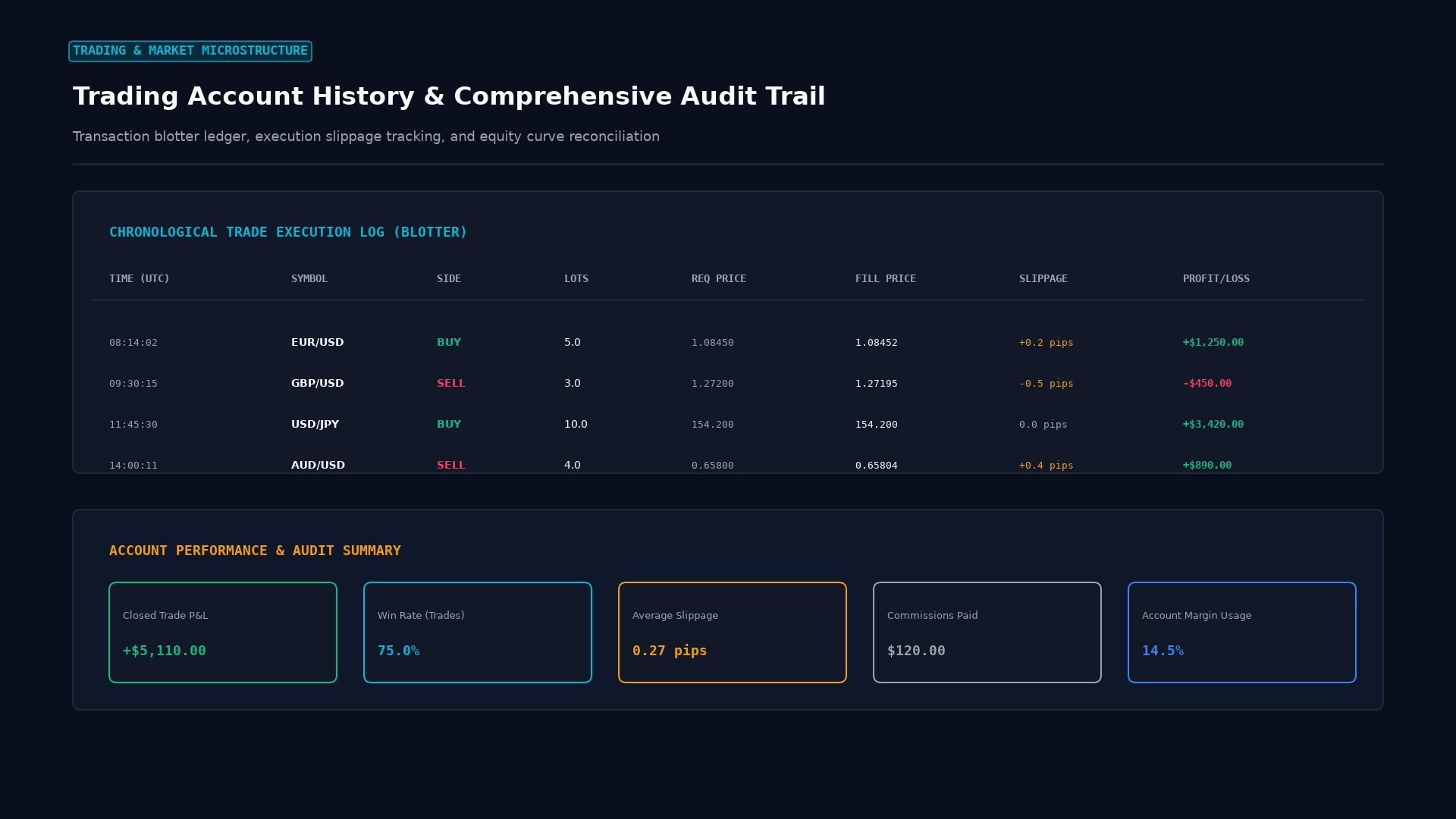 Figure: Chronological trade execution blotter log detailing fill prices, execution slippage, broker commissions, and daily equity curve performance metrics.
Anatomical Components of a Professional Trading Ledger
Every transaction recorded in a regulated broker’s account history contains standardized data points:
- Ticket ID / Deal Reference: A unique sequential numerical string generated by the matching engine that links the closed trade back to the raw server execution log.
- Execution Timestamps: Millisecond-accurate records of when the position was opened and closed (typically referenced in UTC or server time).
- Asset Class & Direction: The underlying ticker or currency cross (e.g., GBP/USD) and the side taken (Buy/Long or Sell/Short).
- Volume / Position Size: The quantity transacted, denoted in standard lots ($100,000$ base units), mini lots ($10,000$), micro lots ($1,000$), or fractional contracts.
- Entry and Exit Prices: The exact bid or ask rates at which liquidity was consumed upon opening and liquidation.
- Frictional Costs (Swap & Commission):
- Commissions: Explicit fees charged per round-turn lot by ECN/STP brokers.
- Swaps / Rollover: Daily interest debited or credited at 5:00 PM EST based on the interbank interest rate differential between the two currencies.
- Net Realized P&L: The final gross profit or loss minus all commissions and net swap adjustments, credited directly to account cash balance.
Quantitative Performance Metrics Derived from Account History
Systematic traders and hedge funds do not judge account performance by raw profits alone. Instead, historical ledger exports (CSV, XML, or HTML statements) are processed through quantitative engines to compute institutional risk-adjusted metrics:
1. Profit Factor
$$\text{Profit Factor} = \frac{\sum \text{Gross Winning Trades}}{\sum \text{Gross Losing Trades}}$$ A profit factor below 1.0 indicates an unprofitable strategy; 1.5 to 2.0 represents a robust, sustainable trading edge.
2. Expectancy per Trade
$$\text{Expectancy} = (\text{Win Rate} \times \text{Average Win}) - (\text{Loss Rate} \times \text{Average Loss})$$ Quantifies the statistical dollar return an investor can expect to generate for every single trade executed over the long run.
3. Maximum Peak-to-Trough Drawdown (MDD)
The largest single historical percentage drop in account equity from a prior peak before a new high is achieved. MDD defines portfolio survival probability and regulatory capital compliance.
4. Sharpe and Sortino Ratios
By calculating the mean and standard deviation of daily realized returns from the account history, analysts determine whether profits were generated through skill or excessive volatility risk.
Practical Statement Analysis: The Hidden Cost of Execution Drag
Consider an excerpt from an active currency trader’s 1-month account history:
| Metric | Raw Strategy Figures | Impact on Account Balance |
|---|---|---|
| Gross Trading Profit | +$12,450.00 | Winning trades minus losing trade exits |
| Number of Trades | 180 Closed Lots | High-frequency swing approach |
| Broker Commissions | -$1,260.00 | $7.00 per round-turn lot across 180 lots |
| Overnight Financing (Swaps) | -$2,140.00 | Holding long positions in low-yielding currencies |
| Net Realized Cash Return | +$9,050.00 | Net balance growth credited to trader |
The Forensic Diagnosis
While the gross strategy showed $+12,450.00$, the account history reveals that 27.3% of total profits were consumed by execution frictions ($1,260 in commissions + $2,140 in negative swap drag).
Without reviewing the account history, the trader might conclude that trade selection was flawed, whereas the true bottleneck was holding negative carry pairs over Wednesday triple-swap rollovers.
Comparative Matrix: Account History vs. Active System States
| Operating Dimension | Account History | Open Positions Window | Order Book / Server Log |
|---|---|---|---|
| Transaction State | Fully settled and finalized | Active, open, and fluctuating | Pending, limit, and cancel orders |
| P&L Measured | Net Realized P&L (Cash settled) | Floating / Unrealized P&L | Zero (No execution has occurred) |
| Balance Impact | Permanently updates Cash Balance | Affects Equity & Free Margin only | Zero impact on balance or equity |
| Modifiability | Strictly Immutable (Read-Only) | Modifiable (Stops, targets, size) | Cancellable or editable |
| Regulatory Standing | Legal audit trail for taxes & courts | Operational intraday telemetry | Technical microstructure record |
Regulatory, Legal, and Tax Compliance Functions
-
Tax Preparation and Capital Gains: In jurisdictions like the United States (IRS Section 988 for ordinary income vs. Section 1256 for 60/40 capital gains on regulated futures) and the United Kingdom (HMRC capital gains reporting), annual account history records are legally binding documents used to calculate taxable liability.
-
Resolving Broker Execution Disputes: If a flash crash or platform freeze occurs, the account history provides the precise millisecond timestamps, ticket numbers, and fill prices needed to cross-reference against the broker’s independent liquidity provider tick records.
-
Auditing Proprietary Trading Firm Challenges: Modern retail prop firms enforce strict daily drawdown limits (e.g., 5% maximum intraday equity drop). Automated risk engines continuously parse the account history to verify whether an account has breached scaling rules.
Key Takeaways
- An account history is the permanent, chronological financial record of all completed trades, commissions, swap fees, deposits, and cash transfers.
- It reflects realized profit and loss, distinguishing settled funds from live, fluctuating unrealized market equity.
- Analyzing account history data reveals critical institutional performance metrics, including Profit Factor, Win-Loss Expectancy, and Maximum Drawdown.
- Routine audits of account history statements expose structural execution drags, such as excessive broker commissions and negative overnight financing costs.
- Account histories are essential legal instruments for annual tax filing, compliance reporting, and formal broker dispute arbitrations.
Frequently Asked Questions
Can a broker alter or delete entries in an account history?
In regulated brokerage environments (regulated by the FCA, ASIC, CFTC, or CySEC), modifying historical trade entries is illegal. Matching engines maintain immutable, write-once audit logs. However, brokers may occasionally issue manual balance adjustments (e.g., crediting a refund following a validated technical outage), which appear as separate, explicit ledger line items.
What is the difference between Account Balance and Account Equity in my history?
Account Balance represents your settled cash funds, which only changes when a trade closes or funds are deposited/withdrawn. Account Equity represents your real-time liquidation value (Balance plus or minus live floating profits and losses on open positions).
How long do brokers retain account history records?
Under international financial regulations (such as MiFID II in Europe and SEC/CFTC rules in the U.S.), brokers are legally mandated to retain complete customer transaction logs and account history files for a minimum of five to seven years.
Why do some closed trades in my history show zero profit or loss?
Trades that close at exactly the entry price (breakeven stops) or trades that were canceled before execution will show 0.00 P&L. However, ECN commissions or micro-swap fees may still result in a slight net debit on the ticket.
Ready to trade forex?
Open a free demo account with a regulated broker. Practice with virtual funds before risking real money.