Tick
A tick is the minimum allowable price fluctuation by which an exchange rate or financial asset can change upward or downward on an electronic trading platform.
A tick is the smallest atomic unit of price measurement in financial markets. In electronic foreign exchange trading, every time the bid or ask quote shifts up or down by the smallest allowable fraction, a “tick” has occurred.
While the term is historically used in stock and futures markets to denote contract price increments (such as 0.25 index points on S&P 500 futures), in modern retail forex trading, a tick corresponds to the fifth decimal place (a fractional pip or pipette), providing the raw data stream that powers charts, execution algorithms, and tick-volume indicators.
The Hierarchy: Tick vs. Pip vs. Pipette
Understanding the structural relationship between ticks, pips, and pipettes prevents costly position-sizing errors:
| Price Unit | Decimal Place (EUR/USD) | Price Example | Fractional Multiplier | Monetary Value per Standard Lot ($100k) |
|---|---|---|---|---|
| Big Figure | 2nd decimal place | 1.08500 | 100 Pips ($0.0100) | $1,000.00 |
| Standard Pip | 4th decimal place | 1.08500 | 1 Pip ($0.0001) | $10.00 |
| Tick (Pipette) | 5th decimal place | 1.08502 | 0.10 Pip ($0.00001) | $1.00 |
The Modern 5-Decimal Quotation Standard
Historically, retail currency brokers quoted pairs to four decimal places (e.g., EUR/USD at 1.0850), making a single pip the minimum tick. In the late 2000s, competitive electronic communication networks (ECNs) introduced fractional pip pricing (5 decimal places, e.g., 1.08502).
Under modern 5-digit pricing:
- 1 Pip = 10 Ticks (Pipettes)
- For Yen currency pairs quoted to 3 decimal places (e.g., USD/JPY at 154.502), the 3rd decimal place represents the tick ($0.001$), while the 2nd decimal place represents the standard pip ($0.01$).
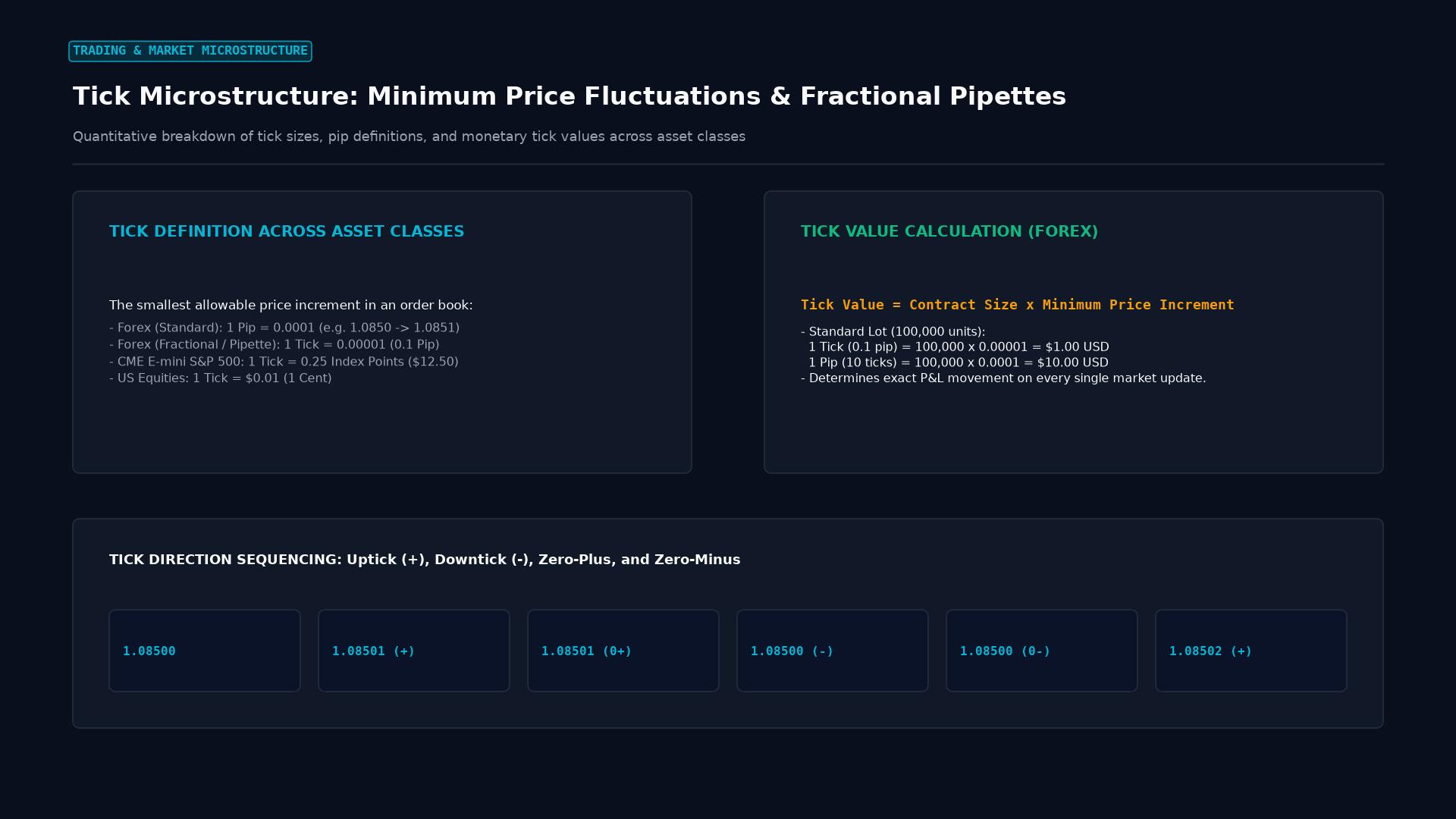 Figure: Tick granularity across asset classes: minimum price increment, fractional 0.1 pip pipettes, and tick value calculations for position sizing.
How Ticks Power Market Microstructure
In algorithmic and quantitative trading, raw price action is processed as a continuous series of ticks:
- Tick Data Feeds: Institutional trading algorithms do not read 5-minute candles; they ingest live tick-by-tick Level 2 data feeds via FIX API protocols. Every incoming tick carries three pieces of information: timestamp (in milliseconds or microseconds), new Bid/Ask price, and available order book volume.
- Tick Charts vs. Time-Based Charts: Professional intraday scalpers frequently trade using tick charts (such as a 500-tick or 1,000-tick chart) rather than standard 5-minute time charts.
- On a time chart, a new bar forms every 5 minutes regardless of whether the market is dead or explosive.
- On a tick chart, a new bar forms only after a fixed number of transactions occur (e.g., exactly 1,000 price changes). This automatically compresses quiet consolidations into few bars and expands high-volatility news spikes into detailed candlestick sequences.
- Tick Volume Generation: Because decentralized spot forex lacks a central clearinghouse to report traded dollar volume, MetaTrader and institutional terminals count the number of ticks occurring within each candlestick, creating the tick-volume histogram.
Calculating the Dollar Value of a Tick
The monetary value of a single tick depends on the trade’s notional lot size and the currency pair’s quote denomination:
$$\text{Tick Value} = \text{Contract Size} \times \text{Lot Count} \times \text{Tick Size}$$
Concrete Calculation on EUR/USD:
- Standard Lot (1.0 Lot / $100,000): $$100,000 \times 0.00001 = \mathbf{$1.00 \text{ per tick}}$$
- Mini Lot (0.10 Lot / $10,000): $$10,000 \times 0.00001 = \mathbf{$0.10 \text{ per tick}}$$
- Micro Lot (0.01 Lot / $1,000): $$1,000 \times 0.00001 = \mathbf{$0.01 \text{ per tick}}$$
If a trader goes long 3.0 standard lots of EUR/USD and the price ticks upward from 1.08500 to 1.08507 (a 7-tick advance, or 0.7 pips), the immediate floating gain equals:
$$7 \text{ ticks} \times $3.00/\text{tick} = \mathbf{$21.00}$$
Key Takeaways
- Atomic Price Unit: A tick is the absolute smallest price change permissible for a given financial asset on an exchange or broker terminal.
- Modern Fractional Standard: In modern 5-digit forex quoting, a tick represents one pipette (the 5th decimal place, or $0.10$ of a standard pip).
- Tick Charts for Scalpers: Tick-based charts build candles based on transaction frequency rather than elapsed time, filtering market noise during quiet periods.
- Foundation of Tick Volume: Decentralized spot forex calculates volume by tallying the frequency of price ticks per bar.
- Predictable Value: For standard USD-quoted pairs, one tick on a 1.0 standard lot is worth exactly $1.00.
Frequently Asked Questions
Is a tick the same thing as a pip?
Not in modern electronic trading. While a pip was historically the smallest price increment, modern forex brokers quote pairs to five decimal places. A pip represents the fourth decimal place ($0.0001$), while a tick represents the fifth decimal place ($0.00001$, or a pipette). Therefore, 1 pip contains 10 ticks.
What is the “Uptick Rule” in financial trading?
The Uptick Rule (historically enforced by the SEC in equity markets) is a trading regulation that permits short-selling an asset only on an “uptick”—meaning the price must be higher than the immediately preceding transaction. It was designed to prevent predatory short sellers from driving a collapsing asset downward in a destabilizing cascade.
Why do some brokers’ charts have more ticks than others?
Because spot forex is decentralized, each retail broker connects to its own specific pool of liquidity providers (tier-1 banks, non-bank market makers, ECNs). A broker with deeper, more active liquidity feeds will stream more price updates per second, producing a higher tick count on identical timeframes.
Ready to trade forex?
Open a free demo account with a regulated broker. Practice with virtual funds before risking real money.