Accounts Receivable Aging
Accounts Receivable Aging is a periodic accounting and credit management report that segments an enterprise's outstanding customer invoices into standardized chronological brackets to evaluate collection efficiency, manage liquidity, and calculate allowances for credit losses.
What Is Accounts Receivable Aging?
Accounts Receivable (AR) Aging is a critical financial and managerial reporting schedule that sorts a company’s unpaid customer invoices into distinct chronological time buckets based on how long each balance has been overdue past its payment due date.
Standard aging schedules categorize receivables into five primary tiers:
- Current (0–30 days): Invoices within normal commercial credit terms (e.g., Net 30).
- 31–60 days past due: Invoices showing initial payment friction requiring collection follow-ups.
- 61–90 days past due: Elevated credit risk requiring credit holds or formal demand notices.
- 91–120 days past due: High probability of commercial dispute, insolvency, or default.
- Over 120 days past due: Severe delinquency candidate for collection agencies, legal recovery, or bad debt write-off.
AR Aging is used by corporate treasurers to forecast short-term cash flows, by credit underwriters to establish customer credit limits, and by accountants to calibrate balance sheet allowances under the Current Expected Credit Losses (CECL) accounting standard.
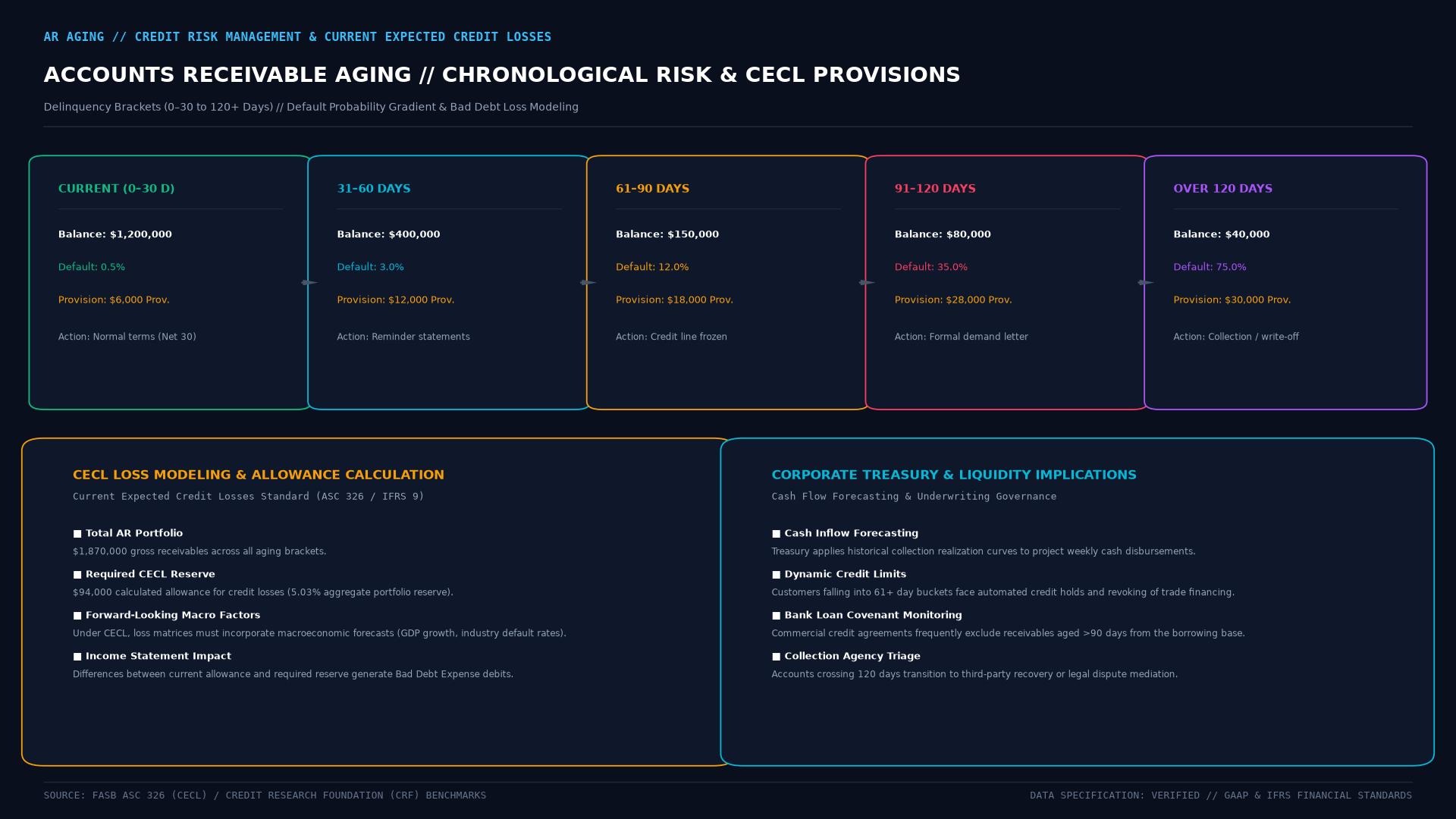 Figure: Accounts Receivable aging schedule and default probability matrix across chronological brackets (Current 0–30 days through Over 120 days), showing CECL loss allowance calculations (ASC 326), required provisions, and corporate treasury liquidity actions.
Technical Mechanics & Mathematical Formulas
Financial controllers utilize the AR aging schedule to calculate credit loss provisions and assess working capital health:
1. Allowance for Credit Losses (CECL Aging Method)
Under US GAAP (ASC 326), companies apply historical default percentages to each aging bucket to determine balance sheet reserves: $$\text{Total Allowance} = \sum_{k=1}^{m} \left( \text{Receivable Balance}_k \times \text{Expected Loss Rate}_k \right)$$
Example:
- Current ($500,000) at $0.5% = $2,500$
- 31–60 Days ($120,000) at $3.0% = $3,600$
- 61–90 Days ($40,000) at $12.0% = $4,800$
- 91+ Days ($15,000) at $50.0% = $7,500$
- Total Required Allowance: $$18,400$
2. Days Sales Outstanding (DSO)
The average number of days required to collect payment after a credit sale has been completed: $$\text{DSO} = \left( \frac{\text{Ending Accounts Receivable}}{\text{Total Credit Sales}} \right) \times \text{Number of Days in Period}$$
3. Collection Effectiveness Index (CEI)
Quantifies the percentage of available receivables successfully collected during a given operating period: $$\text{CEI} = \frac{\text{Beginning AR} + \text{Credit Sales} - \text{Ending Total AR}}{\text{Beginning AR} + \text{Credit Sales} - \text{Ending Current AR}} \times 100%$$
Comparative Matrix: Accounts Receivable Aging vs Alternative Credit Models
| Dimension | AR Aging Schedule | Direct Write-Off Method | Percentage of Sales Method | Factoring Advance Verification |
|---|---|---|---|---|
| Core Mechanism | Categorizes balances by days delinquent | Charges bad debt only when customer defaults | Multiplies total gross sales by static loss rate | Third-party factor verifies invoice creditworthiness |
| GAAP / IFRS Compliance | Full compliance (matches CECL & IFRS 9) | Non-compliant with GAAP (violates matching) | Partial compliance; must be reconciled to aging | Ancillary financing tool, not pure reporting |
| Balance Sheet Accuracy | Highest; directly values asset realizability | Lowest; overstates assets until write-off occurs | Moderate; ignores specific customer payment age | Real-time liquidity valuation by commercial lender |
| Primary Metric Tracked | Delinquency distribution & bucket migration | Realized default dollar loss | Macro portfolio credit loss ratio | Advance rate discount (typically 80%–90%) |
Real-World Case Study: Industrial Parts Manufacturer Mitigating Supply Chain Delinquencies
In 2023, an industrial components supplier supplying automotive assembly plants observed its Days Sales Outstanding expand from 42 days to 68 days:
- The AR Aging Diagnosis: Running an aging audit revealed that while Tier-1 automakers remained current in the 0–30 day bucket, regional subcontractor accounts had ballooned in the 61–90 day category, accumulating $4.2 million in uncollected balances.
- Intervention: The CFO instituted automated credit limits tied directly to aging thresholds: any account reaching 45 days past due triggered an automatic shipping freeze. Concurrently, the finance department offered a $2/10\text{ Net }30$ cash discount (2% discount if paid within 10 days).
- The Outcome: Within two quarters, 65% of delinquent customers settled invoices to capture the early payment discount. The supplier recovered $3.1 million in working capital, reduced DSO back to 44 days, and avoided drawing down its expensive floating-rate bank credit line.
Frequently Asked Questions (FAQ)
How often should a finance department run an AR aging report?
At a minimum, companies should generate AR aging reports weekly for active collections management and at the end of every calendar month for financial close reconciliations and allowance computations. High-volume enterprises often review real-time automated dashboards daily.
What is the difference between “Due Date” and “Invoice Date” aging?
Invoice date aging measures delinquency from the date the invoice was printed or sent, while due date aging counts days starting only after the payment grace period (such as Net 30 terms) has officially expired. Due date aging is the standard metric used for formal credit collections.
Can an invoice in the 91+ day bucket ever be recovered?
Yes. An invoice remaining past 90 days does not guarantee complete non-payment. Companies frequently negotiate partial structured settlements, secure collateralized promissory notes, or offer discounted lump-sum releases before resorting to writing off the debt or selling it to third-party collection agencies.
Ready to trade forex?
Open a free demo account with a regulated broker. Practice with virtual funds before risking real money.