Accredited Personal Financial Planning Specialist
An Accredited Personal Financial Planning Specialist (Personal Financial Specialist or CPA/PFS) is a professional credential awarded by the AICPA exclusively to licensed CPAs who demonstrate advanced expertise in estate planning, retirement, tax, and wealth management.
What Is an Accredited Personal Financial Planning Specialist?
An Accredited Personal Financial Planning Specialist (officially designated as the Personal Financial Specialist or CPA/PFS) is a premier professional financial planning credential awarded exclusively to licensed Certified Public Accountants (CPAs) by the American Institute of Certified Public Accountants (AICPA).
While standard financial planners often enter the profession from sales or brokerage backgrounds, a CPA/PFS professional combines the rigorous auditing, taxation, and statutory accounting foundation of the CPA license with specialized fiduciary financial advisory expertise. These professionals provide holistic advisory services spanning complex multi-generational estate structures, executive deferred compensation, business succession, risk management, and private portfolio wealth management.
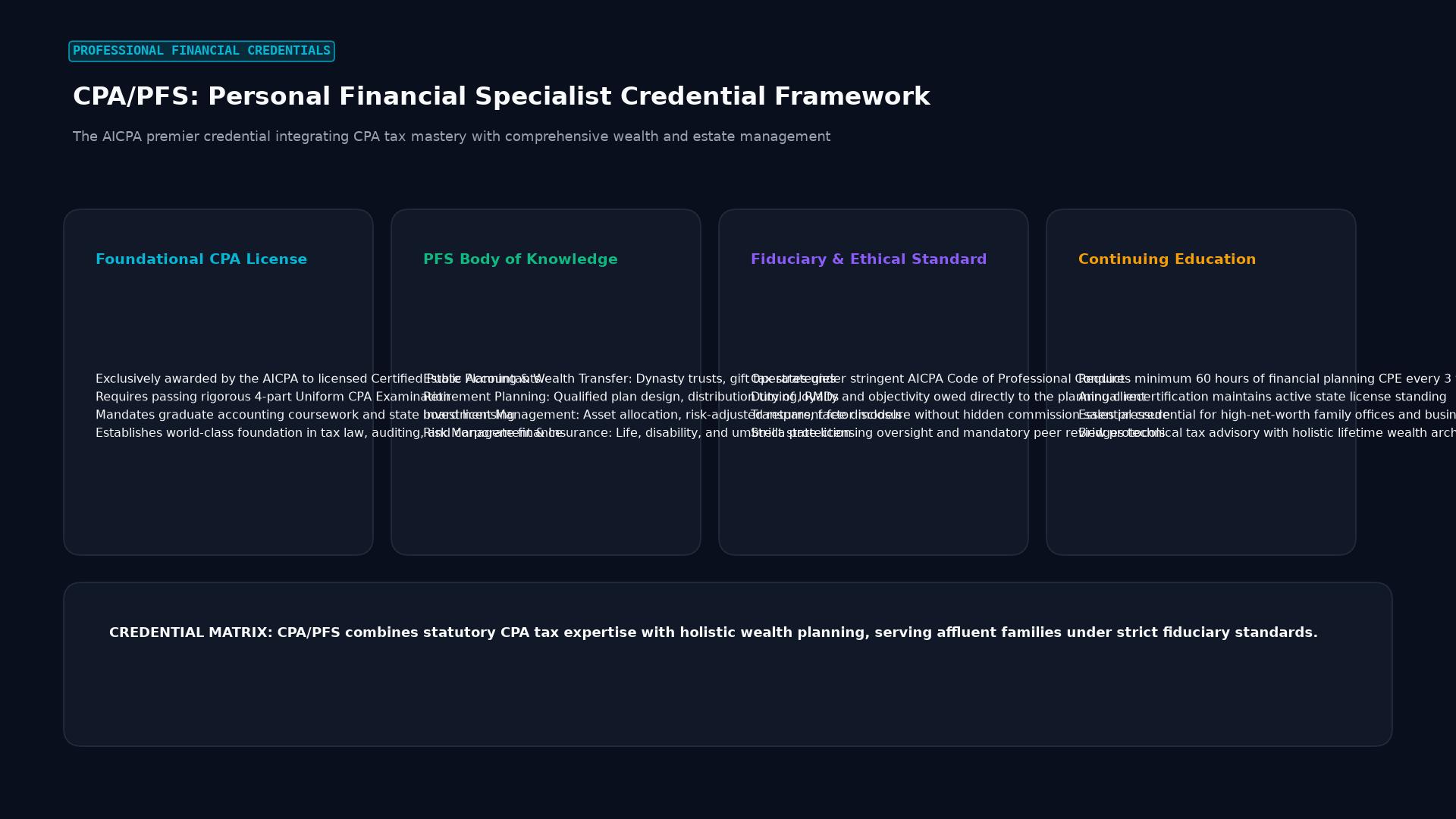 Figure: The AICPA premier credential integrating CPA tax mastery with comprehensive wealth and estate management
Technical Mechanics & Qualification Standards
Earning and maintaining the Personal Financial Specialist (PFS) credential requires meeting strict professional prerequisites administered by the AICPA:
1. Active CPA Licensure in Good Standing
Candidates must hold an active, valid CPA license issued by a state board of accountancy. Unlicensed planners, enrolled agents, or individuals holding only undergraduate accounting degrees are ineligible to sit for the credential.
2. Comprehensive Examination and Body of Knowledge
Candidates must pass the rigorous, comprehensive PFS Credential Examination (or hold an active Certified Financial Planner - CFP certification in good standing, which satisfies the initial exam requirement). The curriculum covers seven core disciplines:
- Personal Financial Planning Process & Professional Ethics
- Income Tax Planning & Corporate Integration
- Retirement and Employee Benefit Planning
- Estate, Gift, and Wealth Transfer Planning
- Risk Management and Asset Protection Strategies
- Investment Planning & Modern Portfolio Optimization
- Elder Care and Special Needs Financial Architecture
3. Experience and Continuing Professional Education (CPE)
- Experience Requirement: A minimum of 3,000 hours of qualified, verifiable personal financial planning experience within the preceding five years.
- Continuing Education: Ongoing completion of at least 60 hours of financial planning-specific CPE credits every three years to maintain credential standing.
Comparative Matrix: CPA/PFS vs. CFP vs. CFA
| Dimension | Personal Financial Specialist (CPA/PFS) | Certified Financial Planner (CFP) | Chartered Financial Analyst (CFA) |
|---|---|---|---|
| Issuing Body | AICPA | CFP Board of Standards | CFA Institute |
| Prerequisite | Active CPA License (Mandatory) | Bachelor’s Degree in any major | Bachelor’s Degree or equivalent work experience |
| Primary Strength | Deep tax code mastery, estate planning, and accounting | Broad general personal financial and retirement planning | Advanced institutional equity research, portfolio math |
| Target Client | High-net-worth individuals, business founders, executives | Mass affluent and middle-market retail households | Pension funds, mutual funds, sovereign wealth desks |
| Fiduciary Mandate | Strict statutory CPA ethics + AICPA PFP Standards | CFP Board Code of Ethics and Standards of Conduct | CFA Institute Code of Ethics and Standards |
Real-World Case Study: Business Succession and Estate Optimization
In 2024, the founder of a regional manufacturing enterprise generating $35 million in revenue sought to transition ownership to three adult children while preparing for personal retirement. The founder held extensive company equity, commercial real estate, and appreciated securities portfolios, creating an estimated $14 million future federal estate tax exposure under current lifetime exemption sunset rules.
The founder engaged a CPA/PFS practitioner to structure the transition:
- Corporate Reorganization: Executed an internal recapitalization into voting and non-voting equity, transferring 70% of non-voting common stock into an Intentionally Defective Grantor Trust (IDGT) using promissory note financing, freezing the founder’s estate valuation while shifting future enterprise growth to the heirs tax-free.
- Tax-Efficient Retirement Income: Structured a defined benefit cash balance plan, allowing the founder to defer $280,000 annually in pre-tax income during the final three operating years.
- Charitable Shield: Established a Charitable Remainder Unitrust (CRUT) funded with $2 million of zero-basis public equities, eliminating immediate capital gains tax and creating a 7% lifetime income distribution.
The integrated financial and tax strategy eliminated over $5.2 million in projected estate tax liabilities, illustrating the distinct advantage of engaging an advisor with simultaneous mastery of CPA tax law and personal wealth management.
Frequently Asked Questions (FAQ)
Can a financial advisor claim to be a Personal Financial Specialist without a CPA?
No. The Personal Financial Specialist (PFS) credential is legally restricted by the AICPA exclusively to certified public accountants. Non-CPA advisors who practice financial planning typically hold credentials like the CFP (Certified Financial Planner) or ChFC (Chartered Financial Consultant).
What are the AICPA Statement on Standards in Personal Financial Planning Services?
The AICPA enforces binding professional rules governing conflict disclosure, planning competency, client confidentiality, and written documentation. A CPA/PFS who violates these standards faces formal disciplinary review and potential revocation of both their specialty credential and state accounting license.
Why do high-net-worth clients frequently prefer a CPA/PFS over a traditional stockbroker?
High-net-worth individuals face complex tax considerations where investment decisions carry severe federal, state, and cross-border tax consequences. A CPA/PFS operates as a fee-only fiduciary advisor equipped to calculate tax-adjusted returns, structure tax-efficient trusts, and integrate corporate accounting records directly into personal estate plans.
Ready to trade forex?
Open a free demo account with a regulated broker. Practice with virtual funds before risking real money.