Accrual Swap
A structured interest rate or currency derivative where one party pays a standard benchmark floating rate (such as SOFR or EURIBOR) while receiving an enhanced coupon that accrues exclusively on business days when a designated reference rate fixes strictly within a pre-agreed boundary or range.
What is an Accrual Swap?
An accrual swap (often known as a range accrual swap) is an over-the-counter (OTC) structured derivative designed to enhance yield in low-volatility or predictable interest rate environments. In a standard vanilla interest rate swap, two counterparties simply exchange fixed-rate payments for floating-rate payments across regular settlement dates.
In contrast, an accrual swap introduces conditional daily performance:
- The payer leg pays a standard floating benchmark rate, such as the Secured Overnight Financing Rate (SOFR), EURIBOR, or a fixed rate.
- The receiver leg receives an enhanced, above-market coupon rate. However, interest on this leg accrues only on days when the underlying reference rate fixes inside a pre-specified range or corridor $[R_{\min}, R_{\max}]$.
If the benchmark rate breaches either the lower barrier or the upper barrier on a given business day, that specific day contributes zero interest to the cumulative coupon for the period.
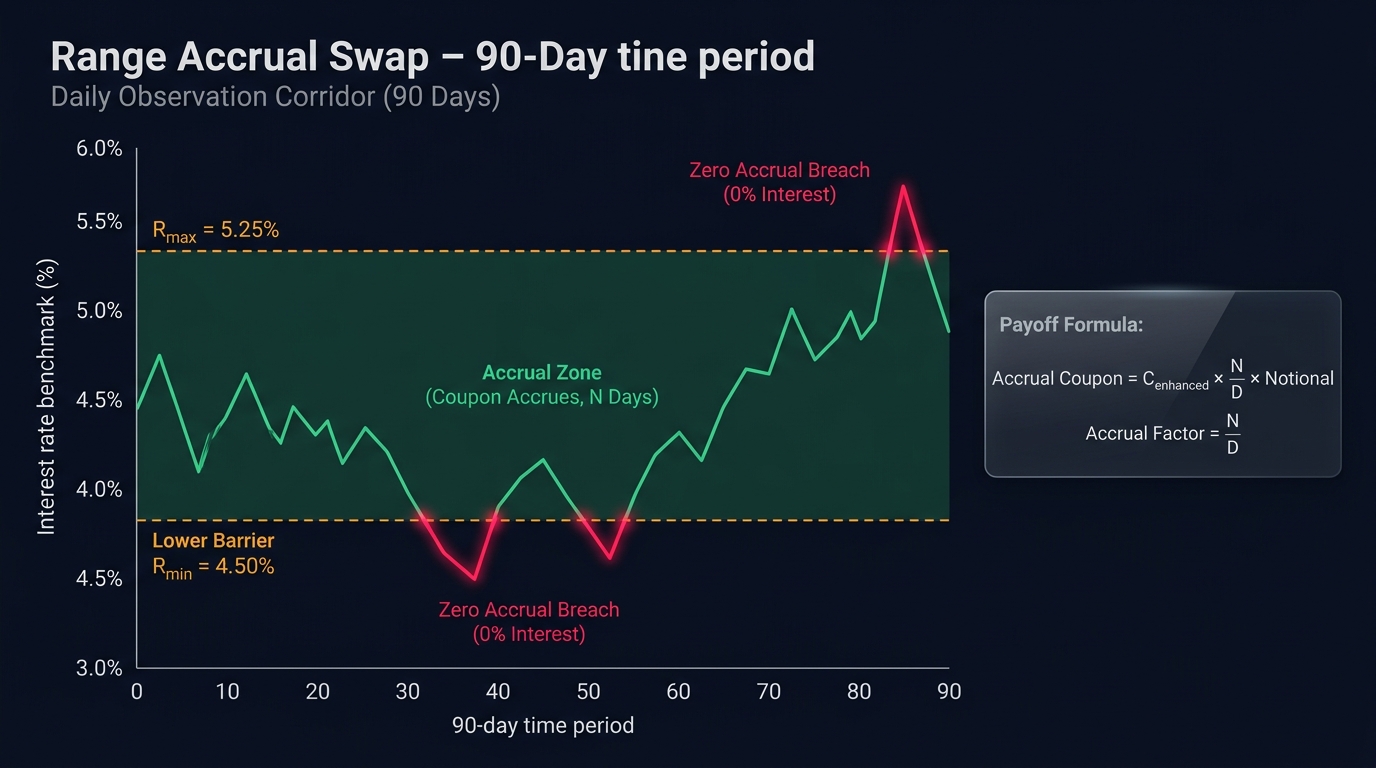
       Accrual Swap Daily Observation Corridor
   Interest Rate (%)
         ^
         |      Upper Corridor Boundary (R_max = 5.25%)
   ------+--------------------------------------------------+------
         |      * * * *                     * * * *         |
         |    *         *                 *         *       |  <-- Accrues Coupon
         |  *             *             *             *     |      (N days)
   ------+------------------*---------*--------------------+------
         |                    * * * *   Lower Corridor (R_min = 4.50%)
         |                              Zero Accrual Days!  |
         +--------------------------------------------------> Time (Days)
Core Payoff Mechanics and the Accrual Factor
The coupon payment due to the investor at the end of each calculation period is determined by multiplying the contract’s enhanced coupon rate by an accrual factor:
$$\text{Accrual Coupon} = C_{\text{enhanced}} \times \left( \frac{N}{D} \right) \times \text{Notional} \times \text{Day Count Fraction}$$
Where:
- $C_{\text{enhanced}}$ = Above-market agreed fixed coupon or spread (e.g., SOFR + 150 bps, or a flat 6.25%).
- $N$ = Number of calendar or business days during the accrual period where the reference rate fixes inside the specified boundary ($R_{\min} \le R_t \le R_{\max}$).
- $D$ = Total number of fixing or business days in the entire calculation period.
- $N / D$ = The accrual fraction (ranging from 0.0 to 1.0).
If macroeconomic conditions remain stable and the reference rate never exits the corridor, $N = D$, and the investor earns the full, premium coupon. If rates violently breakout of the band, $N$ drops toward zero, severely penalizing the investor’s cash flow.
Embedded Optionality: The Financial Engineering Behind the Trade
Why does an investment bank offer an above-market yield on an accrual swap? From a financial engineering standpoint, the investor entering an accrual swap is selling a portfolio of daily binary (digital) options to the dealer:
- For every day $t$ in the coupon period, the investor implicitly sells two digital options:
- A digital put struck at the lower barrier ($R_{\min}$).
- A digital call struck at the upper barrier ($R_{\max}$).
- The premium collected from writing these daily binary options is embedded into the coupon structure, providing the enhanced yield ($C_{\text{enhanced}}$).
- The bank hedges this risk dynamically across interest rate volatility surfaces. In return, the investor assumes the downside: should central banks abruptly hike or slash rates beyond the corridor, the daily binary options expire out of the money, wiping out the day’s accrual.
Institutional Case Study: Enhancing Yield on a $50 Million Liquidity Book
A corporate treasury holds $50,000,000 in excess liquidity. The current 3-month SOFR sits at 4.85%. The treasurer anticipates that the Federal Reserve will maintain a neutral monetary stance over the next 12 months, keeping money market rates within a bounded range.
To beat standard money market fund yields, the treasury enters a 1-year semi-annual Range Accrual Swap with an investment bank:
Contract Specifications
- Notional Principal: $50,000,000.
- Accrual Range: 4.25% ($R_{\min}$) to 5.35% ($R_{\max}$).
- Treasury Pays: Standard 3-month SOFR (flat).
- Treasury Receives: Fixed 6.35% $\times (N / D)$ (150 bps above the vanilla 1-year fixed swap rate of 4.85%).
- Observation Period: 125 business days in the first half-year ($D = 125$).
Performance Scenarios
| Scenario | Market Behavior | Inside Days ($N$) | Outside Days | Effective Coupon Paid | Semi-Annual Cash Inflow | Net Margin vs. Vanilla |
|---|---|---|---|---|---|---|
| A: Range Bound | Fed on pause; SOFR stays between 4.70% and 5.05%. | 125 (100%) | 0 | $6.35% \times (125/125) = 6.35%$ | $1,587,500 | +$375,000 |
| B: Moderate Drift | Inflation uptick pushes SOFR to 5.40% for 25 days before retreating. | 100 (80%) | 25 | $6.35% \times (100/125) = 5.08%$ | $1,270,000 | +$57,500 |
| C: Breakeven State | Rates breach band for 29.5 business days. | 95.5 (76.4%) | 29.5 | $6.35% \times (95.5/125) = 4.85%$ | $1,212,500 | $0 (Matches Vanilla) |
| D: Severe Rate Cuts | Emergency Fed cuts push SOFR below 4.25% on day 40. | 40 (32%) | 85 | $6.35% \times (40/125) = 2.03%$ | $507,500 | -$705,000 |
Under Scenario A, the treasury captures an additional $375,000 in annualized net yield. Under Scenario D, however, the unexpected policy pivot exposes the structural fragility of the corridor, dropping returns far below vanilla floating benchmarks.
Derivative Comparison: Accrual Swap vs. Traditional Rate Instruments
| Structural Feature | Accrual Swap | Vanilla Interest Rate Swap | Interest Rate Collar | Floating Rate Note (FRN) |
|---|---|---|---|---|
| Primary Objective | Yield enhancement in range-bound markets | Hedging interest rate exposure | Capping maximum borrowing / floor rates | Unhedged market floating return |
| Payoff Mechanism | Daily binary accrual factor ($N/D$) | Continuous linear fixing ($S_t - K$) | Floor and cap strike barriers | Direct benchmark rate + spread |
| Embedded Optionality | Short daily digital range options | None (Linear derivative) | Long cap + Short floor (or vice versa) | None |
| Maximum Coupon | Capped at stated premium rate | Variable / unbounded floating | Capped at ceiling strike | Unbounded floating rate |
| Minimum Coupon | 0.00% (if all days fall outside) | Negative or benchmark floor | Protected by floor strike | Benchmark floor |
| Market Volatility Risk | High (benefits from low volatility) | Neutral to volatility | Sensitive to implied volatility shifts | Low sensitivity |
Critical Risk Factors and Institutional Pitfalls
-
Range Breakout (Directional Policy Risk): The dominant threat to an accrual swap is macroeconomic regime shift. Central bank forward guidance changes, currency crises, or sudden geopolitical shocks can trigger sustained rate cycles that leave the reference rate stranded outside the corridor for months.
-
Term Structure and Curve Steepening: In callable or multi-year range accruals, the dealer often reserves the right to cancel the swap if rates stay inside the corridor (callable accrual swap). The investor holds downside risk if rates breakout, while upside is capped by the dealer’s call option.
-
Illiquidity and Early Unwind Penalties: Accrual swaps are highly customized bi-lateral OTC instruments. Because valuation requires complex numerical models (such as Black-Karasinski or SABR volatility cubes) to price daily barrier options, exiting or novating the swap early through secondary dealers incurs substantial bid-ask markdowns.
Key Takeaways
- An accrual swap pays an enhanced above-market coupon in exchange for conditioning daily interest accumulation on an index remaining inside a bounded corridor.
- The investor effectively earns higher yield by selling portfolios of daily digital range options to the structuring dealer.
- If the index trades outside the defined boundaries, the accrual factor $N/D$ contracts, reducing or entirely eliminating the coupon for those days.
- The instrument outperforms vanilla swaps and floating notes during stable, range-bound monetary regimes but underperforms sharply during aggressive central bank hiking or cutting campaigns.
- Complex valuation, lack of secondary exchange liquidity, and dealer callable features require sophisticated institutional risk oversight.
Frequently Asked Questions
What happens if the benchmark rate touches the corridor boundary exactly?
The contract terms specified in the International Swaps and Derivatives Association (ISDA) confirmation dictate whether the boundary is inclusive or exclusive. In most institutional range accruals, boundaries are inclusive ($R_{\min} \le R_t \le R_{\max}$), meaning that fixing directly on the barrier counts as an accrual day.
Can an accrual swap be based on currency exchange rates rather than interest rates?
Yes. Known as an FX Range Accrual Swap, the daily accrual factor is determined by whether a currency pair (e.g., EUR/USD or USD/JPY) fixes inside a specified price band at 2:00 PM CET or 10:00 AM EST fixing times.
What is the difference between an accrual swap and a standard interest rate collar?
A standard collar uses vanilla cap and floor options to establish absolute maximum and minimum rate boundaries for borrowing. An accrual swap uses binary options to determine whether interest accumulates on a day-to-day basis, resulting in an all-or-nothing daily accrual rather than a continuous buffered rate.
What is a “callable range accrual”?
A callable range accrual grants the structuring bank the option to terminate the swap at predetermined intervals (e.g., quarterly). If rates remain inside the corridor and the bank is paying the expensive premium coupon, the bank will exercise its call to terminate the trade, limiting the investor’s long-term gains.
Ready to trade forex?
Open a free demo account with a regulated broker. Practice with virtual funds before risking real money.