Repurchase Agreement (Repo)
A repurchase agreement (repo) is a short-term collateralized financing arrangement in which one party sells government securities to an investor with a binding agreement to buy them back at a specified future date and higher price.
A repurchase agreement—universally known as a repo—is a foundational short-term financing mechanism that forms the internal plumbing of the global financial system. Economically, a repo functions as a secured cash loan where the borrower pledges high-grade debt instruments (predominantly sovereign government bonds such as U.S. Treasuries) as collateral to obtain overnight or short-term cash liquidity.
With multiple trillions of dollars transacted daily, the repo market enables institutional banks, hedge funds, money market funds, and central banks to manage liquidity, finance securities inventories, and anchor benchmark short-term interest rates.
How a Repo Transaction Works
A standard repo involves two simultaneous commitments executed between a cash borrower and a cash lender:
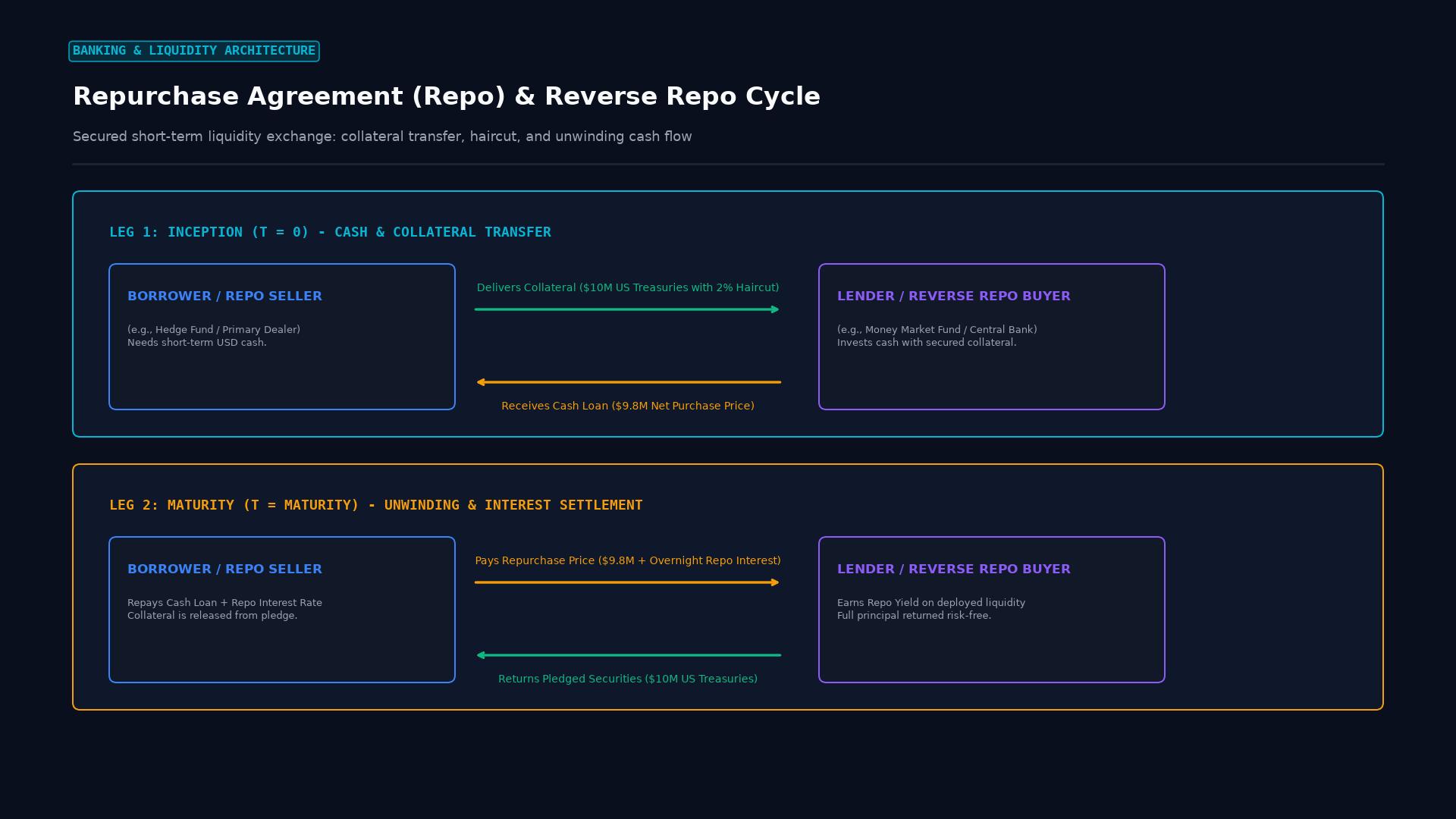 Figure: Two-leg repo transaction mechanics: collateral transfer and cash funding at inception (T=0), followed by repurchase price settlement and collateral return at maturity.
- The Sale: At inception, Party A (the borrower) sells $100 million of U.S. Treasury notes to Party B (the cash lender).
- The Haircut: To protect the cash lender against fluctuations in bond prices during the loan term, the lender applies a discount known as a haircut (for instance, 2%). The lender provides $98 million in cash against the $100 million bond pledge.
- The Repurchase: On the agreed future date (typically the next morning for an overnight repo), Party A buys back the exact same securities at a slightly higher predetermined repurchase price. The difference between the original cash amount and the repurchase price constitutes the interest paid on the loan.
The Repo Rate Formula
The annualized interest rate earned by the cash lender—known as the Repo Rate—is computed as follows:
$$\text{Repo Rate} = \left(\frac{\text{Repurchase Price} - \text{Initial Sale Price}}{\text{Initial Sale Price}}\right) \times \left(\frac{360}{\text{Days to Maturity}}\right) \times 100$$
Repo vs. Reverse Repo: Two Sides of the Same Coin
Whether a transaction is termed a repo or a reverse repo depends entirely on the perspective of the participating counterparty:
- Repurchase Agreement (Repo): From the borrower’s perspective—selling securities today and repurchasing them later to raise cash.
- Reverse Repurchase Agreement (Reverse Repo): From the lender’s perspective—purchasing securities today with cash and selling them back later to earn interest.
Central banks frequently use reverse repos to drain excess liquidity from the commercial banking sector. For example, the Federal Reserve’s Overnight Reverse Repo Facility (ON RRP) allows money market mutual funds to park hundreds of billions of dollars of cash overnight at the Fed, setting a rigid administrative floor beneath the federal funds rate.
Why the Repo Market Matters to Forex Traders
While retail forex traders rarely trade repos directly, repo market conditions dictate global currency liquidity and foreign exchange swap pricing:
1. The Global Dollar Funding Squeeze
Because the U.S. dollar is the world’s reserve currency, international financial institutions require massive amounts of daily dollar cash to settle foreign exchange and trade obligations. When liquidity in the U.S. repo market dries up, foreign banks face severe dollar shortages, causing the spot U.S. dollar to spike aggressively in forex markets.
2. The September 2019 US Repo Market Shock
In mid-September 2019, a confluence of corporate tax payment deadlines and heavy U.S. Treasury debt issuance drained bank cash reserves. Overnight repo interest rates exploded from 2.0% to nearly 10.0% within hours. The Federal Reserve was forced to step in with emergency overnight lending facilities to prevent a broader financial contagion. In forex markets, the sudden scramble for cash triggered widespread volatility across major USD pairs.
3. Direct Foundation for SOFR
Following the discontinuation of LIBOR, the Secured Overnight Financing Rate (SOFR)—the premier global dollar interest rate benchmark—is calculated directly from actual overnight transactions in the U.S. Treasury repo market, anchoring hundreds of trillions of dollars in derivatives and currency swaps.
Key Takeaways
- Collateralized Financing: A repo is a short-term, secured loan where securities are sold with a binding agreement to buy them back at a higher price.
- Financial Plumbing: The repo market provides trillions of dollars in daily liquidity to commercial banks, primary dealers, and money market funds.
- The Haircut Buffer: Cash lenders apply a percentage discount to the collateral to protect against bond price volatility during the loan term.
- Policy Rate Anchor: Central banks utilize repo and reverse repo operations as their primary monetary transmission lever to keep interbank rates inside target corridors.
- Forex Market Connection: Strains in repo funding create immediate offshore dollar shortages, driving sharp volatility in spot forex and currency swap rates.
Frequently Asked Questions
What securities are used as collateral in repo transactions?
U.S. Treasuries, government agency debt, and sovereign bonds from major economies (such as German Bunds or UK Gilts) form the vast majority of repo collateral due to their zero credit risk and immense liquidity. Lower-grade corporate bonds or equities can be used in “credit repos,” but require substantially larger haircuts.
What is the typical duration of a repo trade?
The overwhelming majority of repos are overnight contracts lasting just 24 hours. However, parties can also execute “term repos,” which run for designated durations such as one week, one month, or up to three months.
How does the repo market affect cross-currency basis swaps?
When dollar liquidity becomes scarce in the repo market, foreign banks must pay a higher premium in the cross-currency basis swap market to borrow U.S. dollars against their local currency reserves (such as euros or yen), making foreign exchange hedging significantly more expensive.
Ready to trade forex?
Open a free demo account with a regulated broker. Practice with virtual funds before risking real money.