Monetary Tightening
Monetary tightening is a contractionary policy executed by a central bank to rein in an overheating economy and curb inflation by raising benchmark interest rates, increasing reserve requirements, and reducing liquidity across the financial system.
Monetary tightening—frequently referred to as hawkish or contractionary monetary policy—is an macroeconomic strategy enacted by central banks to slow down economic expansion, prevent speculative financial bubbles, and combat escalating consumer price inflation.
When sustained consumer demand and rapid credit growth push an economy beyond its productive capacity, wages and prices rise unsustainably. Central banks respond by making money more expensive to borrow and scarcer in the banking sector. In global foreign exchange markets, central bank tightening cycles are major catalysts for long-term structural currency bull markets.
The Toolkit of Monetary Tightening
Central banks deploy several complementary policy tools to tighten monetary conditions:
| Policy Tool | Mechanism of Action | Economic Objective |
|---|---|---|
| Policy Rate Hikes | Increasing benchmark overnight rates (e.g., the Federal Funds Rate or ECB Deposit Rate) | Directly elevates commercial bank prime rates, raising borrowing costs on mortgages, auto loans, and corporate lines of credit. |
| Quantitative Tightening (QT) | Halting the reinvestment of maturing government bonds or actively selling securities off the balance sheet | Siphons excess cash reserves out of the interbank banking system and puts upward pressure on long-term bond yields. |
| Reserve Requirement Increases | Raising the mandatory cash percentage commercial banks must hold in vault reserves | Constrains commercial bank lending capacity, limiting the creation of new bank credit. |
| Hawkish Forward Guidance | Issuing official economic projections and speeches indicating sustained high future interest rates | Anchors market expectations and pushes market yield curves higher across all maturities. |
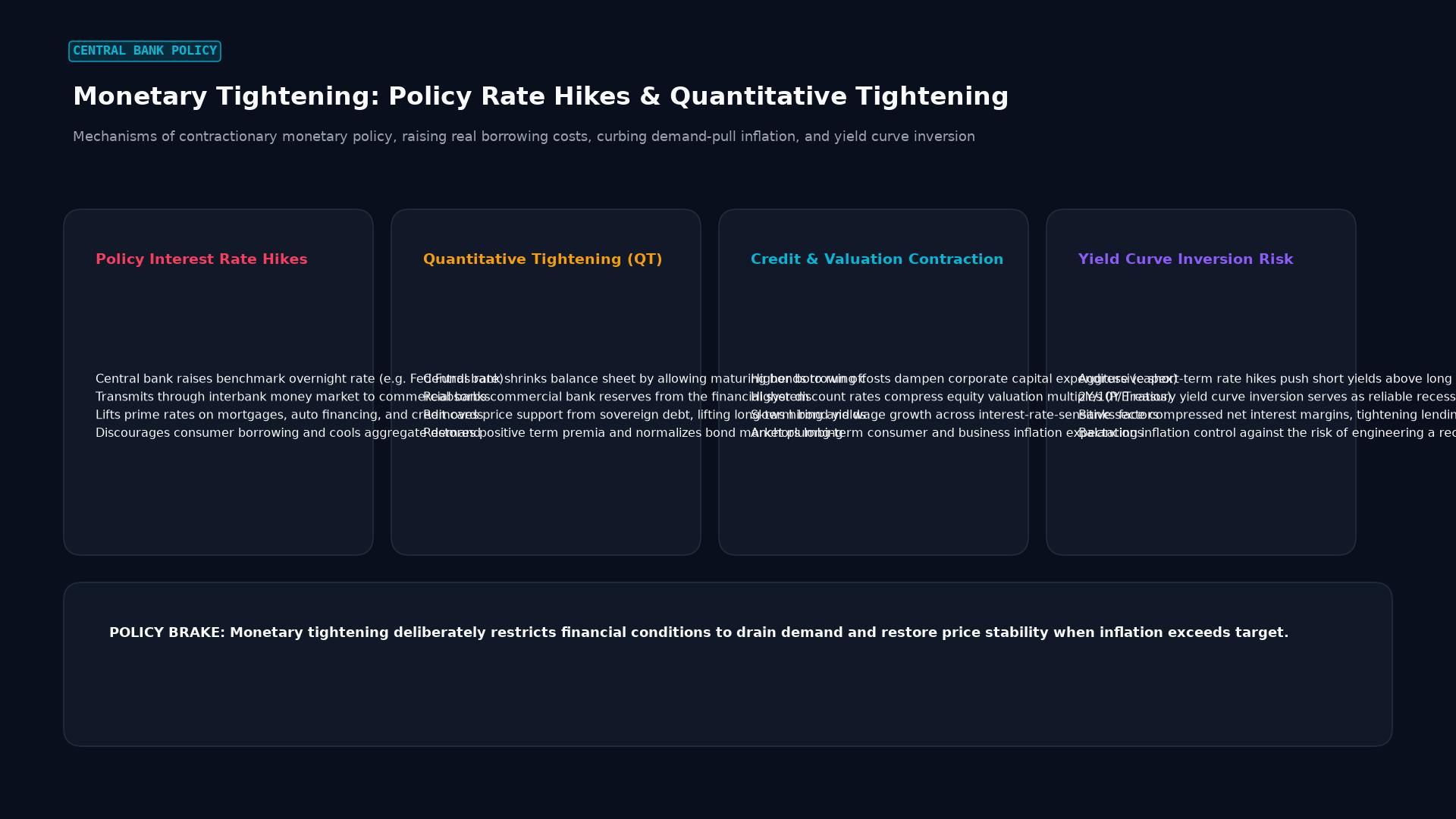 Figure: Mechanisms of contractionary monetary policy, raising real borrowing costs, curbing demand-pull inflation, and yield curve inversion
The Economic Transmission Mechanism
Monetary tightening cools the economy through three primary channels:
- Credit Contraction: Higher interest rates disincentivize borrowing. Businesses cancel or postpone capital expenditure projects, while consumers pull back on financing large ticket items like automobiles and homes.
- Asset Valuation Compression: As risk-free government bond yields rise to attractive levels, capital rotates out of speculative equities and real estate. Falling asset valuations reduce paper wealth (a negative wealth effect), cooling consumer spending.
- Cooling Labor Markets: As corporate profit margins compress and borrowing costs mount, business hiring slows, vacancy rates fall, and wage growth decelerates, breaking the potential for an entrenched wage-price inflation spiral.
Impact on Foreign Exchange Markets
In currency trading, monetary tightening is a primary catalyst for currency appreciation:
- Interest Rate Differentials and Carry Flows: International institutional capital—including sovereign wealth funds and global pension managers—continuously seeks higher risk-adjusted yields. When a central bank embarks on an aggressive tightening cycle while other central banks lag behind, capital rushes into the tightening nation’s short-term government debt and money-market instruments, driving upward demand for its currency.
- The “Terminal Rate” Expectation: Currency markets trade forward expectations rather than current headlines. An exchange rate does not merely rise on the day a rate is hiked; it rallies as traders price in how high the ultimate “terminal rate” (the peak interest rate of the cycle) will reach.
Practical Example: The Historic Federal Reserve Tightening Cycle (2022)
The 2022 macroeconomic environment provided a historic demonstration of monetary tightening in currency markets:
- The Inflation Shock: In mid-2022, U.S. Consumer Price Index (CPI) inflation breached 9.1%, reaching a 40-year high driven by post-pandemic supply shortages and stimulus liquidity.
- The Aggressive Response: The U.S. Federal Reserve initiated the fastest tightening cycle in four decades, delivering consecutive 75-basis-point rate increases that lifted the Federal Funds Rate from near 0.00% to over 4.25% in less than ten months, while simultaneously shrinking its balance sheet by $95 billion per month via Quantitative Tightening.
- The Divergence: During the same window, the Bank of Japan remained committed to ultra-loose yield curve control (keeping rates negative), while the European Central Bank delayed its initial rate hike until July 2022.
- Market Outcome:
- The U.S. Dollar Index (DXY) surged from 96.00 to a 20-year peak above 114.75.
- EUR/USD plummeted from 1.1500 to break below parity, touching a low of 0.9535.
- USD/JPY soared from 115.00 to over 151.90, illustrating the massive directional force exerted by aggressive monetary tightening.
Risks of Overtightening: The “Hard Landing” Trap
While monetary tightening is essential to prevent hyperinflation, tightening too fast or holding rates too high for too long introduces severe structural vulnerabilities:
- The Hard Landing / Recession Risk: Aggressive rate hikes can abruptly choke off business investment and consumer demand, tipping the economy into an unintended recession.
- Financial Fragility and Bank Runs: Rapidly rising interest rates reduce the market value of existing fixed-rate sovereign bonds held by commercial banks. In March 2023, this dynamic triggered the rapid collapse of several U.S. regional banks (including Silicon Valley Bank) and forced the emergency buyout of Credit Suisse in Europe.
Key Takeaways
- Contractionary Mandate: Monetary tightening aims to suppress inflation and cool an overheating economy by increasing borrowing costs and draining banking liquidity.
- Core Mechanisms: Utilizes policy rate hikes, balance sheet reduction (QT), and higher bank reserve requirements.
- Forex Appreciation Engine: A central bank leading global rate hikes attracts global capital flows, sparking strong structural currency bull runs.
- Terminal Rate Dominance: Currency pairs respond dynamically to shifting market projections of where peak policy rates will land.
- Systemic Spillover: Overtightening risks triggering economic recessions, corporate defaults, and banking sector balance-sheet stress.
Frequently Asked Questions
What is the difference between monetary tightening and quantitative tightening (QT)?
Monetary tightening is the broad policy stance of reducing credit expansion and raising interest rates. Quantitative Tightening is a specific technical tool within that policy where a central bank actively contracts its balance sheet by selling bonds or letting them mature without replacing them.
Why do stock markets typically fall when monetary tightening begins?
Higher interest rates increase corporate debt servicing costs, reduce future discounted cash-flow valuations, and make safe fixed-income assets (like U.S. Treasuries) more attractive relative to risky equities, causing a rotation of capital away from stocks.
How do forex traders know when a tightening cycle is ending?
Traders watch for “dovish pivots”—shifts in central bank communications where policymakers acknowledge that inflation has peaked, remove references to future rate increases, and begin emphasizing downside risks to employment and economic growth.
Ready to trade forex?
Open a free demo account with a regulated broker. Practice with virtual funds before risking real money.