Accrue
To accrue in finance means to accumulate or record revenues, expenses, or interest over time as they are earned or incurred, establishing a legal claim or accounting liability prior to cash receipt or payment.
What Does It Mean to Accrue in Finance?
In accounting, financial management, and capital markets, the verb Accrue refers to the systematic accumulation or recognition of financial claims, rights, expenses, or interest over time.
The concept is derived from the French accroître (to increase) and forms the operational backbone of modern commerce. When an economic event occurs that creates a financial right to receive money or a legal obligation to pay money, that value is said to accrue incrementally with each passing day, regardless of whether a physical cash transaction or formal billing invoice has been executed.
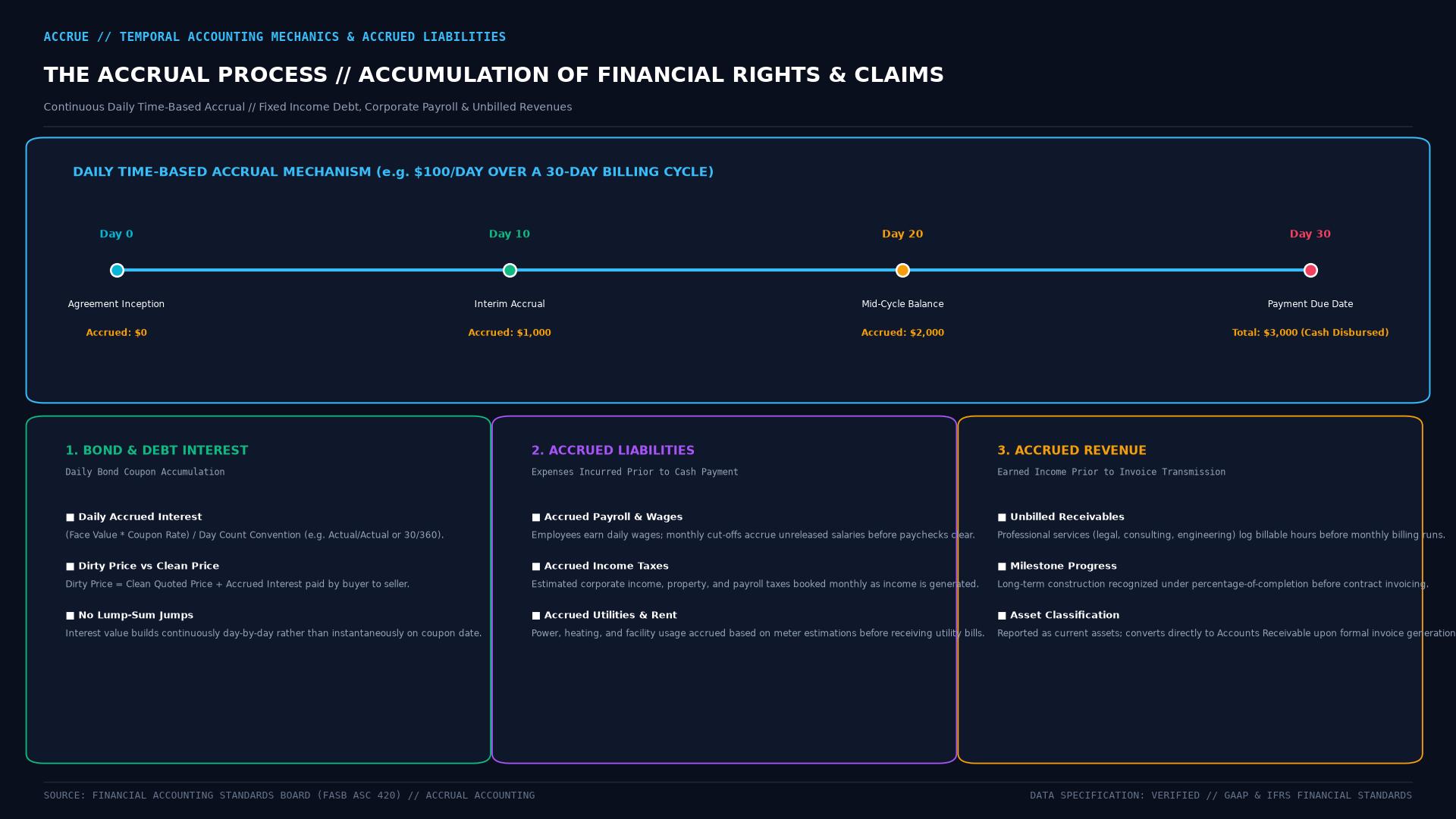 Figure: The operational accrual process across a 30-day billing cycle, illustrating continuous daily time-based accumulation for fixed-income bond interest, accrued corporate liabilities (payroll and taxes), and unbilled accrued revenues.
Technical Mechanics: Primary Applications of Accrual
Financial professionals utilize the accrual mechanism across three major commercial sectors:
1. Fixed-Income Debt & Interest Accrual
In bond markets and commercial lending, interest does not accumulate in a single lump-sum instant on the payment date. Instead, it accrues continuously each calendar day:
Daily Accrued Interest = (Face Value × Annual Coupon Rate) / Day Count ConventionIf an investor purchases a corporate bond halfway between its semi-annual coupon payment dates, the buyer must pay the seller the market price of the bond plus the exact interest that has accrued up to the settlement date.
2. Corporate Expense Accruals (Accrued Liabilities)
Corporations consume operational resources weeks or months before receiving vendor invoices. To reflect liabilities accurately on balance sheets:
- Accrued Payroll: Workers earn wages daily. If the monthly payroll cut-off falls on Friday the 28th, wages earned on the 29th, 30th, and 31st must accrue as an expense and liability in that month, even if paychecks clear the following week.
- Accrued Taxes: Corporations record estimated income, property, and payroll tax liabilities monthly as profits are generated, long before statutory quarterly tax returns are submitted to government authorities.
- Accrued Utilities: Electricity and gas consumed during a billing period are accrued based on meter estimates prior to utility invoice delivery.
3. Revenue Accrual (Unbilled Receivables)
In professional services, long-term construction, and software engineering, companies perform billable work over extended periods. Revenue accrues as hours are logged or project milestones are achieved, recorded on the balance sheet as an asset (Accrued Revenue or Unbilled Accounts Receivable) before formal invoices are transmitted.
Comparative Matrix: Accrue vs. Cash Flow vs. Amortize
| Term | Operational Focus | Balance Sheet Manifestation | Cash Flow Direct Impact |
|---|---|---|---|
| Accrue | Recognizing value or obligations as time elapses | Increases receivables (assets) or payables (liabilities) | Zero immediate cash movement |
| Cash Flow | Physical transfer of liquid monetary funds | Increases or decreases corporate cash deposits | Immediate, verifiable bank cash entry |
| Amortize | Spreading an existing capitalized cost over time | Decreases intangible asset or bond premium carrying value | Non-cash accounting depreciation expense |
| Defer | Delaying revenue/expense recognition until earned | Establishes prepaid asset or unearned revenue liability | Cash was previously exchanged upfront |
Real-World Case Study: Municipal Bond Secondary Market Trade
In September 2024, an institutional fixed-income manager purchased $2,000,000 par value of a 5.0% municipal bond maturing in 2034. The bond pays semi-annual coupons on June 1 and December 1, operating under a standard 30/360 day count convention (each month treated as 30 days, year treated as 360 days).
The trade settled on September 16, exactly 105 days after the previous coupon payment on June 1:
- Annual Coupon Distribution: $2,000,000 × 5.0% = $100,000 per year ($50,000 per semi-annual coupon).
- Daily Interest Accrual Rate: $100,000 / 360 days = $277.78 per day.
- Accrued Interest Owed to Seller:
Total Accrued Interest = 105 days × $277.778 = $29,166.67When settling the purchase, the buyer paid the clean market price of the bonds (e.g., $2,040,000) plus the $29,166.67 of interest accrued during the seller’s holding period, illustrating how interest accrual guarantees equitable compensation across changing bond ownership.
Frequently Asked Questions (FAQ)
What is the difference between an accrued expense and an account payable?
An account payable represents an obligation for which a formal invoice has already been received from a vendor but not yet paid. An accrued expense represents a liability for goods or services consumed where no formal invoice has yet been received from the supplier or creditor.
Can employee vacation and sick time accrue?
Yes. Under standard corporate human resource policies, employees earn (accrue) paid time off (PTO) at a set rate per pay period (for instance, 1.25 vacation days per month worked). Companies must track this accumulated PTO on their balance sheets as an accrued payroll liability because it represents earned compensation the company is legally obligated to disburse upon employee separation.
How does interest accrue on revolving credit card balances?
Credit card issuers calculate interest on a daily basis using an Average Daily Balance (ADB) formula: the annual percentage rate (APR) is divided by 365 to establish a daily periodic rate, which is multiplied daily against the outstanding balance. The accumulated interest accrues continuously throughout the monthly billing cycle and is posted to the statement on the cycle closing date.
Ready to trade forex?
Open a free demo account with a regulated broker. Practice with virtual funds before risking real money.