Accumulated Dividend
An Accumulated Dividend represents unpaid periodic dividends owed to holders of cumulative preferred stock that have accrued due to board omission and must be settled in full before common stockholders receive distributions.
What Is an Accumulated Dividend?
An Accumulated Dividend (frequently referred to in corporate finance and securities law as dividends in arrears) refers to scheduled dividend payments that a corporation owes to holders of cumulative preferred stock but has omitted or deferred.
Unlike corporate bond interest payments, which represent legally binding debt obligations whose omission triggers immediate technical bankruptcy, equity dividends must be formally authorized and declared by a company’s board of directors. When an enterprise experiences a severe cash flow contraction, operating losses, or restrictive debt covenant breaches, the board may choose to suspend quarterly dividend payments.
However, if the corporation issued cumulative preferred shares, the unpaid dividend amounts do not disappear. Instead, they accumulate on a cumulative basis. Under statutory corporate charters, the company is legally barred from paying any cash dividends or initiating share repurchases for common stockholders until every cent of accumulated preferred dividends has been paid in full.
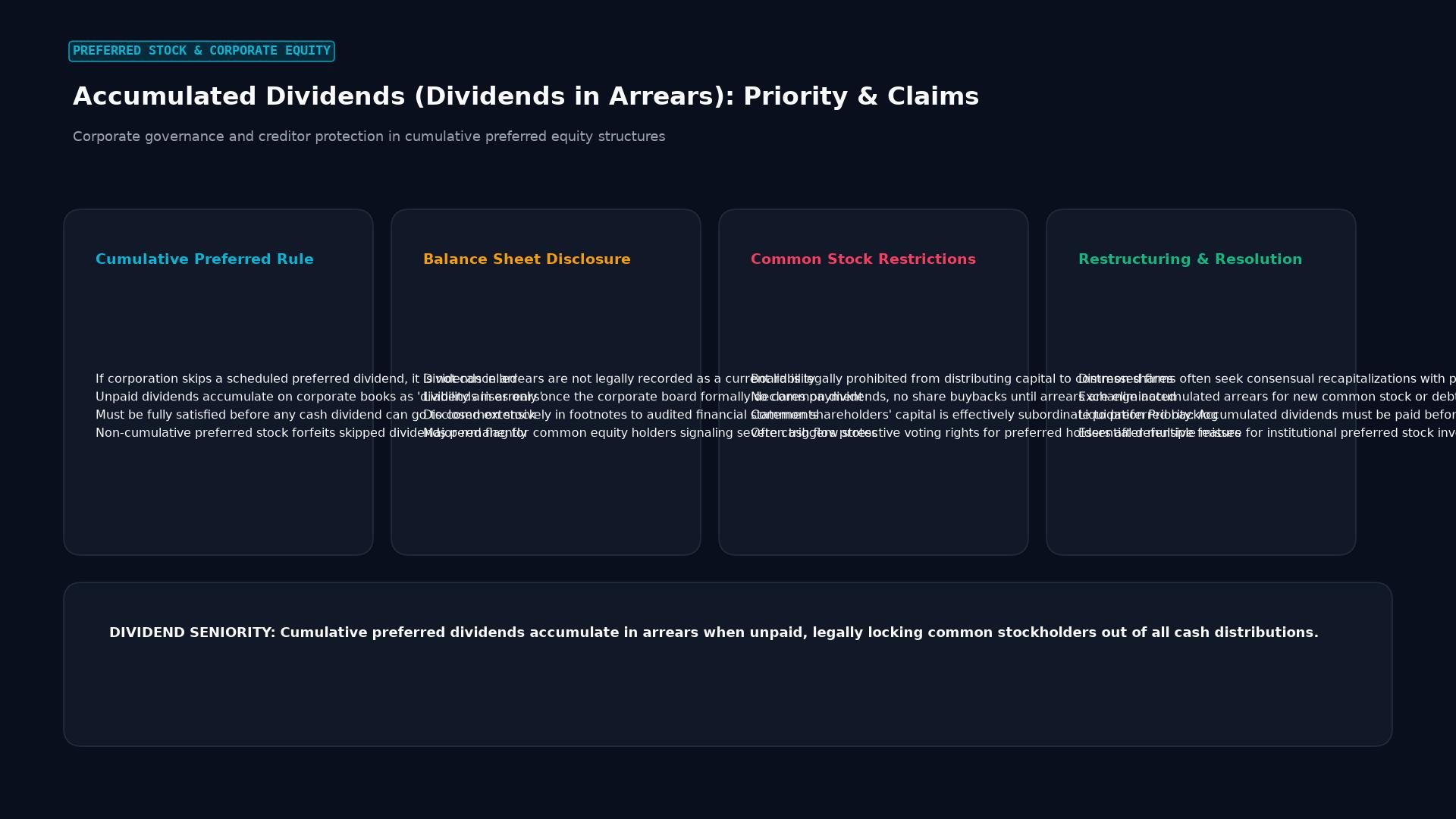 Figure: Corporate governance and creditor protection in cumulative preferred equity structures
Technical Mechanics & Legal Enforceability
The handling of accumulated dividends is governed by specific corporate governance and financial reporting conventions:
1. Balance Sheet Footnote Disclosure vs. Liability Recognition
Accounting standards (US GAAP ASC 505 and IFRS IAS 32) mandate that unpaid cumulative dividends are not recognized as a formal liability on the face of the balance sheet. Because a dividend does not become a legal debt until the board formally declares it, accumulated dividends do not appear under current liabilities.
Instead, corporate accounting requires prominent disclosure in the financial statement footnotes and within the statement of shareholders’ equity, detailing:
- The total dollar amount of dividends in arrears.
- The per-share accumulation figure across each class of preferred stock.
- The contractual restrictions imposed on common share equity capital.
2. Cumulative vs. Non-Cumulative Preferred Stock
- Cumulative Preferred: Every missed dividend accumulates automatically. If an issuer misses four years of 7% dividends on a $100 par issue, it must disburse $28 per share before common shareholders see a dividend.
- Non-Cumulative Preferred: If the board skips a dividend in a given quarter, the right to that payment is permanently extinguished. The issuer can resume paying dividends to common stockholders in subsequent quarters without making up past omissions.
3. Voting Rights and Protective Covenants
Most institutional preferred stock indentures contain protective contingency covenants. If accumulated dividends remain unpaid for a specified consecutive duration (such as six consecutive quarters), cumulative preferred shareholders automatically gain statutory voting rights, including the contractual power to elect dedicated directors to the corporate board.
Comparative Matrix: Cumulative vs. Non-Cumulative vs. Bond Interest
| Financial Dimension | Cumulative Preferred Dividend | Non-Cumulative Preferred Dividend | Corporate Bond Coupon Interest |
|---|---|---|---|
| Legal Nature | Discretionary equity distribution | Discretionary equity distribution | Enforceable contractual debt claim |
| If Missed | Accumulates in arrears indefinitely | Permanently lost and extinguished | Triggers corporate event of default |
| Balance Sheet Status | Disclosed in financial footnotes | Disclosed in financial footnotes | Accrued interest payable (current liability) |
| Common Share Blocker | Blocks all common dividends and buybacks | Blocks common dividends only for current period | Prevents common payouts via debt covenants |
| Tax Treatment to Issuer | Paid from after-tax corporate profit | Paid from after-tax corporate profit | Deductible business interest expense |
Real-World Case Study: Automotive Component Supplier Restructuring
In 2022, an automotive tier-one supplier issued $150 million of 6.5% Cumulative Series A Preferred Stock ($100 par value, 1.5 million shares) to fund factory automation. In 2023 and 2024, semiconductor supply shortages caused corporate operating income to drop by 60%, prompting the board to suspend dividend payments for eight consecutive quarters.
By early 2025, total accumulated dividends reached $13.00 per share ($19.5 million aggregate arrears). When electric vehicle orders surged in late 2025, the company generated $55 million in free cash flow and sought to distribute a special dividend to common shareholders.
Institutional proxy advisors and corporate legal counsel blocked the distribution. To reward common shareholders and avoid preferred board representation covenants, the company first executed a $19.5 million lump-sum catch-up distribution to preferred holders. Only after the transfer agent confirmed that preferred arrears stood at exactly zero did the board authorize distributions to common equity holders.
Frequently Asked Questions (FAQ)
Do accumulated dividends earn compound interest while unpaid?
Generally, no. Unless the corporate charter explicitly specifies a compound penalty dividend clause, accumulated dividends in arrears sit as a static, non-interest-bearing obligation until settled by the board.
What happens to accumulated dividends during a corporate liquidation?
In the event of corporate liquidation or bankruptcy proceedings, cumulative preferred shareholders hold priority over common stockholders. They are entitled to receive their full par value plus all accumulated dividends in arrears before any remaining liquidation proceeds are distributed to common equity holders.
Can an acquiring company cancel accumulated dividends during an acquisition?
In friendly or distressed acquisitions, buyers often negotiate restructuring terms with preferred shareholders. If preferred holders refuse to tender or vote in favor of a merger, the acquirer must either pay off the accumulated dividends in cash or exchange the shares for newly issued securities of equal or greater value containing identical cumulative rights.
Ready to trade forex?
Open a free demo account with a regulated broker. Practice with virtual funds before risking real money.