Accreted Value
Accreted Value is the current balance sheet or theoretical value of a discounted debt instrument, such as a zero-coupon bond, calculated by adding accumulated amortized interest to its initial issue price as it approaches par maturity.
What Is Accreted Value?
In fixed-income mathematics, accounting, and bond portfolio management, Accreted Value represents the imputed, accumulated monetary value of a debt security issued at a discount to its face value (nominal par value).
Most conventional bonds distribute periodic cash interest (coupons) semi-annually or annually to investors. However, zero-coupon bonds, capital appreciation bonds (CABs), and deep-discount notes pay zero interim cash interest. Instead, they are sold at a substantial discount to their maturity face value (for example, purchasing a 10-year bond with a $1,000 par value for $558).
The accreted value is the bond’s calculated worth at any given intermediate point in its lifespan. It reflects the original discounted purchase price plus the accumulated portion of the discount that has earned interest (accreted) up to that specific date. By the time the instrument reaches its final maturity date, its accreted value exactly equals its nominal par value.
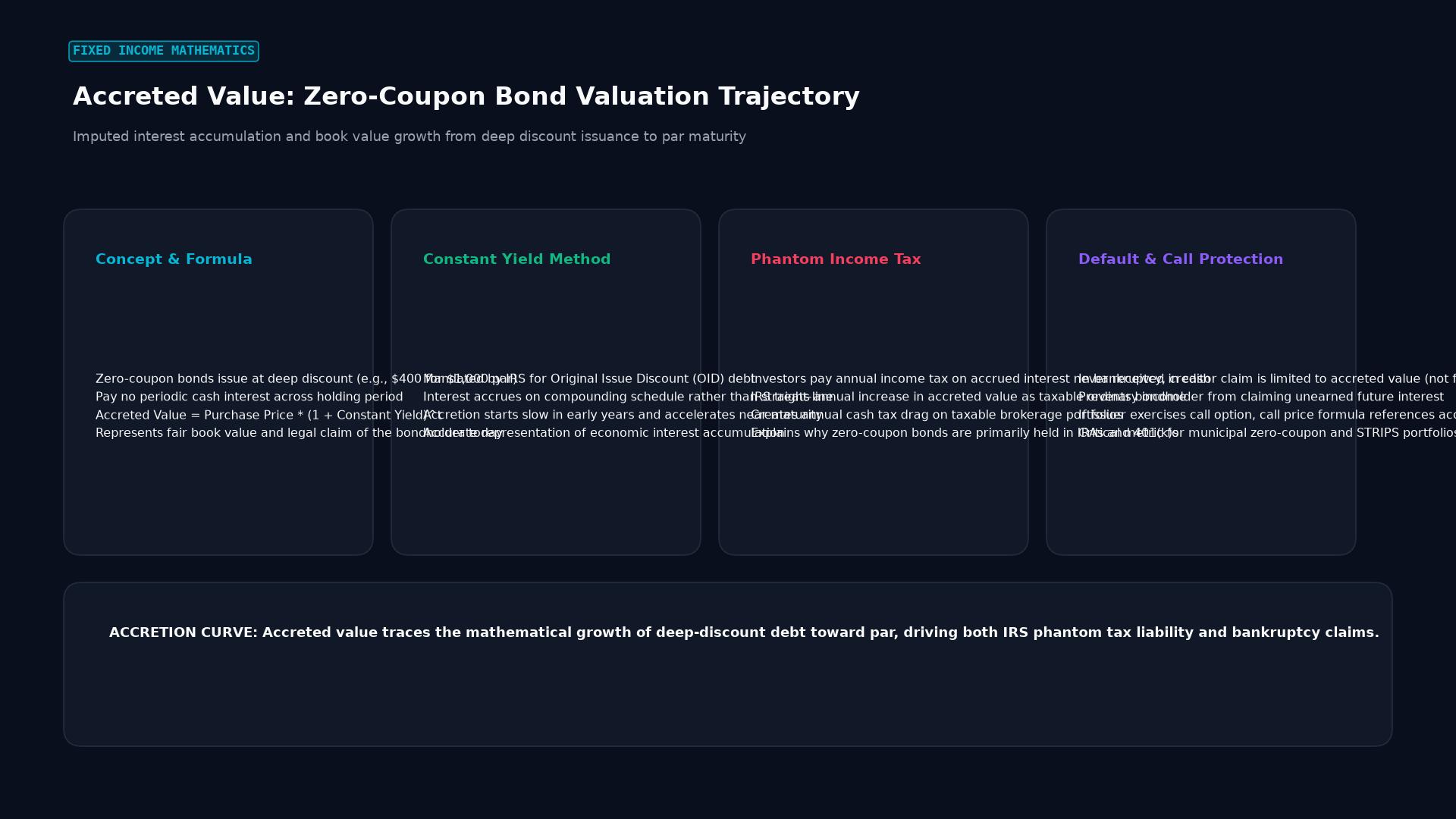 Figure: Imputed interest accumulation and book value growth from deep discount issuance to par maturity
Technical Mechanics & Calculation Methods
Accounting standards (US GAAP ASC 310 / ASC 835 and IFRS 9) as well as tax authorities (such as the US Internal Revenue Service under Original Issue Discount rules) require firms and bondholders to calculate accreted value through standardized methods:
1. The Constant Yield Method (Effective Interest Method)
The constant yield method is the regulatory and institutional benchmark. Rather than recognizing linear amortization, it calculates periodic accretion based on compound interest:
Accreted Value_t = Issue Price × (1 + YTM / m)^(m × t)Where:
- Issue Price: The initial discounted purchase price per bond.
- YTM: The semi-annual Yield to Maturity established at issuance.
- m: Compounding frequency per year (typically 2 for semi-annual bond standards).
- t: Number of years elapsed since the original settlement date.
2. The Straight-Line Method
Under straight-line accretion, the total discount is divided evenly by the total days or months to maturity:
Daily Accretion = (Par Value - Purchase Price) / Total Days to Maturity
Accreted Value = Purchase Price + (Daily Accretion × Days Elapsed)
While straight-line accretion is simpler, GAAP permits its use only when the numerical variance compared to the constant yield method is materially negligible.
3. Tax Phantom Income Implications
Under IRS tax codes, holders of taxable zero-coupon bonds must declare the annual change in accreted value as taxable ordinary interest income each year, even though they receive zero physical cash distributions until maturity. This phenomenon is known as phantom income (or imputed interest), making unregistered zero-coupon debt popular primarily within tax-deferred retirement accounts (IRAs) or sovereign and municipal tax-exempt issues.
Comparative Matrix: Accreted Value vs. Fair Market Value
| Financial Parameter | Accreted Value | Fair Market Value (Clean Market Price) | |—|—|—|—| | Underlying Driver | Pure mathematical compounding of original yield to maturity | Current secondary market supply, demand, and interest rates | | Sensitivity to Rates| Completely unaffected by benchmark market rate fluctuations | Highly volatile; inversely correlated with prevailing yields | | Accounting Role | Amortized cost basis reported on balance sheets | Mark-to-market trading asset valuation | | Call Option Base | Benchmark floor price used in early bond redemption covenants | Prevailing quote on secondary electronic dealer networks | | At Maturity | Exactly equals face value ($1,000 par) | Converges to face value ($1,000 par) |
Real-World Case Study: Municipal Capital Appreciation Bond Call
In 2018, a state transportation agency issued 20-year Zero-Coupon Capital Appreciation Bonds (CABs) to fund highway expansion, issuing $50 million in aggregate par value at an initial discounted price of $19.45 million (reflecting a 5.0% semi-annual compound yield to maturity).
The bond indenture contained an extraordinary early call covenant exercisable at Year 6 at 102% of accreted value.
By Year 6 (2024), prevailing market interest rates had declined to 3.25%, creating an opportunity for the authority to refinance its debt. The fiscal trustee calculated the exact accreted value:
Accreted Value (Year 6) = $19.45 million × (1 + 0.05 / 2)^(2 × 6) = $19.45 million × (1.025)^12 = $26.16 million
Call Redemption Price (102%) = $26.16 million × 1.02 = $26.68 million
The municipality exercised the call, redeeming the bonds for $26.68 million. While secondary market quotes had soared to $31 million due to falling market interest rates, the legal structure bound bondholders to accept the formulaic accreted value plus premium, saving the public issuer over $4.3 million in refinancing costs.
Frequently Asked Questions (FAQ)
What happens to accreted value if prevailing interest rates rise sharply?
Accreted value does not change when secondary market interest rates rise or fall. It is a contractual mathematical amortization schedule established at the moment of issuance based on original yield to maturity. However, the bond’s fair market value will decline below its accreted value if prevailing interest rates rise.
How is accreted value treated in corporate bankruptcies?
If a corporation issuing zero-coupon debt files for bankruptcy protection before maturity, the bankruptcy court does not grant bondholders a claim for the full future par value ($1,000). Instead, the allowable claim against the debtor’s bankruptcy estate is legally limited to the bond’s accreted value as of the petition filing date.
Can accreted value apply to preferred stock?
Yes. Cumulative or redeemable preferred stock issued at a discount or carrying mandatory liquidation accretion features tracks accreted value on corporate balance sheets, reflecting the expanding equity redemption claim over time.
Ready to trade forex?
Open a free demo account with a regulated broker. Practice with virtual funds before risking real money.