Accrual Bond
An Accrual Bond, frequently designated as a Z-bond or Z-tranche in structured credit, is a fixed-income security that defers periodic cash coupon payments, compounding interest directly into the principal balance until maturity or the retirement of senior tranches.
What Is an Accrual Bond?
An Accrual Bond (most prominently recognized in structured mortgage markets as a Z-Bond or Z-Tranche) is a specialized fixed-income debt security that defers regular cash coupon payments. Instead of distributing semi-annual or monthly cash interest checks to investors, the earned interest accrues and is added directly to the principal face value of the bond, compounding over time.
While plain-vanilla bonds pay continuous cash income throughout their term, an accrual bond reinvests all earned interest automatically back into the debt instrument. Investors receive cash payments only after a specified deferral period has expired, upon final maturity, or, in the context of Collateralized Mortgage Obligations (CMOs), after preceding senior bond tranches have been completely paid off.
Accrual bonds serve as vital building blocks in structured finance, allowing bond issuers to direct cash flow to pay down senior short-term tranches while offering long-term institutional investors guaranteed compound returns free from interim reinvestment risk.
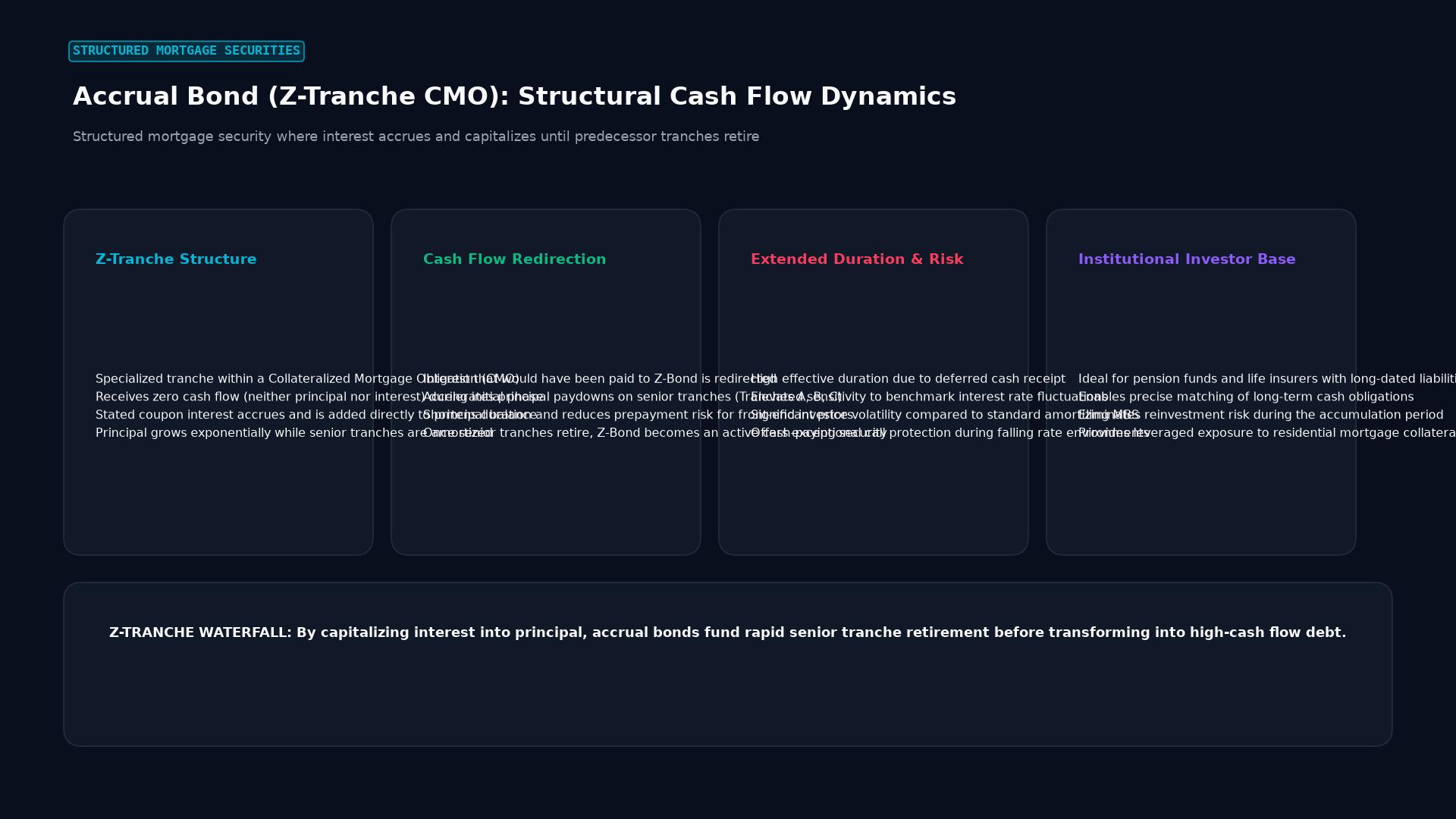 Figure: Structured mortgage security where interest accrues and capitalizes until predecessor tranches retire
Technical Mechanics of Accrual Bonds
Accrual bonds operate through distinct compounding and cash distribution mechanisms:
1. The Principal Accretion Equation
During the accrual phase, the bond’s stated principal balance expands systematically at the contractual coupon rate:
Principal_t = Principal_(t-1) × [1 + (Coupon Rate / Compounding Periods per Year)]If an investor holds a $1,000,000 face value accrual bond with a 6.0% annual coupon compounded semi-annually, after one year of deferral the principal balance expands to $1,060,900 ($1,000,000 × 1.03^2), with subsequent interest calculated against the enlarged principal balance.
2. The CMO Waterfall Role
In structured real estate and asset-backed transactions, the Z-tranche acts as a financial shock absorber:
- The cash interest that would normally be disbursed to the Z-bondholder is diverted to accelerate the principal retirement of the senior Class A and Class B notes.
- This diversion significantly shortens the average life and lowers the prepayment risk for short-duration institutional investors (such as commercial bank treasury desks).
- Once the senior tranches are extinguished, the “lockout” period on the Z-bond terminates, and all subsequent collateral cash flows are channeled to pay down the accrued Z-bond principal.
3. Reinvestment Risk vs. Duration Volatility
- Elimination of Reinvestment Risk: In a declining interest rate environment, conventional bondholders face the challenge of reinvesting coupon cash at lower prevailing yields. An accrual bond locks in the initial yield across the entire accrual window.
- Amplified Duration and Price Sensitivity: Because all cash flows are pushed into the distant future, accrual bonds exhibit extremely long Macaulay Duration. When market benchmark interest rates rise, the secondary market price of an accrual bond falls far more steeply than that of a standard coupon-bearing security.
Comparative Matrix: Accrual Bond vs. Zero-Coupon vs. Standard Bond
| Dimension | Accrual Bond (Z-Tranche) | Traditional Zero-Coupon Bond | Standard Coupon Bond |
|---|---|---|---|
| Issue Price | Issued at par ($1,000) or slight discount | Issued at deep discount (e.g., $550) | Issued at or near par ($1,000) |
| Interim Cash Flow | Zero cash during accrual phase; cash begins later | Exactly zero cash flow until final maturity | Regular semi-annual or annual cash coupons |
| Principal Balance | Grows continuously via interest accretion | Static nominal par value ($1,000) | Static nominal par value ($1,000) |
| Maturity Structure | Variable; tied to underlying loan amortizations | Fixed, definitive maturity date | Fixed, definitive maturity date |
| Primary Use Case | CMO tranching, pension liability matching | Defeasance, targeted college savings, IRAs | Income generation, general treasury funding |
Real-World Case Study: Pension Liability Immunization
In 2020, a corporate pension fund needed to fund guaranteed annuity obligations maturing in 2035 and 2036 totaling $45 million. With 10-year Treasury yields near historical lows (1.20%), fund managers faced severe reinvestment risk if they purchased standard corporate bonds, as interim coupons would have to be reinvested at uncertain future rates.
The fund allocated $22 million into an institutional CMO Z-Tranche yielding 5.40% contractual accrual with an estimated 15-year weighted average life.
Between 2020 and 2028, senior mortgage tranches absorbed all collateral principal, while the pension fund’s Z-bond balance accreted from $22.0 million to $33.5 million. By 2030, with senior tranches retired, the Z-tranche began distributing massive monthly cash flows directly aligned with the fund’s scheduled pensioner payouts, successfully immunizing the fund’s future liabilities without suffering coupon reinvestment slippage.
Frequently Asked Questions (FAQ)
Are accrual bonds subject to annual income tax if no cash is received?
Yes. Similar to zero-coupon bonds, taxable accrual bonds are subject to Original Issue Discount (OID) taxation under US tax law. Investors must report the annual accrued, uncollected interest as taxable ordinary income in the year it compounds, making them best suited for tax-exempt pension funds or tax-deferred accounts.
What causes a Z-bond’s payout phase to begin earlier than expected?
In a Collateralized Mortgage Obligation, a Z-bond’s cash payout begins early if homeowners in the underlying mortgage pool refinance their mortgages at accelerated rates (high prepayment speeds). Rapid prepayments retire the preceding senior tranches ahead of schedule, terminating the Z-bond’s accrual lockout early.
Can an accrual bond suffer principal default?
Yes. If default rates on the underlying collateral pool exceed initial credit enhancement buffers (such as overcollateralization and subordinated tranches), the Z-bond can experience credit impairment, reducing the ultimate principal recovered.
Ready to trade forex?
Open a free demo account with a regulated broker. Practice with virtual funds before risking real money.