Actuals
Actuals in commodity markets refers to real physical goods available for immediate delivery and ownership, as opposed to derivative futures contracts; in corporate finance, it denotes verified historical accounting results versus projections.
What Are Actuals?
In commodities trading, financial planning, and macroeconomic analysis, the term Actuals operates across two major commercial contexts:
- Physical Commodities (Actuals / Physicals): In commodity and mercantile exchanges, actuals refers to the tangible, physical goods themselves (such as thousands of bushels of corn, barrels of West Texas crude oil, metric tons of copper cathodes, or bales of cotton) that require physical handling, warehousing, and delivery, as opposed to paper derivative contracts.
- Corporate Financial Performance (Actuals vs. Forecast): In corporate finance, accounting, and equity research, actuals designates verified historical financial data (such as actual Q3 revenue or audited earnings) as distinguished from budgeted targets, executive forecasts, or Wall Street analyst consensus estimates.
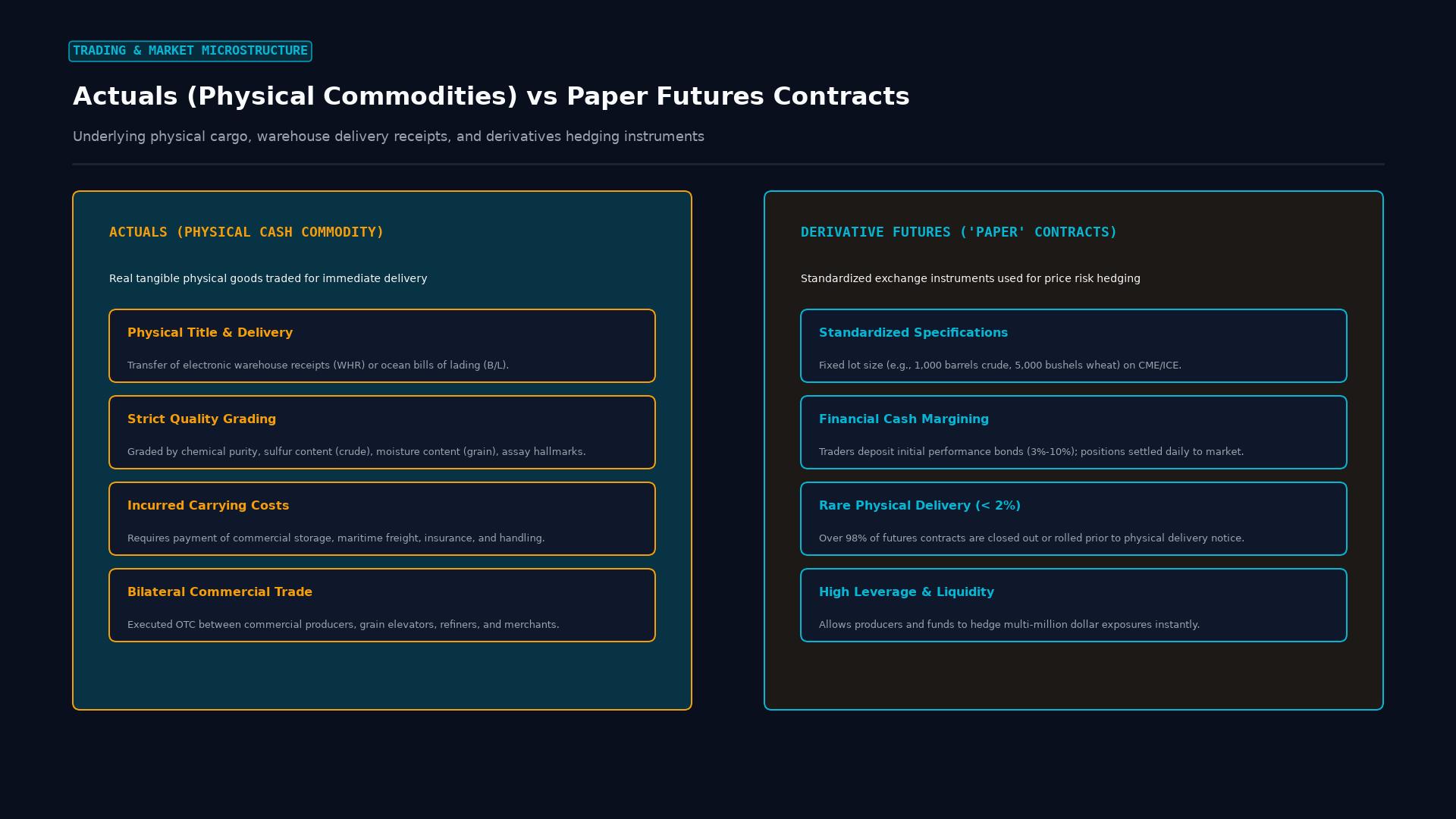 Figure: Physical cash commodity trading (‘Actuals’) featuring electronic warehouse title receipts, physical assay grading, and maritime transport versus standardized financial futures hedging.
Technical Mechanics in Commodity Markets
Trading actuals requires specialized legal and operational arrangements governing physical handling:
1. Negotiable Warehouse Receipts
In modern commodity bourses, traders rarely touch physical sacks of wheat or copper bars. Instead, physical ownership is traded via Warehouse Receipts or Electronic Vault Warrants issued by exchange-approved depositories. A warehouse receipt certifies that a specific quantity, grade, and weight of a commodity is stored in a designated facility, allowing physical actuals to be bought, sold, and pledged as loan collateral across global trade desks without moving the underlying freight.
2. Spot Premiums and Location Differentials
The pricing of physical actuals reflects real-world logistical frictions:
- Free On Board (FOB): The seller delivers the actuals onto a vessel designated by the buyer at a specific port; buyer pays marine insurance and shipping freight.
- Cost, Insurance, and Freight (CIF): The seller covers transport and marine insurance to the destination discharge port.
- Grade Differentials: Physical agricultural commodities are graded based on protein content, moisture levels, and foreign matter, with actuals trading at explicit premiums or discounts relative to base exchange specifications.
Technical Mechanics in Corporate Finance: Variance Analysis
In corporate financial planning and analysis (FP&A), evaluating actuals is the core tool for operational governance through Variance Analysis:
Budget Variance = Actual Result - Budgeted Target- Favorable Variance: Occurs when actual revenues exceed budget, or actual operating expenses come in below projections.
- Unfavorable Variance: Occurs when actual costs exceed budget, prompting management audits into supply-chain inflation, production scrap rates, or labor overtime.
Comparative Matrix: Actuals vs. Futures vs. Forward Contracts
| Dimension | Actuals (Physicals) | Futures Contracts | Forward Contracts |
|---|---|---|---|
| Asset Form | Physical, tangible raw materials in storage | Standardized legal exchange contracts | Bilateral private financial agreements |
| Primary Intent | Industrial processing, refining, consumption | Price risk hedging and speculation | Bespoke commercial price fixing |
| Fungibility | Variable; dependent on grade and warehouse | 100% standardized by exchange rules | Non-fungible; customized to counterparty |
| Storage & Carry | Buyer incurs physical storage & insurance costs | Reflected implicitly in futures cost of carry | Handled by commercial delivery terms |
| Settlement | Immediate transfer of physical warehouse title | Cash settlement or exchange delivery cycle | Delivered on agreed future maturity date |
Real-World Case Study: Physical Copper Warehouse Arbitrage
In early 2024, a global metals merchant monitored a price dislocation between physical copper cathodes held in Shanghai bonded warehouses and London Metal Exchange (LME) copper futures.
LME paper copper futures were trading at $9,200 per metric ton, while Chinese industrial demand drove domestic physical actuals to trade at a spot premium of $9,480 per ton ($280 cash premium).
- The Cash-and-Carry Arbitrage: The trading desk bought 5,000 metric tons of physical actuals stored in bonded Rotterdam warehouses at $9,220 per ton while simultaneously selling short London futures contracts at $9,200 to lock in price neutrality.
- Physical Shipping: The merchant loaded the physical actuals onto a container carrier bound for Shanghai.
- Delivery Execution: Upon arrival in Shanghai 35 days later, the merchant delivered the physical actuals into the Chinese spot market at $9,480 per ton, netting an operational profit of $1.3 million after deducting freight and insurance costs, illustrating the profitability of trading physical actuals across international supply lines.
Frequently Asked Questions (FAQ)
What does “trading against actuals” mean?
In agricultural commodity trading, “trading against actuals” occurs when a commercial grain elevator or farmer hedges a physical inventory purchase by selling a corresponding futures contract, later buying back the futures position at the exact moment they sell the physical grain to a flour mill.
How do macroeconomic “actuals” impact currency exchange rates?
When macroeconomic data indicators (such as US Non-Farm Payrolls, Eurozone HICP Inflation, or UK GDP) are released, the market reacts to the difference between the actual reported figure and the consensus forecast. An actual figure that beats expectations typically triggers rapid currency appreciation.
Why do some commodity futures settle in cash instead of actuals?
Many modern commodity derivatives, such as Feeder Cattle, Lean Hogs, and certain energy contracts, utilize cash settlement to eliminate the expensive logistics, transportation costs, and grading disputes associated with inspecting and delivering living animals or complex physical fuel blends.
Ready to trade forex?
Open a free demo account with a regulated broker. Practice with virtual funds before risking real money.