Adjusted Gross Income
Adjusted Gross Income (AGI) is a foundational tax metric defined under US Internal Revenue Code Section 62 that equals total gross income minus specific above-the-line deductions, establishing the benchmark for tax brackets and credit eligibility.
What Is Adjusted Gross Income (AGI)?
In individual taxation, financial planning, and wealth management, Adjusted Gross Income (AGI) is a vital income metric defined under Section 62 of the United States Internal Revenue Code (IRC). It serves as the intermediate gateway connecting an individual or married couple’s total raw earnings to their ultimate federal taxable income.
Reported on line 11 of IRS Form 1040, AGI represents total gross income from all worldwide sources reduced by specific statutory tax deductions known as “above-the-line” adjustments.
AGI is arguably the single most important number on a US personal tax return. Beyond determining the starting point for calculating income taxes, AGI functions as the regulatory baseline that dictates an individual’s eligibility for valuable tax credits, phase-out limits for retirement savings contributions, and statutory deduction floors for healthcare expenses and charitable gifts.
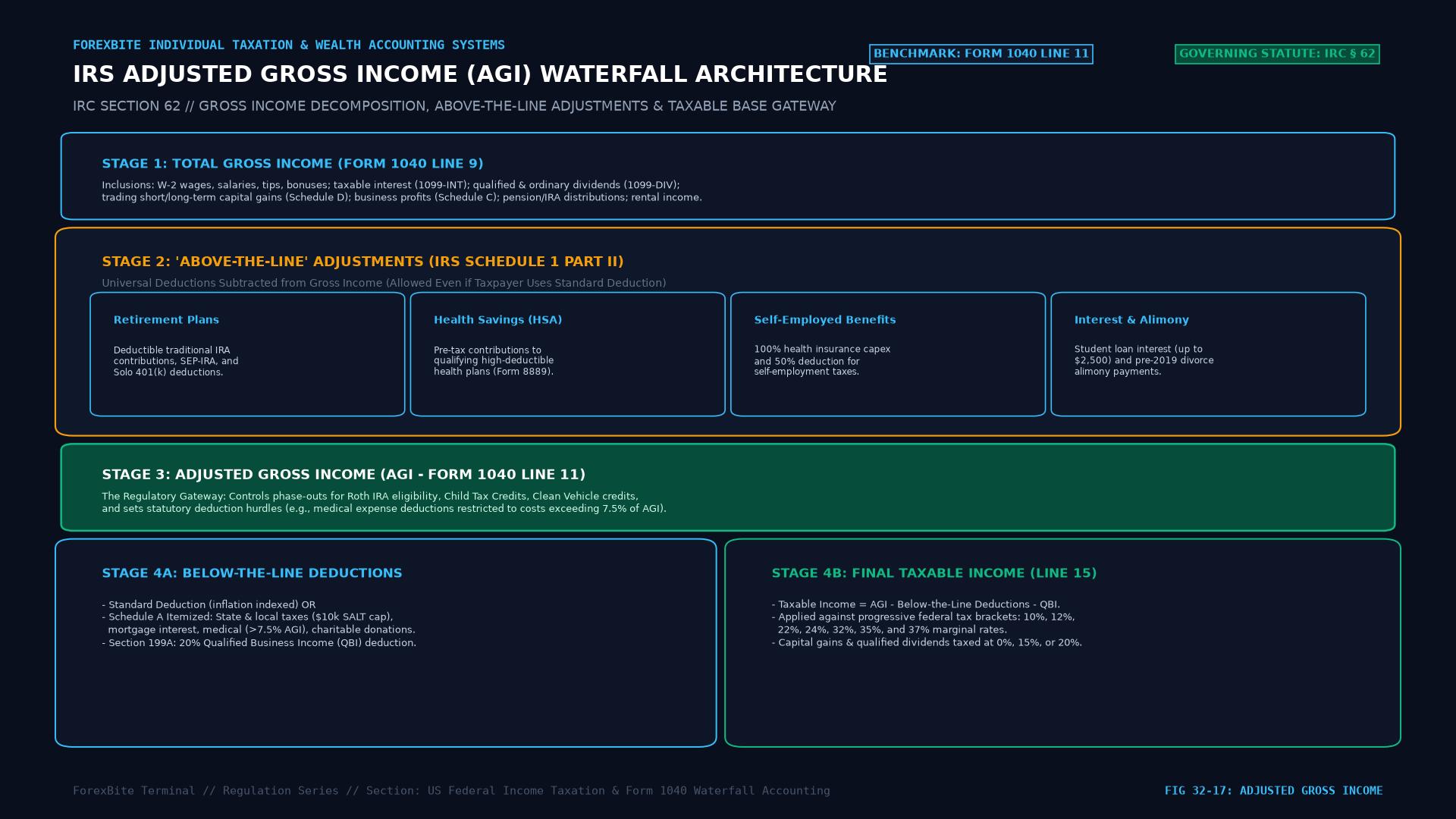 Figure: The statutory IRS waterfall from gross income to Adjusted Gross Income (AGI) via above-the-line deductions, and on to final taxable income.
Technical Mechanics: The AGI Equation
Calculating Adjusted Gross Income involves a precise two-stage statutory formula:
1. Total Gross Income
Includes all non-exempt worldwide monetary compensation received during the calendar tax year:
Gross Income = Wages + Business Profits + Capital Gains + Dividends + Interest + Rental Income + Royalties2. “Above-the-Line” Deductions (Adjustments to Income)
Reported on IRS Schedule 1 (Part II), above-the-line deductions are uniquely powerful because taxpayers can claim them regardless of whether they choose the standard deduction or itemize deductions on Schedule A:
- Retirement Contributions: Deductible contributions to traditional individual retirement accounts (IRAs), SEP-IRAs, and Solo 401(k) plans.
- Health Savings Account (HSA): Pre-tax contributions made directly to qualifying HSAs.
- Self-Employed Benefits: Deductions for 100% of self-employed health insurance premiums and 50% of the self-employment tax liability (SE tax deduction).
- Education Deductions: Student loan interest deductions (capped at $2,500 subject to phase-outs) and eligible classroom educator expenses.
- Penalties on Early Savings Withdrawal: Penalties assessed by banks for early certificate of deposit (CD) redemptions.
3. The Core Equation
AGI = Total Gross Income - Total Allowable Above-the-Line DeductionsWhy AGI Matters: The Gatekeeper of Tax Benefits
Federal and state tax codes utilize AGI (and its derivative, Modified Adjusted Gross Income - MAGI) to establish phase-outs and floors:
- Medical Expense Deduction Floor: Under Schedule A, taxpayers can deduct unreimbursed medical and dental expenses only to the extent that they exceed 7.5% of their AGI. A lower AGI expands the allowable deductible medical expense.
- Retirement Account Contribution Phase-Outs: Eligibility to contribute directly to a Roth IRA phases out completely above statutory MAGI thresholds (adjusted annually for inflation).
- Net Investment Income Tax (NIIT): A 3.8% surtax applies to investment earnings (dividends, capital gains, passive rental income) for individuals whose MAGI exceeds statutory limits ($200,000 for single filers, $250,000 for married couples filing jointly).
- Child Tax Credit Phase-Out: The $2,000 per-child tax credit begins phasing out by $50 for every $1,000 that a taxpayer’s AGI exceeds $200,000 (single) or $400,000 (married filing jointly).
Comparative Matrix: Gross Income vs. AGI vs. Taxable Income
| Parameter | Gross Income | Adjusted Gross Income (AGI) | Taxable Income |
|---|---|---|---|
| Location on 1040 | Line 9 | Line 11 | Line 15 |
| Deductions Subtracted | Zero deductions applied | Above-the-line adjustments only | Standard or Itemized deductions + QBI |
| Primary Purpose | Quantifies total raw economic intake | Benchmarks tax credit eligibility & phase-outs | The actual dollar base taxed at tax rates |
| State Tax Impact | Rarely used as state baseline | Dominant starting point for most state taxes | Applied after state-specific adjustments |
| Optimization Levers | Limited (deferring income) | HSA, SEP-IRA, 401(k), student loan write-offs | Mortgage interest, state/local tax (SALT), charity |
Real-World Case Study: Strategic AGI Reduction for Tax Credit Preservation
In 2024, a self-employed financial consultant and spouse (filing jointly with two young children) projected gross business revenue of $235,000 with $20,000 in ordinary business expenses, yielding a net self-employment profit of $215,000.
Without proactive tax planning, their projected AGI of $200,000 would begin triggering the phase-out of family educational tax credits while exposing them to higher state income tax brackets:
- Above-the-Line Optimization:
- Contributed $35,000 into a Solo 401(k) plan.
- Contributed $8,300 into a family Health Savings Account (HSA).
- Deducted $12,000 in self-employed family health insurance premiums.
- Deducted $14,000 representing the 50% self-employment tax deduction.
- Total Above-the-Line Deductions: $35,000 + $8,300 + $12,000 + $14,000 = $69,300.
- Outcome:
Adjusted Gross Income (AGI) = $215,000 - $69,300 = $145,700By lowering their AGI from $200,000 to $145,700, the family preserved 100% of their Child Tax Credits, qualified for full educational credits, and reduced their federal and state income tax liability by over $18,400, demonstrating the compounding power of above-the-line tax planning.
Frequently Asked Questions (FAQ)
What is the difference between AGI and Modified Adjusted Gross Income (MAGI)?
MAGI takes your AGI and adds back specific specialized deductions, such as student loan interest deductions, foreign earned income exclusions, or non-taxable Social Security benefits. For the majority of average individual filers with uncomplicated returns, AGI and MAGI are mathematically identical.
Do 401(k) payroll contributions reduce AGI?
Yes. Traditional employer-sponsored 401(k) contributions are deducted pre-tax directly from your paycheck by your employer. They reduce the gross taxable wages reported in Box 1 of your W-2 form, automatically lowering your total gross income before it ever hits line 1 of Form 1040.
Can business losses reduce Adjusted Gross Income?
Yes. If an individual operates an active sole proprietorship, partnership, or S-corporation that experiences legitimate business operating losses, those losses flow through to Schedule 1 and offset ordinary income (subject to passive activity loss rules and statutory excess business loss limitations), directly lowering total AGI.
Ready to trade forex?
Open a free demo account with a regulated broker. Practice with virtual funds before risking real money.