After-tax basis
An after-tax basis is an analytical method that calculates investment yields, corporate cash flows, or individual earnings after deducting applicable federal, state, and local income taxes.
What Is an After-Tax Basis?
An after-tax basis is a method of financial calculation that evaluates the actual net income, investment yield, or cash flow retained by an investor or corporation after subtracting all applicable tax liabilities. While nominal pre-tax figures indicate gross financial returns, they fail to reveal economic reality because differing asset classes, geographic jurisdictions, and holding periods carry radically divergent tax burdens.
Evaluating financial opportunities on an after-tax basis is standard practice across wealth management, fixed-income portfolio construction, and corporate capital budgeting. By normalizing returns to reflect net take-home dollars, analysts eliminate distortions between tax-exempt securities (such as municipal bonds) and fully taxable instruments (such as corporate debt, dividend-paying equities, or real estate investment trusts).
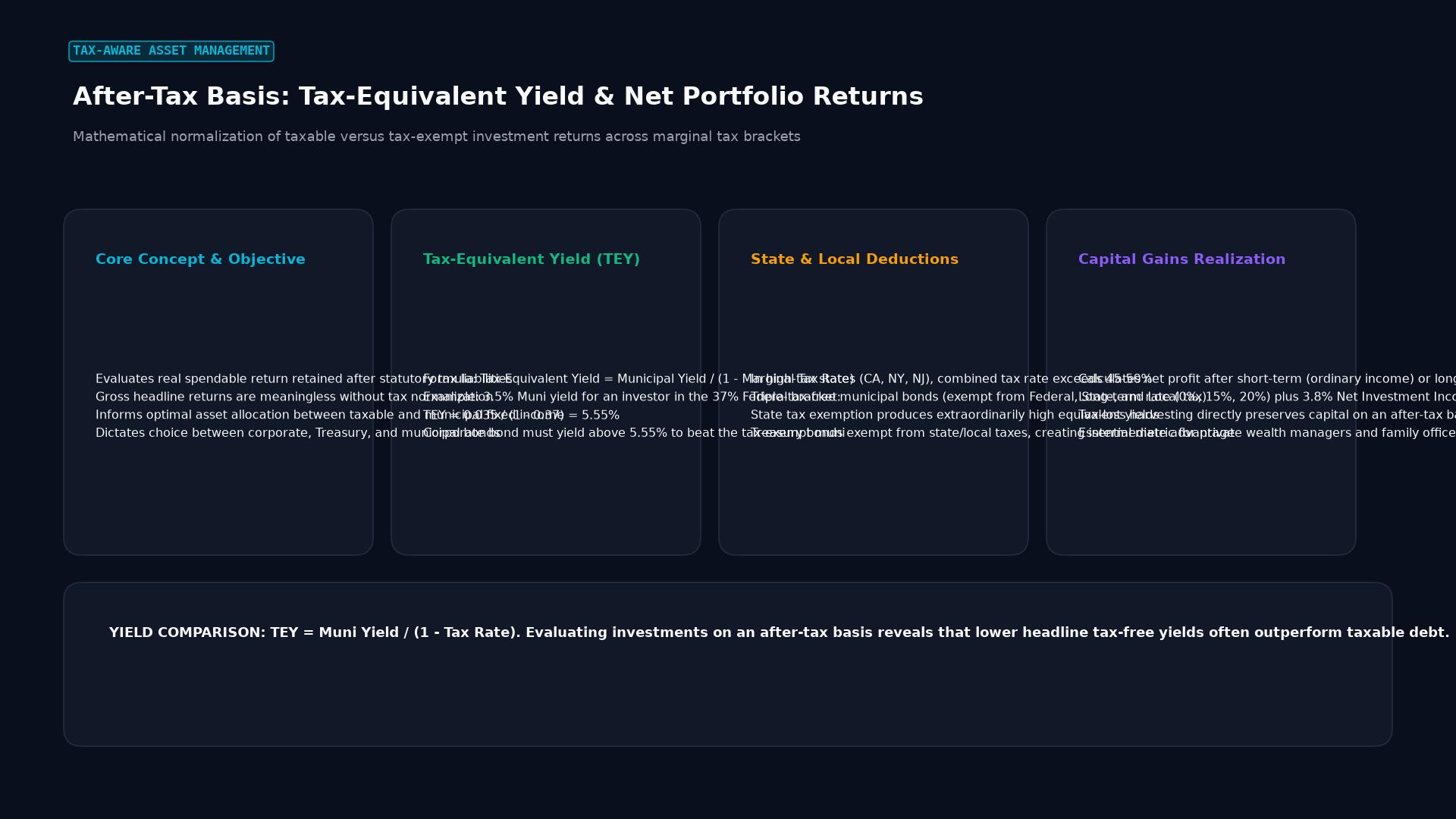 Figure: Mathematical normalization of taxable versus tax-exempt investment returns across marginal tax brackets
Fixed-Income Valuation: Tax-Equivalent Yield (TEY)
The most common application of after-tax analysis occurs when fixed-income investors compare tax-free municipal bonds with taxable corporate or sovereign bonds. Because interest income from municipal bonds is exempt from federal income taxes (and often state taxes for in-state residents), their nominal coupon yields are typically lower than corporate debt of comparable credit rating.
To make an accurate comparison, portfolio managers compute either the After-Tax Yield of the taxable bond or the Tax-Equivalent Yield (TEY) of the tax-exempt bond.
1. After-Tax Yield Formula
$$\text{After-Tax Yield} = \text{Pre-Tax Yield} \times (1 - t)$$
Where $t$ represents the investor’s marginal tax rate. If a corporate bond yields 6.00% and an institutional investor faces a combined marginal tax rate of 35%:
$$\text{After-Tax Yield} = 6.00% \times (1 - 0.35) = 3.90%$$
2. Tax-Equivalent Yield Formula
$$\text{Tax-Equivalent Yield} = \frac{\text{Tax-Exempt Municipal Yield}}{1 - t}$$
If a high-grade municipal bond yields 4.20% tax-free to an individual in the top 37% federal tax bracket:
$$\text{Tax-Equivalent Yield} = \frac{4.20%}{1 - 0.37} = \frac{4.20%}{0.63} = 6.67%$$
Yield Comparison Matrix (37% Tax Bracket):
┌───────────────────────────┬───────────────────────────┐
│ 6.00% Corporate Bond      │ 4.20% Municipal Bond      │
│ (Fully Taxable)           │ (Federal Tax-Free)        │
├───────────────────────────┼───────────────────────────┤
│ Taxes Owed: 2.22% (37%)   │ Taxes Owed: 0.00%         │
│ Net Kept:   3.78%         │ Net Kept:   4.20%         │
└───────────────────────────┴───────────────────────────┘
 Result: The municipal bond yields 42 basis points more net income.
Corporate Finance Applications
In corporate financial strategy, analyzing cash flows on an after-tax basis is required for proper valuation and capital allocation:
1. After-Tax Cost of Debt in WACC
When calculating a corporation’s Weighted Average Cost of Capital (WACC), corporate debt is always evaluated on an after-tax basis. Because interest payments on corporate debt are tax-deductible under most international tax codes, the effective cost of borrowing is reduced by the company’s marginal corporate tax rate ($T_c$):
$$\text{After-Tax Cost of Debt} = K_d \times (1 - T_c)$$
If a corporation borrows at an 8.0% interest rate and faces a 21% corporate income tax rate, its true after-tax cost of capital for debt is only $8.0% \times (1 - 0.21) = 6.32%$.
2. Capital Budgeting and Free Cash Flow
Discounted Cash Flow (DCF) models rely on Net Operating Profit After Tax (NOPAT) rather than gross operating earnings. Depreciation and amortization generate tax shields that preserve cash. Consequently, capital budgeting decisions (NPV and IRR) must incorporate the following after-tax operating cash flow equation:
$$\text{Operating Cash Flow} = (\text{Revenues} - \text{Cash Expenses}) \times (1 - T_c) + (\text{Depreciation} \times T_c)$$
Trading and Active Asset Management Implications
Active traders and forex participants must also monitor after-tax returns across differing transaction structures:
| Asset Class / Instrument | Tax Regime | After-Tax Impact |
|---|---|---|
| Retail Spot Forex (IRC § 988) | Ordinary income rates (up to 37%) | Full marginal rate applies unless trader elects § 988 opt-out |
| Regulated FX Futures (IRC § 1256) | 60% Long-Term / 40% Short-Term | Maximum blended federal rate of 26.8% regardless of trade duration |
| Short-Term Equities (< 1 Year) | Ordinary income tax rates | Subject to standard marginal bracket plus state taxes |
| Long-Term Equities (> 1 Year) | Preferential capital gains rates | Capped at 0%, 15%, or 20% plus 3.8% Net Investment Income Tax |
By utilizing Section 1256 contracts (such as CME currency futures) instead of off-exchange spot forex under Section 988, professional currency traders often achieve a significantly higher net return on an after-tax basis.
Key Takeaways
- An after-tax basis measures the net cash flow or investment yield retained after paying all mandatory income taxes.
- Tax-Equivalent Yield (TEY) allows investors to compare tax-exempt municipal bonds against fully taxable corporate bonds.
- In corporate finance, interest deductibility makes the after-tax cost of debt lower than the nominal interest coupon.
- Tax treatment varies dramatically by financial instrument; currency traders frequently use regulated futures to benefit from lower blended capital gains rates.
Frequently Asked Questions
Why is pre-tax yield misleading for high-net-worth investors?
Pre-tax yield ignores the progressive tax brackets that consume up to 40% to 50% of nominal interest income in high-tax jurisdictions. A corporate bond with an attractive 7% nominal coupon might yield less than 4% on an after-tax basis, underperforming a lower-yielding tax-free municipal bond.
How does depreciation create an after-tax benefit?
Depreciation is a non-cash expense that reduces reported taxable income on the corporate income statement. By lowering taxable earnings, depreciation reduces the amount of cash taxes paid to the government, creating an after-tax “tax shield” that increases retained operating cash flow.
Can investment losses improve an investor’s after-tax portfolio return?
Yes. Through tax-loss harvesting, investors can deliberately realize capital losses to offset taxable capital gains. In many jurisdictions, up to $3,000 of excess capital losses can also offset ordinary income, reducing the overall annual tax liability and boosting net after-tax returns.
Ready to trade forex?
Open a free demo account with a regulated broker. Practice with virtual funds before risking real money.