Advance Refunding
Advance Refunding is a public finance procedure where a municipal or corporate issuer sells new lower-rate bonds more than 90 days prior to the call date of existing debt, placing the proceeds into an escrow account to defease the original debt.
What Is Advance Refunding?
In municipal finance, fixed-income underwriting, and debt management, Advance Refunding (frequently termed prefunding) is a specialized refinancing technique in which a bond issuer issues new bonds at lower prevailing interest rates well in advance of the earliest optional call redemption date of its outstanding higher-interest bonds.
When interest rates drop significantly, a municipal entity (such as a city government, school district, public utility, or airport authority) seeks to refinance its expensive legacy debt to lower annual debt service expenses. However, most municipal bonds contain an optional call protection period, which typically bars the issuer from calling or redeeming the bonds during the first 10 years following issuance.
Advance refunding resolves this constraint. Rather than waiting years for the call date to arrive, the municipality issues new “refunding bonds” immediately, capturing current low market yields. The proceeds from the new offering are placed into an irrevocable escrow trust account invested in US Treasury securities. The cash flows from this escrow fund pay all interest and principal on the old bonds until their call date, at which point the old bonds are formally redeemed and retired.
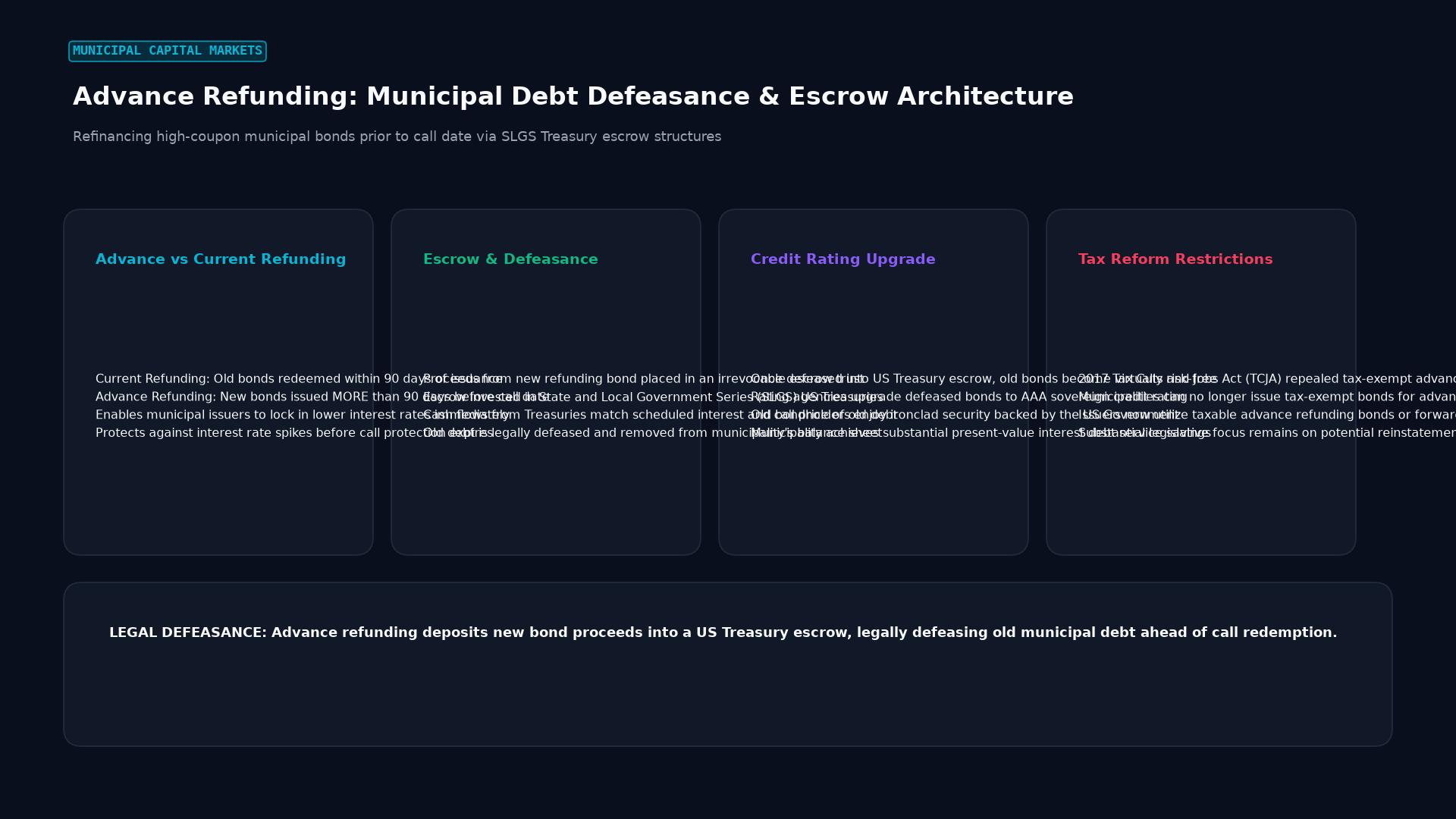 Figure: Refinancing high-coupon municipal bonds prior to call date via SLGS Treasury escrow structures
Technical Mechanics: The Legal Defeasance Process
Advance refunding relies on a legal doctrine known as Defeasance:
1. Legal Defeasance and Balance Sheet Removal
Once the issuer deposits sufficient cash and Treasury securities into an irrevocable escrow account to cover 100% of future principal and interest payments on the old debt, the bond indenture covenants are formally terminated. Under GAAP accounting standards:
- The original bonds are legally deemed paid and removed from the issuer’s balance sheet.
- Original bondholders forfeit their claim against the municipality’s tax revenues or project tolls, instead receiving a direct claim against the risk-free US Treasury escrow account.
- As a result, the credit rating of the old defeased bonds automatically jumps to AAA/Aaa.
2. State and Local Government Series (SLGS) Securities
To structure the escrow account without generating illegal arbitrage profits, municipalities purchase specialized non-marketable US Treasury debt known as SLGS (pronounced “slugs”). The US Bureau of the Fiscal Service issues SLGS with maturities and yield structures customized to match the exact coupon payment dates of the defeased municipal bonds.
3. Current Refunding vs. Advance Refunding
- Current Refunding: The new refunding bonds are issued within 90 days of the optional call date or maturity date of the old bonds.
- Advance Refunding: The new refunding bonds are issued more than 90 days prior to the call date (often three to seven years ahead of schedule).
The Tax Cuts and Jobs Act (TCJA) of 2017 Impact
Prior to 2018, federal tax law permitted municipal issuers to execute one tax-exempt advance refunding per bond issue.
However, the Tax Cuts and Jobs Act of 2017 repealed the federal tax exemption for advance refunding bonds issued after December 31, 2017. As a result:
- Municipalities can no longer issue federal tax-exempt bonds to advance refund existing debt.
- To take advantage of low interest rates today, municipalities must issue Taxable Municipal Advance Refunding Bonds or execute synthetic financial structures like Cinderella Bonds (taxable bonds that convert automatically to tax-exempt status on the call date).
Comparative Matrix: Advance Refunding vs. Current Refunding
| Operational Dimension | Advance Refunding | Current Refunding |
|---|---|---|
| Timing to Call Date | More than 90 days before call date (often years) | Within 90 days of call date or maturity |
| Federal Tax Status | Taxable (post-2017 TCJA tax reform) | Tax-Exempt (if underlying project qualifies) |
| Escrow Requirement | Mandatory irrevocable Treasury escrow account | Temporary settlement escrow (under 90 days) |
| Defeasance Accounting | Full legal defeasance of original debt | Direct redemption without extended defeasance |
| Arbitrage Restriction | Strict yield-burning and SLGS yield ceilings | Minimal escrow arbitrage restrictions |
Real-World Case Study: Water Authority Debt Service Optimization
In 2021, a regional municipal water authority held $120 million in outstanding 30-year revenue bonds issued in 2016 carrying an average coupon of 5.25%. The bonds contained a 10-year call protection clause barring early redemption until June 1, 2026.
With investment-grade corporate and municipal borrowing costs plunging to historic lows in 2021, the water authority’s financial advisory team evaluated an advance refunding:
- The Issue: The authority issued $118 million in Taxable Refunding Bonds at an average fixed interest rate of 2.80%.
- The Escrow Structure: Net proceeds of $116 million were deposited with a corporate trustee and invested in an escrow portfolio of US Treasury notes structured to mature precisely on June 1 and December 1 of each year through 2026.
- Outcome: The escrow cash flows paid all debt service on the original 5.25% bonds through June 2026, at which point the escrow paid off the remaining principal in full.
The transaction delivered net present value (NPV) debt service savings of $14.2 million, reducing annual operational utility expenses and preventing planned municipal water utility rate hikes for local households.
Frequently Asked Questions (FAQ)
What does “crossover refunding” mean?
A crossover refunding is a variation of advance refunding where the escrow account pays debt service on the new refunding bonds until the call date, rather than the old bonds. On the crossover date (the call date), the escrow proceeds redeem the old bonds, and the issuer begins paying debt service on the new bonds from general operating revenues.
What are “Cinderella Bonds” in public finance?
Cinderella bonds are municipal debt instruments issued initially on a taxable basis for an advance refunding, structured to automatically convert to lower-rate tax-exempt bonds on the exact 90-day current refunding call date, “transforming” into tax-exempt debt much like Cinderella at the ball.
Why do investors purchase defeased bonds in secondary markets?
Investors prize defeased municipal bonds because they offer the absolute credit safety of US Treasury debt (which backs the irrevocable escrow) while often trading at slightly higher yields than raw Treasury notes due to secondary market liquidity differences.
Ready to trade forex?
Open a free demo account with a regulated broker. Practice with virtual funds before risking real money.