Adventure Capitalist
An Adventure Capitalist is an unconventional private investor who deploys high-risk growth capital directly into frontier markets, emerging economies, and disruptive early-stage ventures overlooked by traditional institutional venture capital.
What Is an Adventure Capitalist?
In private equity, angel investing, and global macro finance, an Adventure Capitalist is an entrepreneurial investor who specializes in deploying risk capital into unproven startups, frontier economies, and emerging geopolitical markets that traditional institutional venture capital funds avoid.
The term was popularized by famed international investor and hedge fund co-founder Jim Rogers in his best-selling 2003 book Adventure Capitalist: The Ultimate Road Trip, which documented his multi-year journey through 116 countries to discover unheralded investment opportunities across developing nations.
Unlike conventional Silicon Valley venture capitalists who invest institutional capital from air-conditioned office boardrooms into software applications, an adventure capitalist frequently operates on the ground in developing regions across Southeast Asia, Sub-Saharan Africa, Latin America, and Central Asia. They seek out structural inefficiencies, currency mispricings, infrastructure deficits, and local entrepreneurial talent, trading high political and liquidity risk for extraordinary asymmetric investment returns.
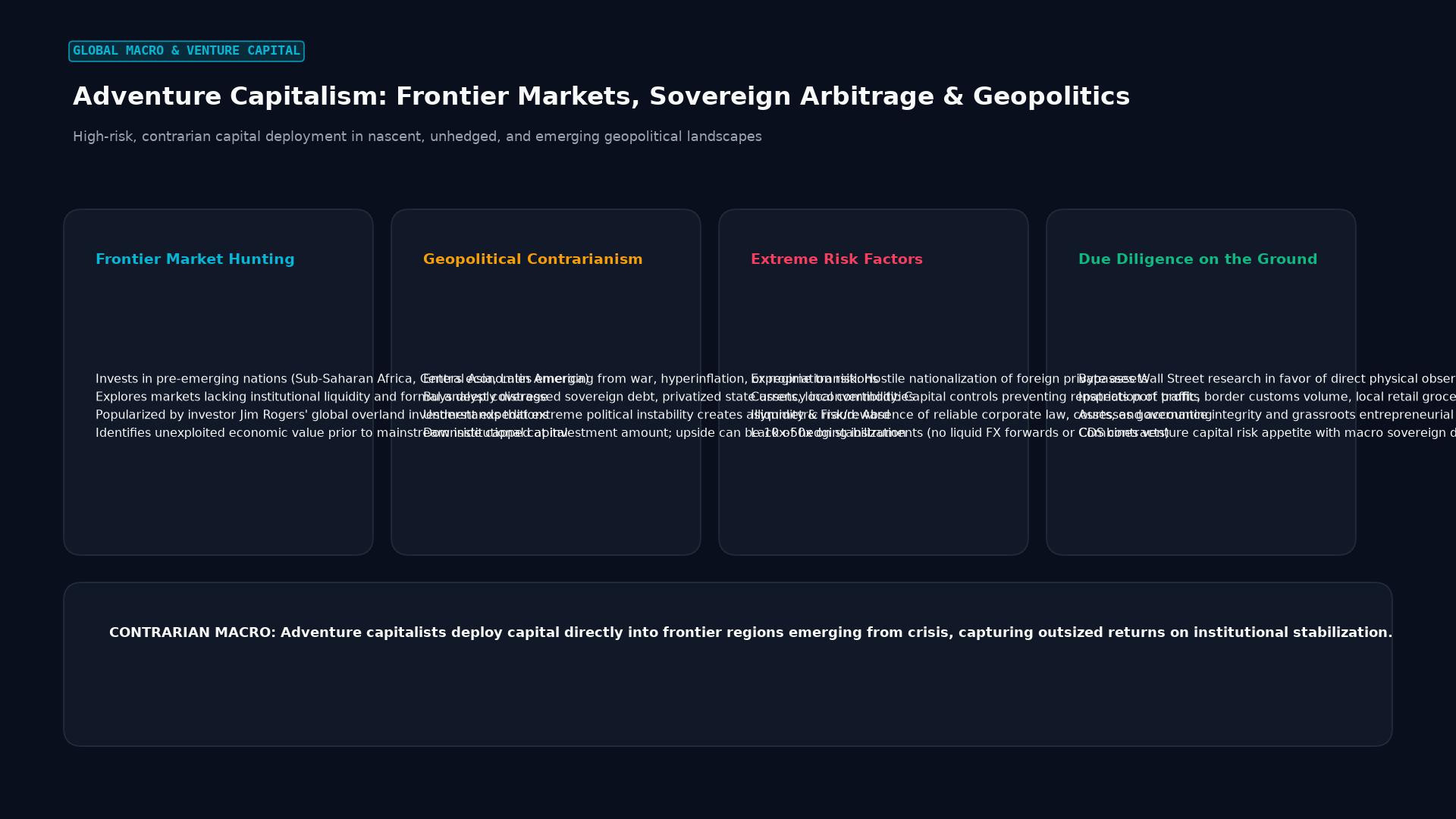 Figure: High-risk, contrarian capital deployment in nascent, unhedged, and emerging geopolitical landscapes
Technical Mechanics: Evaluating Frontier Risk & Capital Deployment
Adventure capitalists manage severe cross-border risks through specialized structuring techniques:
1. Assessing Frontier Market Risks
Investing in unseasoned frontier markets introduces operational hurdles rarely encountered in developed markets:
- Currency Devaluation & Repatriation Controls: Local currencies may suffer sudden devaluations against the US Dollar, or central banks may impose strict capital controls barring foreign investors from converting local profits back into dollars.
- Sovereign Expropriation & Rule of Law: Fragile legal systems, corruption, and political coups can threaten property ownership rights.
- Illiquidity & Exit Horizons: Developing markets lack deep public stock exchanges or secondary buyout markets, forcing investors to design exits around ongoing operational cash-flow dividends or strategic trade sales to multinational conglomerates.
2. Deal Structuring and Protective Covenants
To protect principal, adventure capitalists utilize robust private equity covenants:
- Offshore Holding Structures: The operating business in a developing nation (such as Kenya, Pakistan, or Vietnam) is owned through a holding company incorporated in a jurisdiction with strong English common law protections (such as Singapore, the UK, or Delaware).
- Convertible Hard-Currency Notes: Financing is denominated in US Dollars or Euros using senior secured convertible debt instruments carrying strict operational milestones.
- Local Operational Equity: Ensuring local founders retain significant equity stakes to resolve regional regulatory bureaucracies and cultural nuances effectively.
Comparative Matrix: Adventure Capitalist vs. Institutional VC vs. Angel Investor
| Dimension | Adventure Capitalist | Traditional Institutional VC | Angel Investor |
|---|---|---|---|
| Geographic Scope | Frontier markets & developing nations | Developed technology hubs (US, Europe) | Local domestic community |
| Capital Source | Principal net worth, private syndicates | Institutional LPs (pensions, endowments) | High-net-worth personal savings |
| Primary Risk | Geopolitical, regulatory, currency risk | Product-market fit, technological failure | High startup failure rate |
| Valuation Multiple | Very low entry multiples (1x to 4x EBITDA) | High entry multiples (10x to 30x Revenue) | Early seed valuations ($2M to $8M caps) |
| Exit Strategy | High dividend yields, multinational buyout | Public stock IPO or mega-cap tech buyout | Series A dilution or private sale |
Real-World Case Study: Off-Grid Solar Energy in East Africa
In 2021, an international private investor operating as an adventure capitalist evaluated the rural electrification deficit in East Africa, where over 60% of households lacked access to the electrical grid, relying instead on expensive, toxic kerosene lanterns.
While mainstream institutional venture funds declined to invest due to perceived political instability and currency volatility:
- The Investment: The investor committed $1.5 million in convertible debt into a local pay-as-you-go (PAYGO) solar startup in Nairobi, Kenya.
- Operational Integration: The startup combined rooftop solar hardware with mobile money micro-payments (via Kenya’s M-Pesa mobile payment system), allowing rural households to pay $0.50 daily via smartphone to unlock clean electricity.
- Currency Hedging: To hedge against Kenyan Shilling (KES) depreciation against the US Dollar, the investor structured an agreement with an international development finance institution that provided local currency liquidity swaps.
- The Exit: By 2024, the enterprise had expanded across Kenya, Uganda, and Tanzania, serving 340,000 households and achieving $22 million in recurring annual revenue. A European clean energy conglomerate acquired a majority stake for $65 million, generating a 7.5x cash return on the original seed capital.
Frequently Asked Questions (FAQ)
What skills are required to succeed as an adventure capitalist?
Success demands deep macroeconomic literacy, fluency in international trade law, physical resilience to travel in remote developing regions, cultural adaptability, and the ability to conduct independent due diligence without relying on polished corporate investment banking pitch decks.
How does an adventure capitalist hedge foreign currency risk?
Investors hedge currency exposure through hard-currency contractual covenants (pricing contracts in USD or EUR), utilizing local central bank currency forward contracts, or structuring the business to generate exports in foreign currency while incurring operational costs in depreciated local currency.
Is adventure capitalism limited to physical traveling individuals?
While the term originated with traveling private investors like Jim Rogers, modern adventure capitalism includes specialized boutique private credit funds, frontier venture studios, and decentralized syndicates that pool capital to back high-impact technology founders across developing economies.
Ready to trade forex?
Open a free demo account with a regulated broker. Practice with virtual funds before risking real money.