Advertising
Advertising is a strategic business activity and promotional expenditure aimed at building brand awareness, communicating product value propositions, and stimulating customer demand across media channels.
What Is Advertising in Corporate Finance?
Advertising is the deliberate dissemination of non-personal commercial messages across audio, visual, print, and digital channels to influence consumer behavior and generate product demand. In economic and corporate finance frameworks, advertising serves a dual function: it drives near-term transactional velocity and constructs durable brand equity that functions as an intangible asset.
Under US Generally Accepted Accounting Principles (US GAAP, ASC 720-35) and International Financial Reporting Standards (IFRS, IAS 38), advertising costs are classified as operating expenses (OpEx) within Selling, General, and Administrative (SG&A) expenditures. Companies must expense advertising either as incurred or when the advertisement first airs or appears in circulation. Unlike capital investments in manufacturing equipment or physical property, businesses cannot capitalize general promotional outlays on their balance sheets, even though advertising often delivers multi-year residual cash flows.
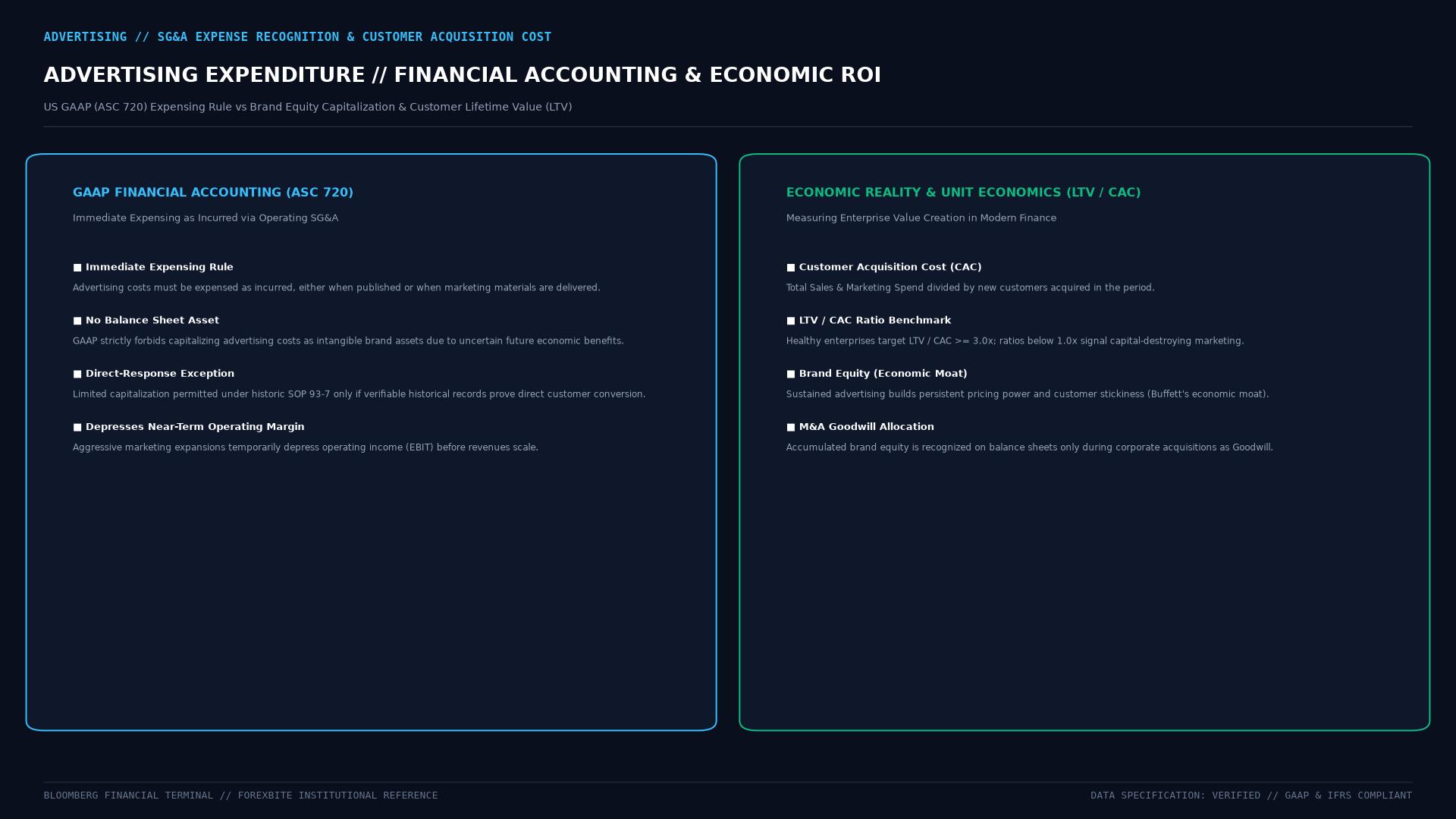 Figure: Accounting treatment of advertising expenditures under GAAP/IFRS (immediate expensing) versus economic capital asset creation, Customer Acquisition Cost (CAC), and multi-year Customer Lifetime Value (LTV).
Core Economic Functions of Advertising
Economists categorize commercial advertising into three primary operational mechanisms:
- Informative Advertising: Transmits functional data regarding pricing, technical specifications, availability, and product utility. This category reduces consumer search costs and expands market efficiency by facilitating direct price and quality comparisons.
- Persuasive Advertising: Focuses on psychological positioning, social status, and lifestyle alignment. Persuasive campaigns build brand loyalty, reducing customer price sensitivity and insulating the firm against competitor price cuts.
- Defensive (Combative) Advertising: Deployed in oligopolistic industries (such as beverage distribution, consumer telecoms, and consumer banking) where rival firms advertise aggressively merely to maintain their existing market shares rather than grow aggregate category demand.
       Informative                       Persuasive                       Defensive
 ┌──────────────────────┐         ┌──────────────────────┐         ┌──────────────────────┐
 │ • Product features   │         │ • Brand prestige     │         │ • Protect market     │
 │ • Price comparisons  │         │ • Emotional appeal   │ │   share from rivals    │
 │ • Service locations  │         │ • Lifestyle identity │         │ • Neutralize counter-│
 │ • Reduces search cost│         │ • Inelastic demand   │ │   campaigns          │
 └──────────────────────┘         └──────────────────────┘         └──────────────────────┘
Modern Channel Distribution and Allocation
The transition from broadcast linear media to programmatic digital ecosystems has fundamentally altered corporate advertising economics:
| Channel Class | Attribution Model | Primary Metrics | Capital Flexibility |
|---|---|---|---|
| Paid Search (SEM) | Direct intent click-through | Cost-per-click (CPC), Conversion Rate | Instant daily budget adjustment |
| Paid Social & Programmatic | Algorithmic audience targeting | Cost-per-mille (CPM), ROAS | Dynamic real-time bidding auctions |
| Connected TV & Streaming | Household IP targeting | Completion rate, Brand lift | Quarterly committed upfront buys |
| Linear Broadcast & Cable | Nielsen demographic panels | Gross Rating Points (GRPs) | Fixed upfront commitments |
| Out-of-Home (OOH & Billboards) | Traffic density & geofencing | Daily effective circulation | Multi-month lease contracts |
Modern financial analysts pay close attention to programmatic ad spend because digital channels generate granular, real-time performance analytics. This transparency allows corporate finance controllers to calibrate cash deployment on a weekly basis, protecting operating margins during economic contractions.
Strategic Evaluation for Equity Investors
When assessing a company’s financial health, institutional analysts scrutinize advertising through several strategic lenses:
1. Operating Leverage and Margin Expansion
As an enterprise scales, marketing expenditures should ideally decline as a percentage of total revenue. A software or consumer enterprise that doubles sales while keeping ad spend relatively constant unlocks substantial operating leverage, directing cash flows straight to free cash flow and net income.
2. Discretionary Expense Smoothing
Because corporate managers possess complete discretion over the timing of advertising spending, troubled firms can temporarily withhold marketing outlays to manufacture artificial beats on quarterly operating earnings. An analyst must cross-reference advertising cuts with subsequent organic customer acquisition numbers to confirm whether earnings growth represents real operational efficiency or short-term balance sheet neglect.
3. Valuation of Brand Equity as an Intangible Moat
Although advertising spending cannot be capitalized under standard accounting rules, decades of sustained, disciplined advertising generate immense corporate value. In acquisition transactions, this unrecorded asset surfaces on the consolidated balance sheet as goodwill or identifiable intangible assets (trademarks and trade names), directly supporting elevated transaction multiples.
Key Takeaways
- Advertising represents operating expenditure dedicated to communicating product offerings, generating customer acquisition, and strengthening enterprise brand equity.
- Standard accounting standards (ASC 720-35 and IAS 38) mandate that advertising costs must be expensed as incurred rather than capitalized as balance sheet assets.
- Digital and programmatic advertising channels provide granular tracking data that permits agile, performance-driven capital allocation.
- In financial analysis, disciplined marketing investments create pricing power, while sudden cuts to advertising may signal desperate attempts to hit short-term earnings targets.
Frequently Asked Questions
Can companies capitalize advertising expenditures on the balance sheet?
Under US GAAP and IFRS, general advertising costs cannot be capitalized as intangible assets because the future economic benefits cannot be measured with sufficient certainty. They must be expensed on the income statement as incurred, with limited exceptions for certain direct-response advertising arrangements where past performance guarantees measurable customer conversion.
How does advertising impact working capital management?
Advertising programs frequently involve large agency retainers and publisher payment obligations. When negotiated with favorable 60-day or 90-day vendor payment terms, advertising liabilities allow companies to fund ongoing customer acquisition from incoming cash receipts before the advertising invoices fall due, optimizing cash conversion cycles.
What is the difference between marketing and advertising?
Marketing is an overarching commercial discipline encompassing product development, market research, pricing architecture, customer segmentation, and distribution strategies. Advertising is a tactical subset of marketing focused specifically on the paid placement of promotional communications across external media channels.
Ready to trade forex?
Open a free demo account with a regulated broker. Practice with virtual funds before risking real money.