Advertorial
An advertorial is a hybrid marketing format that blends commercial advertising with objective journalistic styling, subject to regulatory disclosure requirements to prevent consumer and investor deception.
What Is an Advertorial?
An advertorial is an advertisement disguised as an objective, educational, or editorial piece of journalism. The term combines “advertisement” and “editorial.” Designed to mimic the layout, typography, voice, and investigative tone of the hosting publication, an advertorial aims to overcome reader skepticism and ad-blindness by providing analytical depth, case studies, or narrative storytelling while promoting a commercial brand, financial product, or investment thesis.
While advertorials originated in print magazines and newspapers, they dominate modern digital media environments through sponsored articles, promoted financial research, and native content feeds. Because readers often mistake these placements for unbiased reporting, securities watchdogs and consumer protection agencies impose stringent disclosure rules on publishers, sponsors, and marketing agencies.
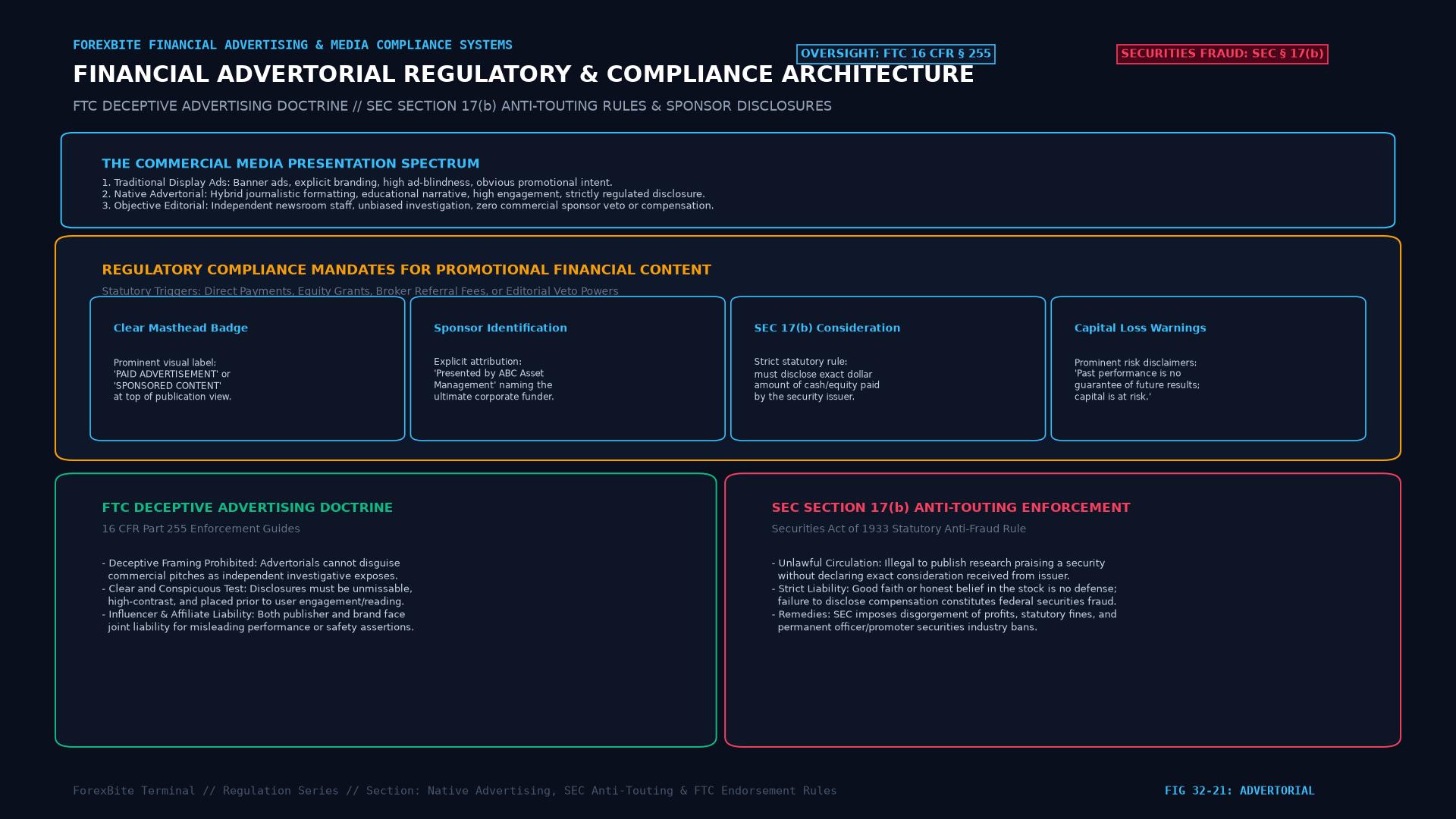 Figure: Regulatory and disclosure architecture for native financial advertorials under FTC Section 5 and SEC Section 17(b) anti-touting rules.
Regulatory Frameworks and Disclosure Mandates
Because advertorials intentionally emulate objective journalism, global financial and trade authorities have developed strict legal boundaries to combat deceptive commercial practices:
1. United States: Federal Trade Commission (FTC)
The FTC Enforcement Policy Statement on Deceptively Formatted Advertisements mandates that commercial intent must be instantly apparent to the average consumer. Advertorials must carry prominent, unambiguous disclosures such as “Paid Advertisement,” “Sponsored Content,” or “Presented By [Brand].” Disclosures cannot be buried in fine print, obscured by low-contrast colors, or hidden behind ambiguous labels like “Promoted Stories” or “From Around the Web.”
2. SEC Section 17(b) Anti-Touting Provisions
In the financial and capital markets sectors, the Securities and Exchange Commission enforces Section 17(b) of the Securities Act of 1933. Under this federal statute, it is unlawful for any person or entity to publish, give publicity to, or circulate any communication describing a security without fully disclosing the receipt (whether past, present, or prospective) of consideration and the exact dollar amount received from the issuer. Paid financial advertorials that promote micro-cap equities, cryptocurrency projects, or private placements without explicit dollar-for-dollar compensation disclosure represent federal securities fraud.
3. United Kingdom: Advertising Standards Authority (ASA) & CMA
The ASA and the Competition and Markets Authority require native commercial articles to be clearly distinguished from editorial matter prior to user engagement. If a reader must click through or scroll halfway down an article to realize it is sponsored, the placement breaches UK consumer protection regulations.
Regulatory Compliance Flowchart for Financial Advertorials:
┌────────────────────────────────────────────────────────┐
│     Drafting Financial Promotional / Analysis Piece    │
└──────────────────────────┬─────────────────────────────┘
                           │
             ┌─────────────┴─────────────┐
             ▼                           ▼
 ┌───────────────────────┐   ┌───────────────────────────┐
 │ Has consideration or  │   │ Independent reporting     │
 │ sponsorship occurred? │   │ without sponsor control   │
 └───────────┬───────────┘   └─────────────┬─────────────┘
             │ YES                         │ NO
 ┌───────────▼───────────────────────┐     │
 │ Mandate Prominent Disclosures:    │     │
 │ • Clear header: "SPONSORED"       │     ▼
 │ • Identify sponsor identity       │ ┌───────────────────────┐
 │ • SEC 17(b): Disclose exact fees  │ │ Standard Journalistic │
 │ • Include clear risk warnings     │ │ Editorial Output      │
 └───────────────────────────────────┘ └───────────────────────┘
Structural Anatomy of a Financial Advertorial
Legitimate corporate advertorials follow a distinct structural architecture:
| Structural Component | Content Function | Compliance Safeguard |
|---|---|---|
| Clear Masthead Badge | Establishes commercial nature | Explicit visual identifier (e.g., “Sponsored by ABC Asset Management”) |
| Analytical Headline | Poses a timely economic or technical question | Avoids misleading clickbait or unsubstantiated return promises |
| Market Context & Data | Reviews macro trends, interest rates, or sector shifts | Cites verified public data, market reports, or official exchange stats |
| Sponsor Integration | Introduces the sponsor’s proprietary platform or product | Framed clearly as a commercial solution, not as universal market consensus |
| Disclaimers & Risk Footers | Clarifies licensing, risk of capital loss, and disclosures | Standard institutional disclaimers regarding market risk and past performance |
Investor Risks and Forensic Evaluation
Retail traders and individual investors are uniquely vulnerable to predatory financial advertorials. Deceptive promotions frequently circulate during speculative bull markets, targeting retail capital through narrative manipulation:
- Pump-and-Dump Schemes: Unscrupulous syndicates sponsor articles disguised as independent equity research reports to artificially boost trading volume and share prices of illiquid small-cap stocks before dumping their holdings.
- Unregulated Broker Promotion: Questionable foreign exchange (Forex) and binary options brokers use advertorials disguised as inspirational wealth-creation case studies to recruit retail deposits into high-leverage accounts.
- Forensic Identification: Astute market participants scrutinize articles for one-sided risk reporting, lack of verifiable author credentials, extreme urgency or fear-of-missing-out (FOMO) language, and vague calls to action directing capital toward specific unregulated brokerages or private token sales.
Key Takeaways
- An advertorial is a paid promotional message designed with the aesthetic, typography, and tone of independent editorial journalism.
- Federal and international authorities (including the FTC, SEC, and ASA) mandate clear, conspicuous disclosures to prevent consumer deception.
- Under SEC Section 17(b), any publication that describes a security in exchange for direct or indirect compensation must disclose the precise amount received.
- Investors should carefully inspect article headers and footers for sponsorship notices before acting on market analysis or broker recommendations.
Frequently Asked Questions
How can a reader tell the difference between an advertorial and an objective article?
Look for disclosure labels located near the headline or byline, such as “Sponsored Content,” “Paid Partner,” or “Advertisement.” In addition, inspect whether the article exclusively highlights the virtues of one particular company, lacks balanced counterarguments or risk warnings, and directs readers toward an external sales funnel.
Is publishing an advertorial legal?
Yes, publishing advertorials is entirely legal provided the publisher and advertiser comply with disclosure regulations. The FTC and equivalent global regulators require that the commercial relationship be made immediately transparent to the reader before and during consumption of the content.
What are the consequences of failing to disclose a financial advertorial?
Failure to disclose financial compensation for promoting securities or investment vehicles violates federal securities laws, including Section 17(b) of the Securities Act of 1933. Violators face severe civil and criminal enforcement actions by the SEC, including disgorgement of promotional profits, substantial fines, and permanent trading bans.
Ready to trade forex?
Open a free demo account with a regulated broker. Practice with virtual funds before risking real money.