Activity Based Budgeting
Activity-Based Budgeting (ABB) is an advanced financial planning methodology that forecasts the activities required to produce target operational outputs, calculating resource and funding needs based on activity demand rather than historical spend.
What Is Activity-Based Budgeting (ABB)?
Activity-Based Budgeting (ABB) is a rigorous, modern managerial accounting and corporate budgeting methodology that allocates financial resources based on the forecasted volume of business activities required to meet organizational strategic objectives.
Traditional corporate budgeting is notoriously incremental: department managers take the previous fiscal year’s expenses and automatically add a fixed inflation adjustment (such as +3% or +5%), regardless of whether operational workloads have expanded, contracted, or transformed. This legacy approach perpetuates historical inefficiencies, protects bloated departments, and starves high-growth business units of essential capital.
Activity-Based Budgeting inverts this dynamic. It works in the exact reverse sequence of Activity-Based Costing (ABC). Instead of analyzing historical costs to determine product expenses, ABB begins with the company’s forecasted sales demand and works backward: it establishes the specific activities needed to fulfill customer demand, calculates the resource capacity required to execute those activities, and budgets the precise capital needed to fund that capacity.
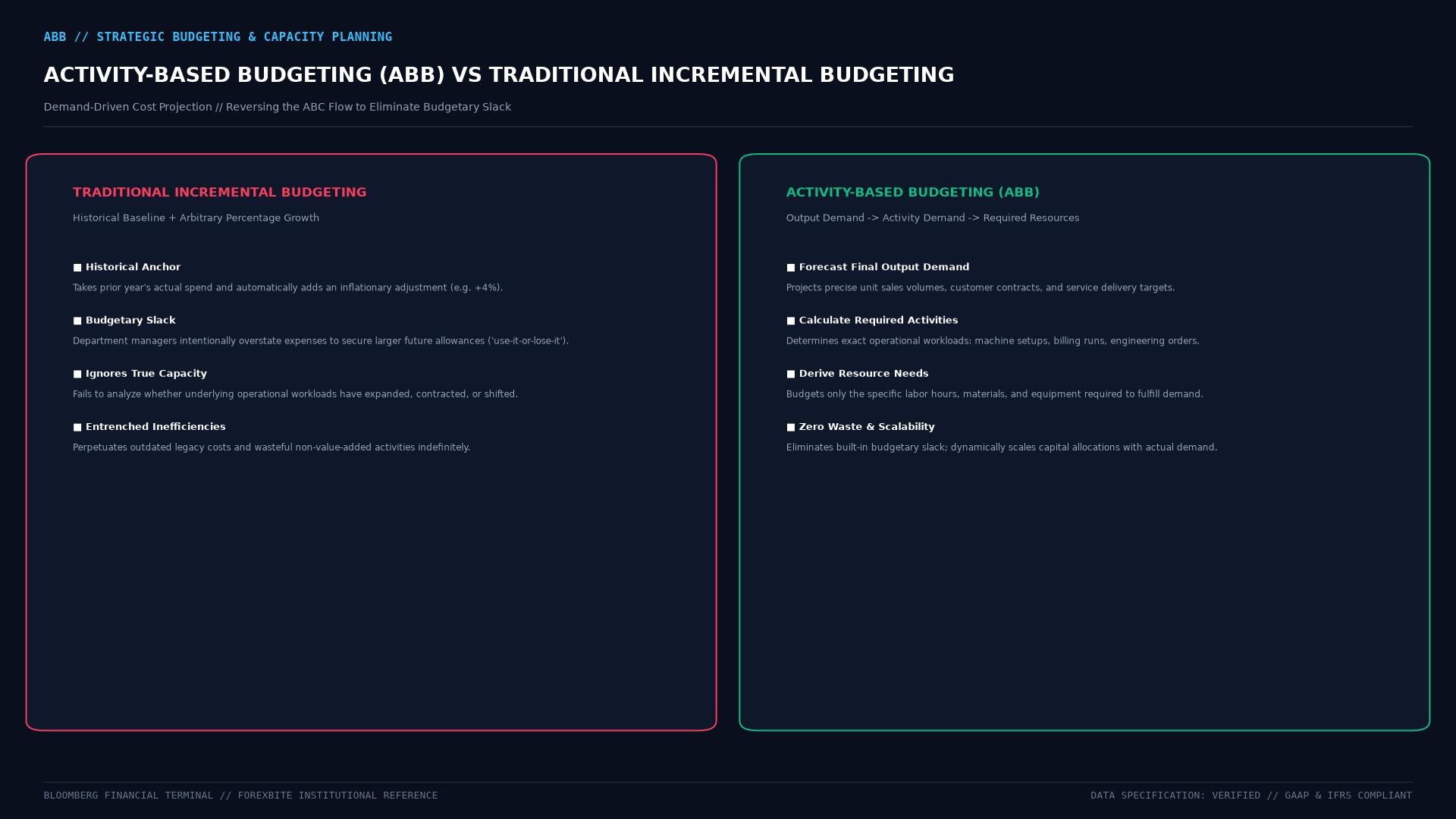 Figure: Activity-Based Budgeting (ABB) operational cycle across four stages: output demand forecasting, activity workload quantification, resource requirements allocation, and budget optimization.
Technical Mechanics: The Three-Stage ABB Process
Corporate Financial Planning and Analysis (FP&A) teams execute Activity-Based Budgeting through a structured three-stage quantitative model:
1. Identify Target Outputs and Forecast Demand
Management establishes concrete operational targets for the upcoming fiscal period across all commercial channels:
- Units of physical product to manufacture.
- Service contracts to onboard and service.
- Customer support ticket volumes projected based on user base expansion.
2. Determine Required Activities and Driver Workloads
For each forecasted output, analysts determine the operational activities required using verified historical consumption ratios:
Total Activity Demand = Forecasted Output Volume × Activity Consumption Rate per UnitFor example, if an enterprise plans to manufacture 20,000 custom aerospace valves, and each valve batch requires 0.5 machine calibration hours, the total budgeted demand for the machine calibration activity is 10,000 machine hours.
3. Calculate Resource Requirements and Financial Budget
Management determines the resources needed to supply the required activity capacity:
Budgeted Cost = Total Activity Demand × Cost per Unit of Activity DriverIf each machine calibration hour costs $85 in power, tooling, and technician wages, the authorized budget for that activity pool is set at $850,000 ($85 × 10,000 hours). If existing department capacity stands at 14,000 hours, ABB immediately flags 4,000 hours of excess idle capacity, allowing leadership to redeploy staff or eliminate leased machinery before authorizing capital.
Comparative Matrix: Activity-Based Budgeting vs. Traditional vs. Zero-Based Budgeting
| Dimension | Activity-Based Budgeting (ABB) | Traditional Incremental Budgeting | Zero-Based Budgeting (ZBB) |
|---|---|---|---|
| Starting Point | Forecasted operational activity demand | Previous year’s actual expenditures | Zero base; every single expense justified |
| Primary Focus | Business processes, activities, capacity | Functional departments and line items | Justifying necessity of all expense line items |
| Capacity Management | Quantifies and manages idle resource slack | Masks unutilized excess capacity | Cuts arbitrary costs without process mapping |
| Resource Allocation | Strictly matches workload volume | Anchored to historical bureaucratic power | High friction; requires extensive manager time |
| Handling Downturns | Automatically cuts budgets as activity falls | Difficult to reduce; managers resist cuts | Cuts deeply, but often damages core processes |
Real-World Case Study: Commercial Fleet Logistics Restructuring
In late 2023, a national commercial freight and logistics firm with $140 million in operating expenses faced declining freight volumes amid macroeconomic slowing. Traditional department heads submitted incremental 2024 budget requests demanding a 4.5% across-the-board spending increase ($146.3 million total).
The Chief Financial Officer rejected the submissions and mandated an Activity-Based Budgeting model:
- Activity Modeling: The FP&A team modeled 12 core operational activities, including dock cross-docking, dispatch routing, trailer fleet safety inspections, and fuel maintenance.
- Workload Recalculation: With projected freight shipments declining by 12% in 2024, the ABB model revealed that required cross-docking hours would drop from 450,000 to 396,000 hours, and fleet inspection cycles would decrease by 14,000 runs.
- Budget Adjustment: The ABB framework authorized an operating budget of $128.5 million, reflecting true activity demand.
Rather than executing blind, arbitrary layoffs that impair core delivery reliability, the company non-renewed 80 leased trailers, eliminated contracted third-party overtime, and consolidated three cross-docking hubs, saving $17.8 million while maintaining an industry-leading 99.2% on-time delivery rate.
Frequently Asked Questions (FAQ)
What is the relationship between Activity-Based Costing (ABC) and Activity-Based Budgeting (ABB)?
Activity-Based Costing is a diagnostic, backward-looking tool that measures what historical activities cost and how resources were consumed. Activity-Based Budgeting is a forward-looking planning tool that uses ABC consumption rates to forecast future resource needs and build operating budgets based on anticipated demand.
Why do some corporations avoid implementing ABB?
ABB requires a mature operational tracking system and robust enterprise resource planning (ERP) software to calculate accurate activity driver rates. Organizations lacking detailed operational data or suffering from departmental silos often find the initial implementation labor-intensive compared to traditional incremental budgeting.
How does ABB handle fixed overhead costs like corporate headquarters rent?
Fixed facility expenses that do not vary with operational activity levels are categorized as facility-sustaining costs. In ABB, these are budgeted separately as fixed baseline obligations, preventing managers from distorting operational activity driver rates with non-variable corporate overhead.
Ready to trade forex?
Open a free demo account with a regulated broker. Practice with virtual funds before risking real money.