Afghani
The Afghani (AFN) is the official currency and legal tender of Afghanistan, issued and regulated by the central bank, Da Afghanistan Bank (DAB).
What Is the Afghan Afghani?
The Afghan Afghani (ISO code: AFN; symbol: ؋) is the national monetary unit and legal tender of Afghanistan. Issued and administered by the country’s central monetary authority, Da Afghanistan Bank (DAB), the afghani is nominally subdivided into 100 puls, though rapid inflation and historical currency devaluations have rendered pul coins obsolete in daily transactions.
The currency reflects the complex political, economic, and geopolitical turbulence of the Afghan state over the past century. Unlike conventional floating currencies that trade across deep, liquid electronic interbank markets, the afghani relies heavily on physical cash circulation, central bank foreign currency auctions, and decentralized informal money-transfer systems known as hawala networks.
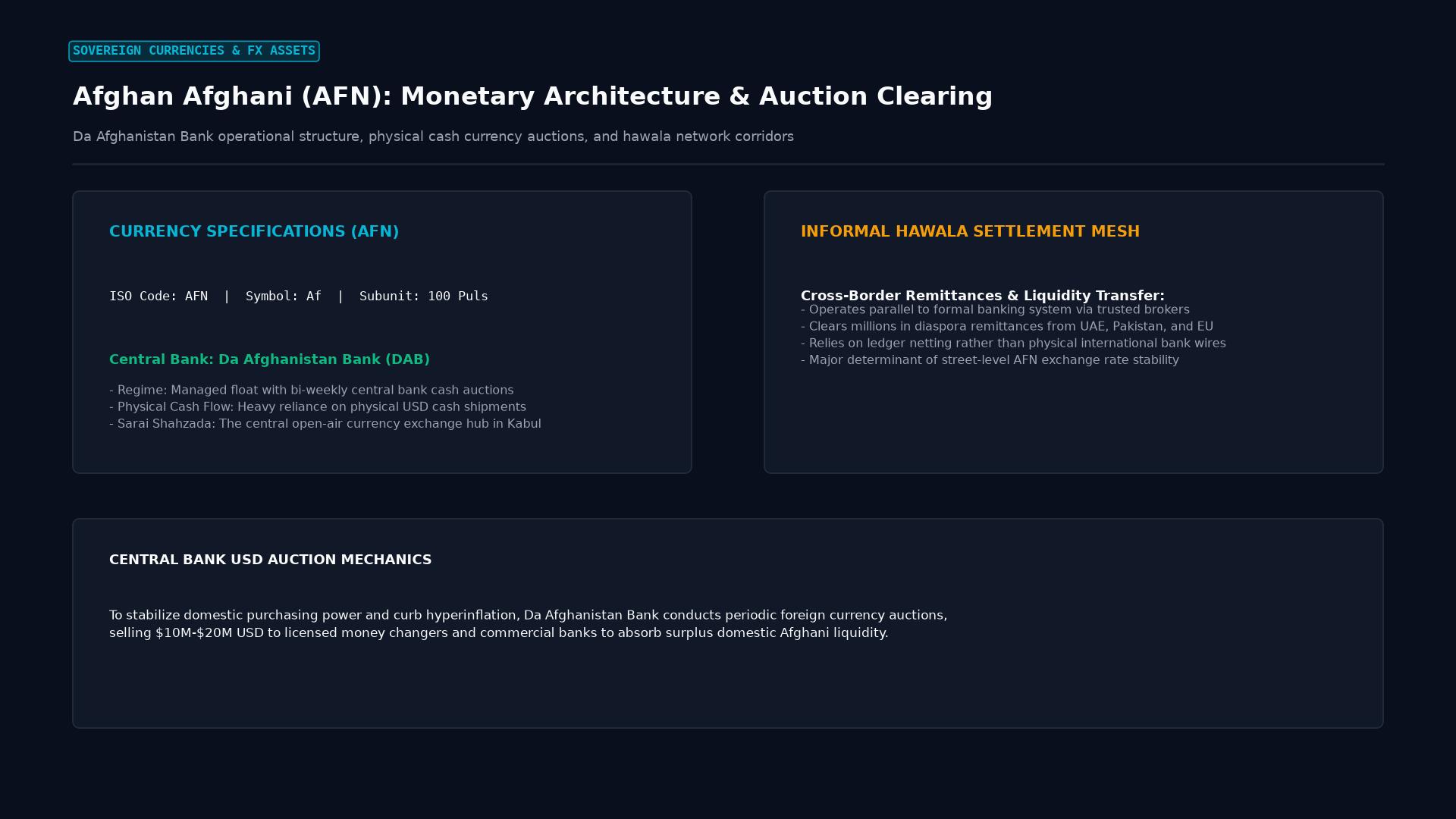 Figure: Da Afghanistan Bank monetary framework: bi-weekly USD cash currency auctions, informal hawala settlement mesh, and Sarai Shahzada open-air market clearing.
Historical Evolution and the 2002 Currency Reform
The afghani was introduced in 1925 under King Amanullah Khan, replacing the historical Afghan rupee at a rate of 1 afghani to 1.1 rupees. For several decades, the currency maintained moderate stability backed by gold and silver reserves held in the royal treasury.
Following the Soviet-Afghan War in 1979 and the civil conflicts of the 1990s, the monetary system fragmented. Warlords, rival factions, and regional administrations printed competing banknotes without gold backing or central oversight. Hyperinflation destroyed purchasing power, with two primary competing issues circulating: the “Dostumi” afghanis printed in northern regions and the “Jumbishi” or “Rabbani” banknotes printed under the nominal Kabul government.
In October 2002, the transitional Afghan government instituted a sweeping monetary reform to re-establish a unified national currency:
- The new Afghani was issued with the ISO code AFN, replacing the discredited legacy currency (AFA).
- Legacy banknotes were converted under a two-tier peg: 1 new AFN for every 1,000 Rabbani Afghanis, and 1 new AFN for every 2,000 Dostum Afghanis.
- The nationwide physical currency swap, executed with logistical support from international monetary partners, stabilized exchange rates and returned price discovery to Da Afghanistan Bank.
2002 Currency Unification Architecture:
┌───────────────────────────┐         ┌───────────────────────────┐
│  Rabbani Faction Banknotes │         │  Dostum Faction Banknotes │
│   (1,000 Old AFA Units)   │         │   (2,000 Old AFA Units)   │
└─────────────┬─────────────┘         └─────────────┬─────────────┘
              │                                     │
              │   Conversion Ratio:                 │   Conversion Ratio:
              │   1,000 AFA : 1 AFN                 │   2,000 AFA : 1 AFN
              ▼                                     ▼
      ┌─────────────────────────────────────────────────────┐
      │             Unified New Afghan Afghani              │
      │                  (1 New AFN Unit)                   │
      └─────────────────────────────────────────────────────┘
Central Bank Operations and Exchange Rate Mechanisms
Under normal economic frameworks, Da Afghanistan Bank utilizes a managed floating exchange rate regime. Because domestic export industries are narrow (consisting primarily of dried fruits, carpets, nuts, and agricultural products), Afghanistan relies heavily on imported essential commodities, including fuel, grain, pharmaceuticals, and consumer electronics.
To support the afghani’s external purchasing power and prevent runaway imported inflation, DAB conducts regular open-market auctions. In these auctions, the central bank sells physical US dollar cash reserves to licensed money changers and commercial banks in exchange for domestic afghanis. This mechanism directly manages the money supply:
Foreign Exchange Auction Liquidity Loop:
┌─────────────────────────┐
│ Da Afghanistan Bank     │
│ Central Vault           │
└────────────┬────────────┘
             │ Physical USD Injected via Auction
             ▼
┌─────────────────────────┐
│ Sarai Shahzada Brokers  │◄── Price Discovery & Commercial Demand
│ & Commercial Banks      │
└────────────┬────────────┘
             │ Domestic AFN Absorbed from Circulation
             ▼
┌─────────────────────────┐
│ Money Supply (AFN)      │
│ Contraction & Stability │
└─────────────────────────┘
The Hawala Network and Sarai Shahzada
Afghanistan possesses one of the lowest formal commercial banking penetration rates in South Asia. Consequently, the vast majority of cross-border remittances, commercial import financing, and currency conversions flow through the hawala informal value transfer system.
The physical nerve center of this market is the Sarai Shahzada financial bazaar in Kabul. Covering several multi-story buildings, thousands of licensed and informal money changers (hawaladars) settle billions of dollars in trade transactions annually. Using trust-based ledgers, messaging applications, and reciprocal merchant accounts across Dubai, Istanbul, and Pakistan, the hawala network facilitates capital transfers even when SWIFT interbank messaging or international clearing lines are severed.
Geopolitical Shifts and Monetary Sanctions
Following the political turnover in August 2021, the Afghan financial sector experienced severe structural disruption:
- Reserve Asset Freezes: Over $9 billion in Da Afghanistan Bank foreign exchange reserves deposited in the Federal Reserve Bank of New York, the Bank for International Settlements, and European commercial banks were frozen by Western authorities.
- Loss of SWIFT Access: Most domestic commercial banks lost their direct correspondent banking relationships, curtailing international wire transfers.
- Cash-Based Stabilization: Despite severe economic headwinds, the afghani demonstrated resilience against the US dollar in subsequent years, driven by tight central bank capital controls, anti-hoarding decrees, a total ban on foreign currency use in domestic retail trade, and regular shipments of United Nations humanitarian cash assistance for civilian aid.
Key Takeaways
- The Afghani (AFN) is Afghanistan’s national currency, issued and governed by Da Afghanistan Bank (DAB).
- The modern currency was created in 2002 via a comprehensive re-denomination that wiped out three zeros and unified factional wartime currencies.
- Exchange rate management relies heavily on central bank US dollar auctions to absorb domestic liquidity and stabilize import prices.
- The hawala market, anchored at Sarai Shahzada in Kabul, handles the majority of the nation’s currency exchange and cross-border commercial payments.
Frequently Asked Questions
What is the difference between AFA and AFN?
AFA was the historical ISO 4217 code for the original Afghan afghani that suffered hyperinflation during civil conflicts. AFN is the modern ISO code established during the 2002 monetary overhaul, which re-denominated the currency at rates of 1,000 to 2,000 old AFA per 1 new AFN.
Are pul coins still used in Afghanistan?
No. While the afghani is legally divisible into 100 puls, purchasing power declines have made pul coins obsolete. Common circulating denominations consist entirely of banknotes ranging from 10 to 1,000 afghanis.
Can international investors trade AFN in global retail forex brokerages?
No. The afghani is an exotic, non-convertible currency that does not trade on standard retail forex brokerage platforms. Outside of local commercial banks, the hawala market, and regional border trade desks in South Asia and the Middle East, there is no liquid international secondary market for AFN trading pairs.
Ready to trade forex?
Open a free demo account with a regulated broker. Practice with virtual funds before risking real money.