AFN
AFN is the three-letter ISO 4217 currency code representing the Afghan afghani, utilized in international banking, financial messaging, and foreign exchange settlement protocols.
What Does AFN Stand For?
AFN is the standardized three-letter currency code established under the International Organization for Standardization (ISO 4217) to designate the Afghan afghani, the national currency of Afghanistan. Established alongside the three-digit numeric identifier 971, the code serves as the universally recognized identifier across global telecommunication networks, international wire transfers, central banking reserves, and foreign exchange reporting systems.
Under the ISO 4217 formatting methodology, currency codes derive their structure through a rigorous two-part naming convention:
- The first two letters (AF) represent the country code for Afghanistan under the ISO 3166-1 alpha-2 standard.
- The final letter (N) stands for “New,” designating the reformed currency introduced in October 2002. This distinguishes the post-reform tender from the legacy pre-reform afghani, which carried the ISO code AFA (numeric code 004).
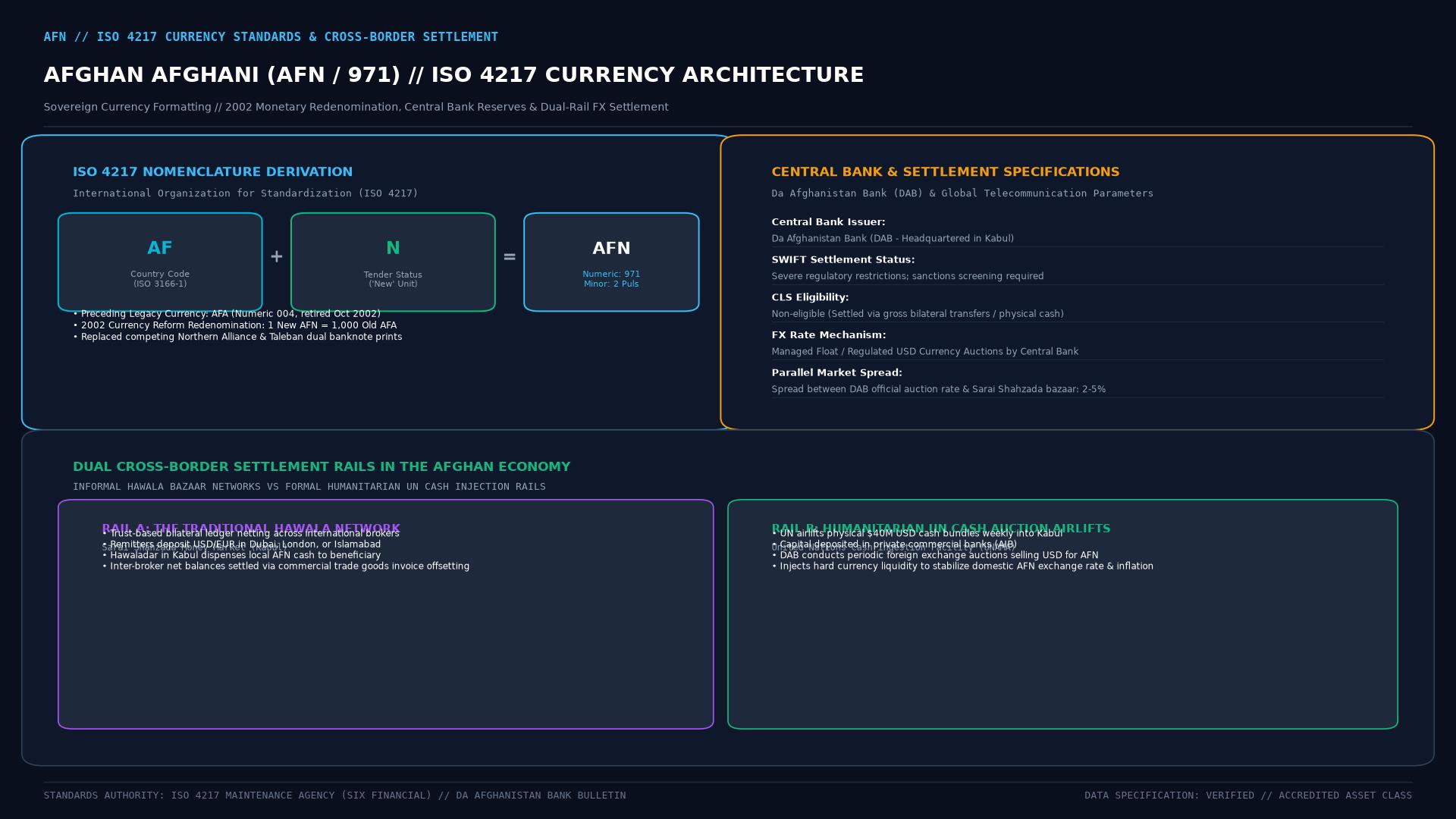 Figure: ISO 4217 currency code derivation for the Afghan Afghani (AFN / 971), 2002 monetary redenomination, and cross-border settlement channels (Hawala network vs. UN cash injections).
ISO 4217 Technical Specifications
The table below outlines the formal parameters assigned to the AFN currency code by the ISO 4217 Maintenance Agency (SIX Financial Information):
| Parameter | Specification Details |
|---|---|
| Alphabetic Code | AFN |
| Numeric Code | 971 |
| Minor Unit Fraction | 2 (Nominally 1 AFN = 100 Puls) |
| Preceding Legacy Code | AFA (Numeric 004, retired in 2002) |
| Issuing Central Bank | Da Afghanistan Bank (DAB) |
| Target Currency Status | Inconvertible / Restricted Capital Account |
| ISO 20022 Migration | pacs.008 / pacs.009 XML settlement compatible |
In international financial infrastructure, the numeric code (971) prevents translation errors in automated clearing systems and cross-border databases where non-Latin character sets or script variations could lead to settlement failure.
Role in Global Banking and Financial Messaging
Although the afghani is an exotic, non-convertible currency with minimal direct presence on Western electronic communication networks (ECNs), the AFN code remains essential across cross-border banking operations:
1. SWIFT and ISO 20022 Telecommunications
When international aid agencies, diplomatic missions, and licensed commercial firms initiate wire transfers, the currency code is transmitted in standard SWIFT MT messages (such as MT103 single customer credit transfers) and modern ISO 20022 XML formats (such as pacs.008.001.08). Field 32A of an MT103 message explicitly details the settlement date, currency code (AFN), and transaction amount.
Sample SWIFT MT103 Field 32A Sequence:
:32A:260923AFN15000000,00
  │   │     │   └─ Transaction Amount: 15,000,000.00
  │   │     └───── ISO 4217 Currency Code: AFN
  │   └─────────── Value Date: September 23, 2026
  └─────────────── SWIFT Mandatory Tag for Value Date/Currency/Amount
2. Cross-Border Remittance Settlement
Because formal correspondent banking accounts for Afghanistan are severely constrained by sanctions and compliance protocols, international money transfer operators (MTOs) utilize the AFN identifier when quoting inbound cash pickup rates. Migrant workers in North America, Europe, and the Persian Gulf remit US dollars or euros, which are translated into AFN counter-values upon collection in Kabul or Herat.
Foreign Exchange Quotation Conventions
In international foreign exchange trading desks, currency pairs follow strict quotation conventions:
- USD/AFN (Base/Quote): The US dollar serves as the base currency, while the afghani serves as the quote (terms) currency. A market quotation of
USD/AFN = 70.50signifies that 1 US dollar purchases 70.50 afghanis. - Spread Dynamics: Because the afghani is illiquid and lacks deep interbank forward markets, the bid-ask spread on USD/AFN in regional trading centers (such as the Sarai Shahzada cash market or Dubai exchange houses) is wide compared to G10 currency pairs. Spreads frequently expand to 1.5% to 3.0% to compensate market makers for inventory carrying risk and currency volatility.
- Absence of Deliverable Forwards: Due to capital controls and counterparty risk, there is no active market for standard deliverable forward contracts in AFN. Hedging activities are conducted primarily via physical spot reserves or informal bilateral agreements.
Key Takeaways
- AFN is the standardized ISO 4217 three-letter currency code for the Afghan afghani, paired with numeric code 971.
- The “N” in AFN signifies the “New” afghani introduced in October 2002 to replace the hyperinflated legacy currency (AFA).
- The code is required across international banking messages (SWIFT MT103 and ISO 20022 XML) for international trade reconciliation and humanitarian capital routing.
- USD/AFN is quoted with the US dollar as the base currency, with spot transactions dominated by physical cash settlements and hawala clearing.
Frequently Asked Questions
Why did the currency code change from AFA to AFN?
The code was changed in 2002 to reflect a national currency re-denomination. The original currency (AFA) had lost purchasing power due to unconstrained printing by rival factions during decades of conflict. The replacement of AFA with AFN allowed global banking networks to distinguish old, hyperinflated banknotes from the new, legally unified currency.
What is the numeric ISO code for the Afghan afghani?
The numeric ISO 4217 code for AFN is 971. Numeric codes are utilized primarily in automated international clearing engines and computerized accounting databases to eliminate ambiguity caused by differing language character sets.
Can traders speculate on AFN through retail Forex platforms?
No. Standard retail brokers do not provide trading in AFN currency pairs because the currency is non-convertible and lacks deep, cleared interbank electronic liquidity. Institutional participation is largely restricted to humanitarian organizations, central bank auctions, and regional trade import financing.
Ready to trade forex?
Open a free demo account with a regulated broker. Practice with virtual funds before risking real money.