AFS
AFS stands for Available-for-Sale, an accounting classification for debt and equity securities held on a financial institution's balance sheet that are not categorized as trading or held-to-maturity assets.
What Does AFS Stand For in Banking and Finance?
In financial accounting and treasury management, AFS stands for Available-for-Sale. It is an official asset classification defined under US Generally Accepted Accounting Principles (US GAAP, specifically ASC 320) and International Financial Reporting Standards (IFRS 9, where it corresponds to Fair Value through Other Comprehensive Income, or FVOCI).
When a commercial bank, credit union, or corporate treasury acquires debt securities (such as US Treasuries, agency mortgage-backed securities, municipal bonds, or corporate debt), executive management must declare the accounting intent for those instruments on the acquisition date. Securities that are neither intended for active, short-term speculative trading nor committed to being held until final principal maturity are categorized as Available-for-Sale.
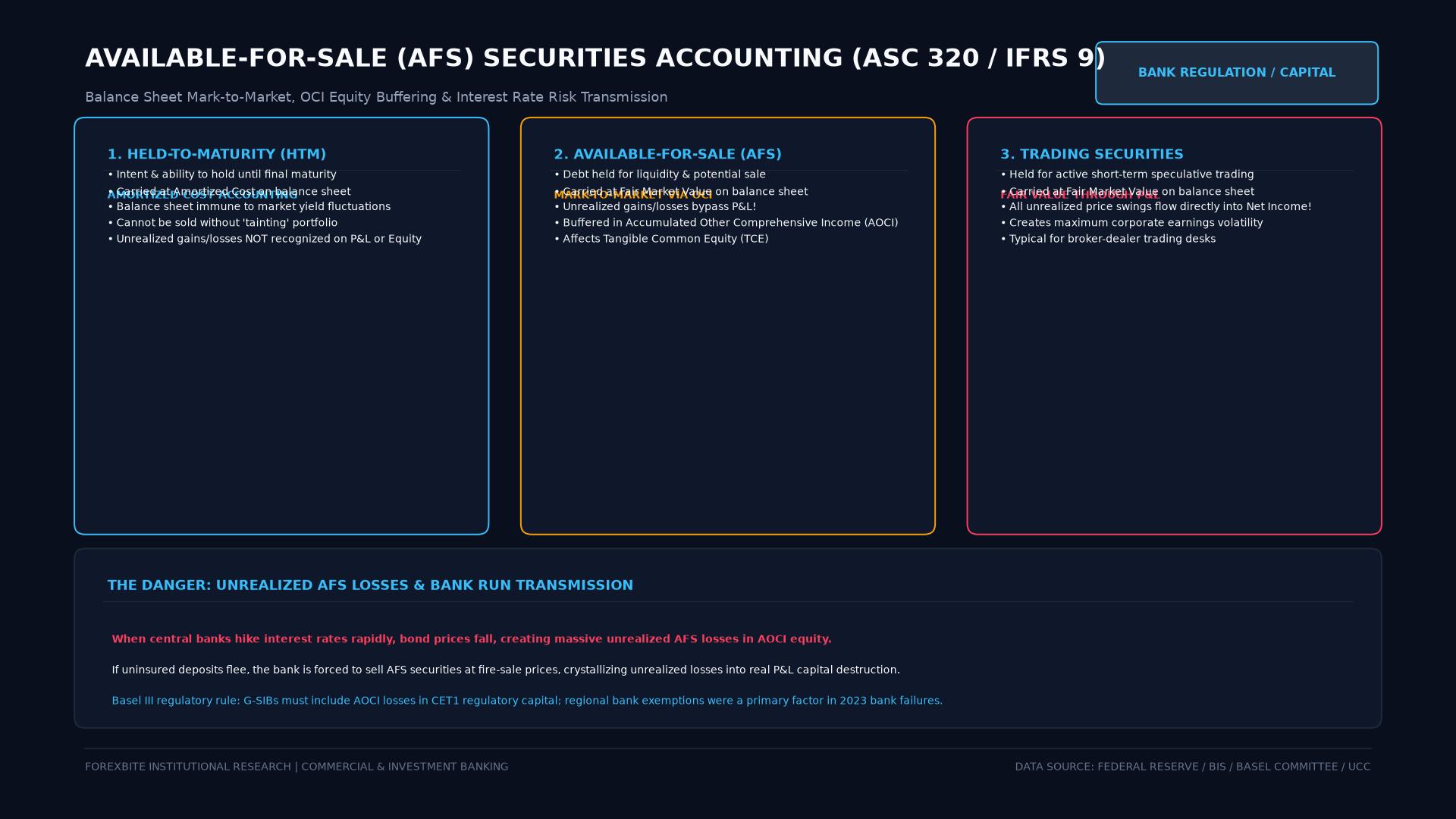 Figure: Accounting classification under IFRS 9 / ASC 320: unrealized mark-to-market gains and losses routing through Other Comprehensive Income (AOCI) and regulatory capital impact.
Accounting Treatment: The Role of AOCI
The defining characteristic of an AFS portfolio is how price fluctuations are recorded across financial statements:
- Balance Sheet Valuation: AFS securities are carried on the balance sheet at fair market value (mark-to-market) at the close of every reporting period.
- Income Statement Neutrality: Unlike trading assets, unrealized gains and losses from periodic market interest rate fluctuations do not flow into the company’s net income. This protects reported earnings per share (EPS) from wild swings caused by temporary bond yield volatility.
- Accumulated Other Comprehensive Income (AOCI): Unrealized gains or losses bypass the income statement and accumulate directly within stockholders’ equity under a dedicated reserve account titled Accumulated Other Comprehensive Income (AOCI).
- Gain/Loss Realization: Only when the financial institution sells the AFS security is the cumulative unrealized gain or loss reclassified out of AOCI and recognized as a realized gain or loss on the formal income statement.
Flow of Unrealized Value Fluctuations for AFS Securities:
┌────────────────────────────────────────────────────────┐
│ Interest Rates Rise ──► AFS Bond Market Value Declines  │
└──────────────────────────┬─────────────────────────────┘
                           │
             ┌─────────────┴─────────────┐
             ▼                           ▼
 ┌───────────────────────┐   ┌───────────────────────────┐
 │ Income Statement      │   │ Stockholders' Equity      │
 │ Zero Impact           │   │ AOCI Reserve Decreases    │
 │ (Net Income Protected)│   │ (Book Equity Declines)    │
 └───────────────────────┘   └───────────────────────────┘
AFS Portfolio Metrics Across Asset Classes
Commercial banks hold AFS portfolios to serve as a secondary liquidity reservoir while generating steady coupon yield:
| Portfolio Category | Primary Assets Included | Accounting Base | Capital Adequacy Treatment |
|---|---|---|---|
| Trading Securities (TS) | Liquid swaps, FX options, market-making bonds | Fair Value (through P&L) | Fully impacts Tier 1 Common Equity (CET1) |
| Available-for-Sale (AFS) | US Treasuries, Agency MBS, Corporate Notes | Fair Value (through AOCI) | Subject to regulatory AOCI opt-out rules |
| Held-to-Maturity (HTM) | Long-duration municipal bonds, fixed agency debt | Amortized Historical Cost | Insulated from interest rate mark-to-market |
Under the Basel III capital framework, globally systemically important banks (G-SIBs) are required to include unrealized AFS gains and losses within their Common Equity Tier 1 (CET1) regulatory capital ratios. However, under US banking regulations following the Economic Growth, Regulatory Relief, and Consumer Protection Act of 2018, small and regional banks were permitted to “opt out” of including AOCI in their regulatory capital calculations.
Systemic Risks: The Silicon Valley Bank Crisis
The strategic vulnerability of AFS accounting was demonstrated during the US regional banking turmoil of March 2023, which triggered the collapse of Silicon Valley Bank (SVB) and Signature Bank:
The AFS Duration Mismatch Liquidity Trap:
┌────────────────────────────────────────────────────────┐
│ 1. Zero Interest Rate Environment (2020-2021)          │
│ Bank invests massive tech deposits into long-term      │
│ 10-year US Treasuries & Agency MBS yielding 1.5%.      │
└──────────────────────────┬─────────────────────────────┘
                           │
                           ▼
┌────────────────────────────────────────────────────────┐
│ 2. Aggressive Federal Reserve Rate Hikes (2022-2023)    │
│ Benchmark rates surge 500 bps; bond prices plummet.    │
│ Paper losses accumulate silently in AOCI reserve.      │
└──────────────────────────┬─────────────────────────────┘
                           │
                           ▼
┌────────────────────────────────────────────────────────┐
│ 3. Sudden Venture Capital Deposit Run (March 2023)     │
│ Bank forced to liquidate $21B of AFS bonds at a loss   │
│ to satisfy cash withdrawals. Paper loss turns into an  │
│ instant $1.8B realized loss, triggering insolvency.    │
└────────────────────────────────────────────────────────┘
Because SVB had designated billions of dollars of Treasuries as AFS, the bank avoided recognizing paper losses on its income statement as rates climbed. When depositors suddenly demanded billions in cash withdrawals, the bank was forced to liquidate the securities immediately. The theoretical “available-for-sale” assets were liquidated in a fire sale, converting paper AOCI drops into catastrophic realized cash losses that wiped out the institution’s tangible equity.
Key Takeaways
- AFS stands for Available-for-Sale, designating debt and equity instruments held at fair market value on a corporate balance sheet.
- Unrealized gains and losses from AFS securities bypass the net income statement and are recorded directly in equity under Accumulated Other Comprehensive Income (AOCI).
- Financial institutions utilize AFS portfolios as an interest-earning liquidity cushion to manage liquidity needs and interest rate risk.
- Liquidating AFS assets ahead of schedule during a deposit run forces unrealized AOCI losses to become realized income statement losses, threatening solvency.
Frequently Asked Questions
What is the difference between AFS and HTM securities?
Available-for-Sale (AFS) securities are marked to market on the balance sheet at fair value, with unrealized swings booked in stockholders’ equity (AOCI). Held-to-Maturity (HTM) securities are debt instruments that the company has the positive intent and ability to hold until final maturity; they are carried at amortized historical cost and ignore market price fluctuations.
Can a company transfer securities between AFS and HTM categories?
Yes, but accounting standards strictly regulate reclassifications. If an institution sells or transfers a significant portion of its HTM portfolio before maturity, it violates the original intent and “taints” the entire HTM category, forcing all remaining HTM assets to be reclassified as AFS and marked to market for at least two years.
How does central bank interest rate policy impact an AFS portfolio?
When central banks increase policy interest rates, the market yields on fixed-income securities rise, causing the prices of existing fixed-rate bonds to fall. This results in negative mark-to-market adjustments that reduce the book equity of institutions holding large AFS portfolios.
Ready to trade forex?
Open a free demo account with a regulated broker. Practice with virtual funds before risking real money.