After acquired clause
An after-acquired clause is a contractual provision in a loan agreement, bond indenture, or mortgage that automatically extends a lender's security interest to any assets or property the borrower acquires in the future.
What Is an After-Acquired Clause?
An after-acquired clause is a protective legal covenant embedded in loan contracts, commercial security agreements, and bond indentures. The clause stipulates that any property, inventory, equipment, or assets that the debtor acquires after the initial signing of the credit agreement automatically become part of the collateral pool securing the underlying obligation.
In commercial lending and asset-based financing, this mechanism creates what commercial law designates as a floating lien. Rather than requiring the borrower and lender to execute supplemental mortgage deeds, pledge agreements, and financing statements every time the business buys a new machine or manufactures a batch of goods, the after-acquired clause ensures the creditor’s lien attaches automatically to incoming assets the moment the debtor acquires rights in them.
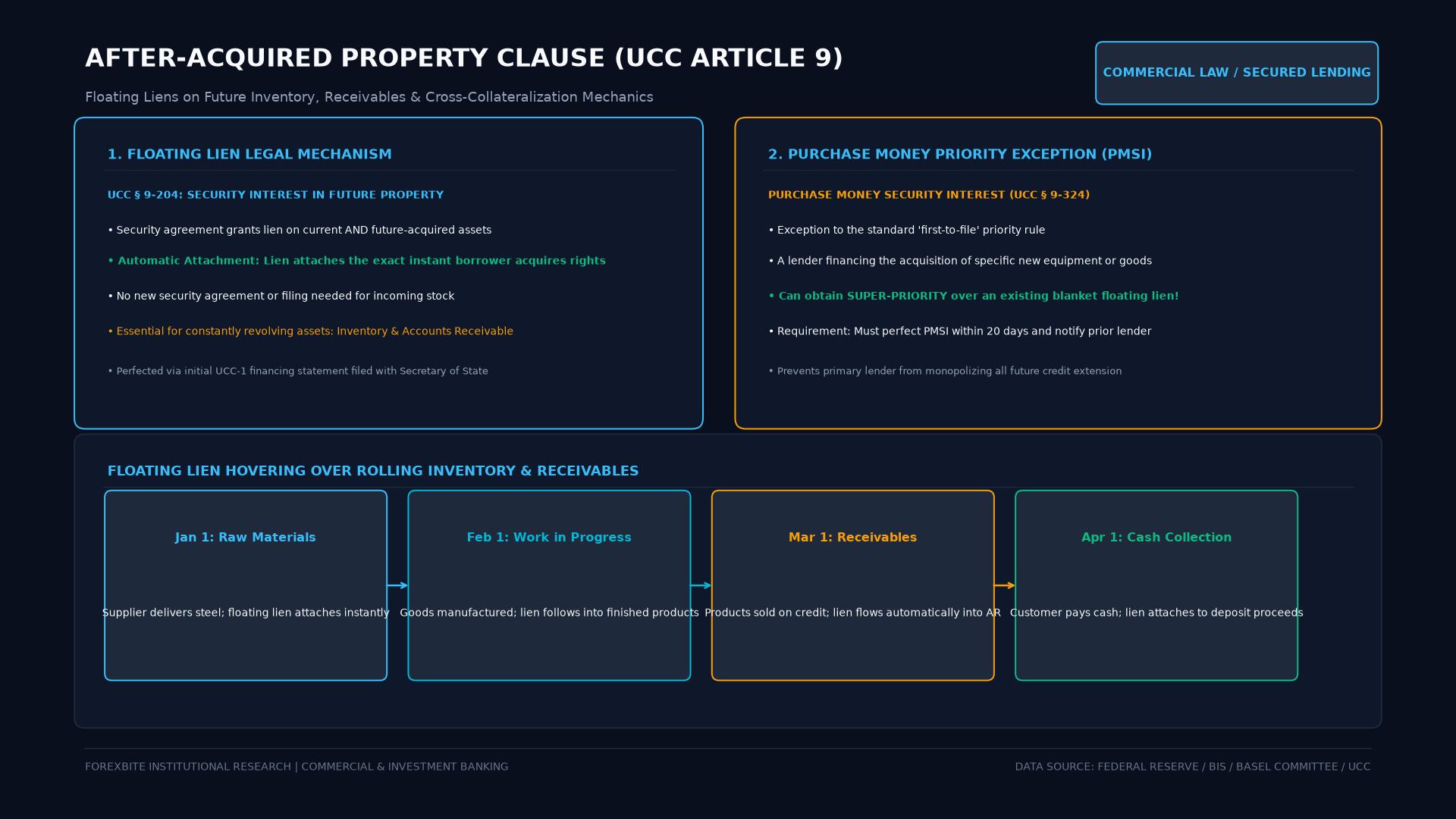 Figure: Floating lien dynamics under UCC Article 9: automatic attachment of newly acquired commercial assets, inventory, and equipment to existing security agreements.
Legal Mechanics Under UCC Article 9
In the United States, after-acquired clauses are governed by Article 9 of the Uniform Commercial Code (UCC), specifically Section 9-204:
- Section 9-204(a) General Rule: A security agreement may create or provide for a security interest in after-acquired collateral. The security interest attaches automatically when the debtor acquires rights in the collateral, provided value has been given and an authentic security agreement exists.
- Section 9-204(b) Statutory Exceptions: The UCC imposes strict consumer-protection limits on after-acquired clauses:
- Consumer Goods: An after-acquired clause cannot attach to consumer goods unless the debtor acquires rights in them within 10 days after the secured party gives value.
- Commercial Tort Claims: An after-acquired clause cannot attach to a commercial tort claim that has not yet arisen at the time the security agreement is signed.
When the secured party files a single UCC-1 Financing Statement with the Secretary of State indicating that collateral includes “all inventory, accounts receivable, and equipment now owned or hereafter acquired,” perfection applies continuously. The lender’s priority dates back to the initial UCC-1 filing date, preempting subsequent general judgment creditors.
Corporate Finance Applications
After-acquired clauses play a central role across multiple institutional debt structures:
1. Revolving Credit Facilities and Asset-Based Lending (ABL)
Commercial operating lines of credit are frequently backed by revolving collateral: accounts receivable and inventory. Because receivables are collected and inventory is sold daily, a static security agreement would leave the lender unsecured within weeks. The after-acquired clause ensures that as old inventory is sold, newly manufactured stock and newly booked receivables instantly replace it within the collateral borrowing base.
2. Utility and Railroad First Mortgage Bonds
Capital-intensive enterprises such as electrical utilities, pipeline operators, and railroad conglomerates historically issue “first mortgage bonds” secured by their entire physical networks. These indentures routinely feature after-acquired property clauses. When the utility builds a new transmission substation or lays additional track, the new physical asset is automatically subjected to the first mortgage lien, securing bondholders against enterprise dilution.
| Debt Instrument Type | Primary Collateral Encumbered | Role of After-Acquired Clause |
|---|---|---|
| ABL Working Capital Line | Invoices & Raw Materials | Captures continuously turning inventory & receivables |
| Utility First Mortgage Bond | Power plants & Distribution grids | Absorbs newly built infrastructure into bondholder pool |
| Equipment Term Loan | Fleet vehicles & Factory robots | Automatically encumbers equipment upgrades and replacements |
| Mezzanine Debt Facility | Subordinated enterprise assets | Ensures junior lien attaches to subsidiary expansions |
The Purchase Money Security Interest (PMSI) Exception
While after-acquired clauses offer robust protection to incumbent senior lenders, they create a major corporate risk: they can prevent a growing company from securing equipment financing from new vendors. If an existing lender’s lien instantly swallows any newly purchased asset, third-party equipment manufacturers will refuse to sell machinery on credit.
Commercial law resolves this gridlock through the Purchase Money Security Interest (PMSI) under UCC Section 9-324:
Super-Priority PMSI Override Mechanism:
┌─────────────────────────────────────────────────────────────┐
│ Incumbent Senior Bank                                       │
│ Holds floating lien on "All after-acquired equipment"       │
└──────────────────────────────┬──────────────────────────────┘
                               │ General Priority: Older filing wins
                               │
               BUT: Equipment Vendor Utilizes PMSI
                               │
┌──────────────────────────────▼──────────────────────────────┐
│ Third-Party Equipment Vendor (PMSI Financier)               │
│ 1. Supplies specific $500,000 CNC machine on credit         │
│ 2. Files UCC-1 within 20 days of delivery                   │
│ 3. Obtains "Super-Priority" lien on that specific machine   │
└─────────────────────────────────────────────────────────────┘
A properly perfected PMSI gives the equipment vendor a “super-priority” lien on that specific newly acquired machine, trumping the senior bank’s prior after-acquired property clause. This allows companies to acquire productive equipment while preserving the senior lender’s floating lien across the remainder of corporate assets.
Key Takeaways
- An after-acquired clause automatically extends an existing security interest or mortgage to property the borrower purchases in the future.
- Under UCC Article 9-204, after-acquired clauses form the legal foundation for floating liens on inventory, receivables, and commercial equipment.
- Statutory exceptions prohibit after-acquired clauses from attaching to consumer goods acquired after 10 days or future commercial tort claims.
- The Purchase Money Security Interest (PMSI) allows secondary financiers to obtain super-priority liens on newly acquired equipment, preventing incumbent lenders from monopolizing credit access.
Frequently Asked Questions
Why do lenders insist on an after-acquired property clause?
Lenders demand after-acquired clauses to maintain consistent collateral coverage over dynamic corporate assets. In businesses where inventory and receivables turn over continuously, failing to include this clause would leave the lender completely unsecured once the initial collateral is sold or collected.
How does an after-acquired clause affect a company’s ability to raise new debt?
It restricts the company’s borrowing capacity because unencumbered assets become encumbered the instant they are acquired. To raise new debt against future purchases, borrowers must either negotiate “carve-outs” in the original loan covenants, seek lien waivers, or finance specific purchases through Purchase Money Security Interests (PMSIs).
What happens to after-acquired collateral during Chapter 11 bankruptcy?
Under Section 552 of the US Bankruptcy Code, the post-petition effect of an after-acquired clause is cut off upon the bankruptcy petition filing date. Assets acquired by the debtor after filing the bankruptcy petition are generally not subject to the pre-petition security interest, unless the post-petition assets constitute proceeds, product, or profits generated directly from the pre-petition collateral.
Ready to trade forex?
Open a free demo account with a regulated broker. Practice with virtual funds before risking real money.