Accretive
An accretive transaction or asset acquisition is one that increases a company's per-share financial metrics, most notably pro-forma earnings per share (EPS) or free cash flow per share, immediately or over a defined post-merger integration timeframe.
What Does Accretive Mean in Finance?
In corporate finance, mergers and acquisitions (M&A), and equity analysis, the adjective Accretive describes a corporate transaction, capital expenditure, or investment that expands a company’s per-share financial metrics.
Most commonly, investment bankers and public company executives evaluate whether a proposed corporate buyout will be accretive to Earnings Per Share (EPS). An acquisition is considered accretive if the combined enterprise’s pro-forma earnings per share post-deal exceed the acquiring company’s standalone earnings per share prior to the announcement.
If an acquisition decreases pro-forma EPS, it is categorized as dilutive. Transactions that cause no change in per-share earnings are deemed neutral. While executive teams routinely market corporate acquisitions as accretive to win shareholder and board approval, Wall Street analysts scrutinize whether the deal delivers genuine long-term economic value creation or merely reflects short-term financial engineering.
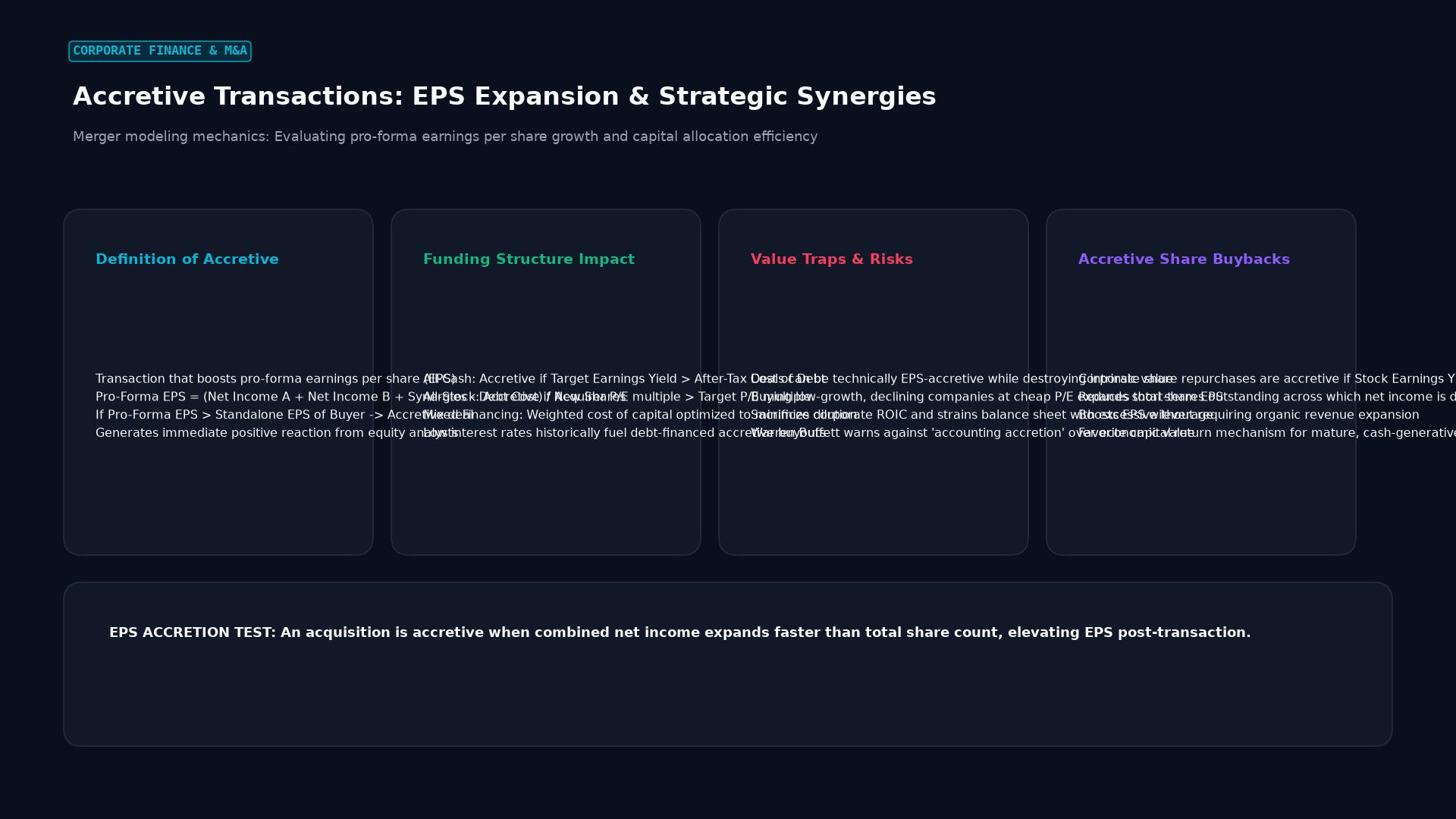 Figure: Merger modeling mechanics: Evaluating pro-forma earnings per share growth and capital allocation efficiency
Technical Mechanics of Accretion-Dilution Analysis
Investment banks construct detailed dynamic financial models to test the accretion or dilution of a transaction across different consideration mixes (cash, debt, and stock):
1. The Cost of Capital Rule (All-Stock Transactions)
In an all-stock transaction where the buyer issues new equity to purchase target shares, the outcome depends strictly on relative Price-to-Earnings (P/E) multiples:
If Acquirer P/E > Offer P/E Paid for Target ===> Deal is Accretive
If Acquirer P/E < Offer P/E Paid for Target ===> Deal is Dilutive
When a high-multiple corporation issues equity, it trades a smaller percentage of its total share count to purchase a larger proportion of the target’s operating earnings, mathematically increasing combined EPS.
2. Debt and Cash-Financed Acquisitions
When a buyer finances a transaction using cash reserves or by issuing new corporate debt, the acquisition is accretive as long as the after-tax yield of the acquired earnings exceeds the opportunity cost of foregone cash interest or after-tax debt borrowing expense:
After-Tax Cost of Debt = Pre-Tax Interest Rate × (1 - Marginal Tax Rate)
Target Earnings Yield = Target Net Income / Total Purchase Price
If the Target Earnings Yield exceeds the After-Tax Cost of Debt, the transaction is accretive to EPS, regardless of the acquirer’s stock multiple.
The Danger of “Accretive Trap” Transactions
A deal can be mathematically accretive to GAAP EPS while destroying fundamental economic value:
- Financial Engineering vs. Organic Health: A low-growth company with a 25x P/E can acquire a declining, capital-intensive business at 8x P/E. On paper, combined EPS will increase immediately. However, adding high-risk, low-margin earnings weakens enterprise quality, eventually triggering a downward rerating of the buyer’s overall valuation multiple.
- Goodwill and Debt Overhang: Cash or debt-financed deals that appear accretive can over-leverage the balance sheet, impairing credit ratings and increasing systemic default vulnerability during economic downturns.
- Ignoring Integration Costs: Pro-forma accretion models often exclude one-time severance packages, IT integration expenses, and operational plant consolidation costs that drain corporate liquidity for years.
Comparative Matrix: Accretive vs. Dilutive vs. Value-Neutral
| Dimension | Accretive Deal | Dilutive Deal | Value-Neutral Deal |
|---|---|---|---|
| Impact on EPS | Increases combined pro-forma EPS | Decreases combined pro-forma EPS | No measurable change in pro-forma EPS |
| P/E Comparison (All-Stock) | Acquirer P/E > Target purchase P/E | Acquirer P/E < Target purchase P/E | Acquirer P/E = Target purchase P/E |
| Market Reaction | Generally favorable, though subject to quality audit | Often triggers immediate share price sell-off | Neutral; market focuses on strategic synergies |
| Shareholder Approval | Easier to justify to institutional proxy voters | Demands compelling strategic or synergy justification | Evaluated on strategic market-share merits |
| Long-Term Risk | Multiple contraction if target is poor quality | Chronic return on capital destruction if synergies miss | Operational execution risk during integration |
Real-World Case Study: Enterprise Cloud Software Acquisition
In 2024, a leading enterprise software provider trading at $150 per share with an earnings multiple of 30.0x ($5.00 EPS across 80 million shares, $12 billion market capitalization) announced the acquisition of a cloud security vendor for $1.5 billion.
The target generated $75 million in net income (an implied deal multiple of 20.0x P/E). The acquirer funded the transaction via 50% stock and 50% corporate debt issued at 6.0% interest:
- Stock Component ($750M): Issued 5.0 million new shares at $150.
- Debt Component ($750M): Annual interest expense of $45 million ($33.75 million after a 25% corporate tax shield).
- Target Contribution to Combined Net Income: $75M target net income - $33.75M after-tax interest = $41.25 million incremental net income.
- Combined EPS Analysis:
Total Combined Net Income = $400M (Acquirer) + $41.25M (Net Target) = $441.25 million
Total Combined Shares = 80M + 5M = 85.0 million shares
Pro-Forma Combined EPS = $441.25M / 85M shares = $5.191 per share
EPS Accretion = $5.191 - $5.000 = +$0.191 per share (+3.82% Accretive)
The transaction delivered an immediate 3.82% boost to earnings per share while simultaneously expanding the company’s enterprise cybersecurity product line.
Frequently Asked Questions (FAQ)
What is the difference between EPS accretion and Free Cash Flow accretion?
EPS accretion measures the increase in net income per share under accrual accounting standards (GAAP/IFRS). Free Cash Flow (FCF) accretion measures the expansion in actual operating cash flow minus capital expenditures per share. Because non-cash charges like purchase price amortization reduce GAAP net income without affecting liquidity, many institutional investors prioritize FCF accretion.
How do synergies affect whether an acquisition is accretive?
Synergies represent expected post-deal cost savings (such as eliminating redundant corporate headquarters or consolidating sales software) or revenue enhancements. If a deal is initially dilutive on a standalone basis, projected synergies can push the combined entity into net accretion within one to two years following closing.
Can share buybacks be accretive?
Yes. When a corporation repurchases and retires its own common stock in the open market, it reduces the total denominator of outstanding shares. As long as the company’s earnings yield exceeds the return it earned on the cash used for the buyback, the transaction is automatically accretive to EPS.
Ready to trade forex?
Open a free demo account with a regulated broker. Practice with virtual funds before risking real money.