After-tax contribution
An after-tax contribution is a deposit made into a qualified retirement account using net compensation after income taxes have been deducted, forming the foundation for tax-deferred growth and advanced Roth conversion strategies.
What Is an After-Tax Contribution?
An after-tax contribution is a capital deposit made into a tax-advantaged retirement vehicle (such as a 401(k), 403(b), or traditional Individual Retirement Account) using money that has already been subjected to federal, state, and local income taxes. Because income taxes were paid prior to the contribution, the initial deposited principal establishes a tax-free cost basis.
In personal wealth management and executive compensation, after-tax contributions must be carefully distinguished from Roth contributions. While both are funded with post-tax dollars, a Roth contribution allows both principal and investment earnings to be withdrawn completely tax-free in retirement. By contrast, a standard after-tax contribution allows the deposited principal to be withdrawn tax-free, but any compounding investment earnings generated on that capital are taxed as ordinary income upon distribution.
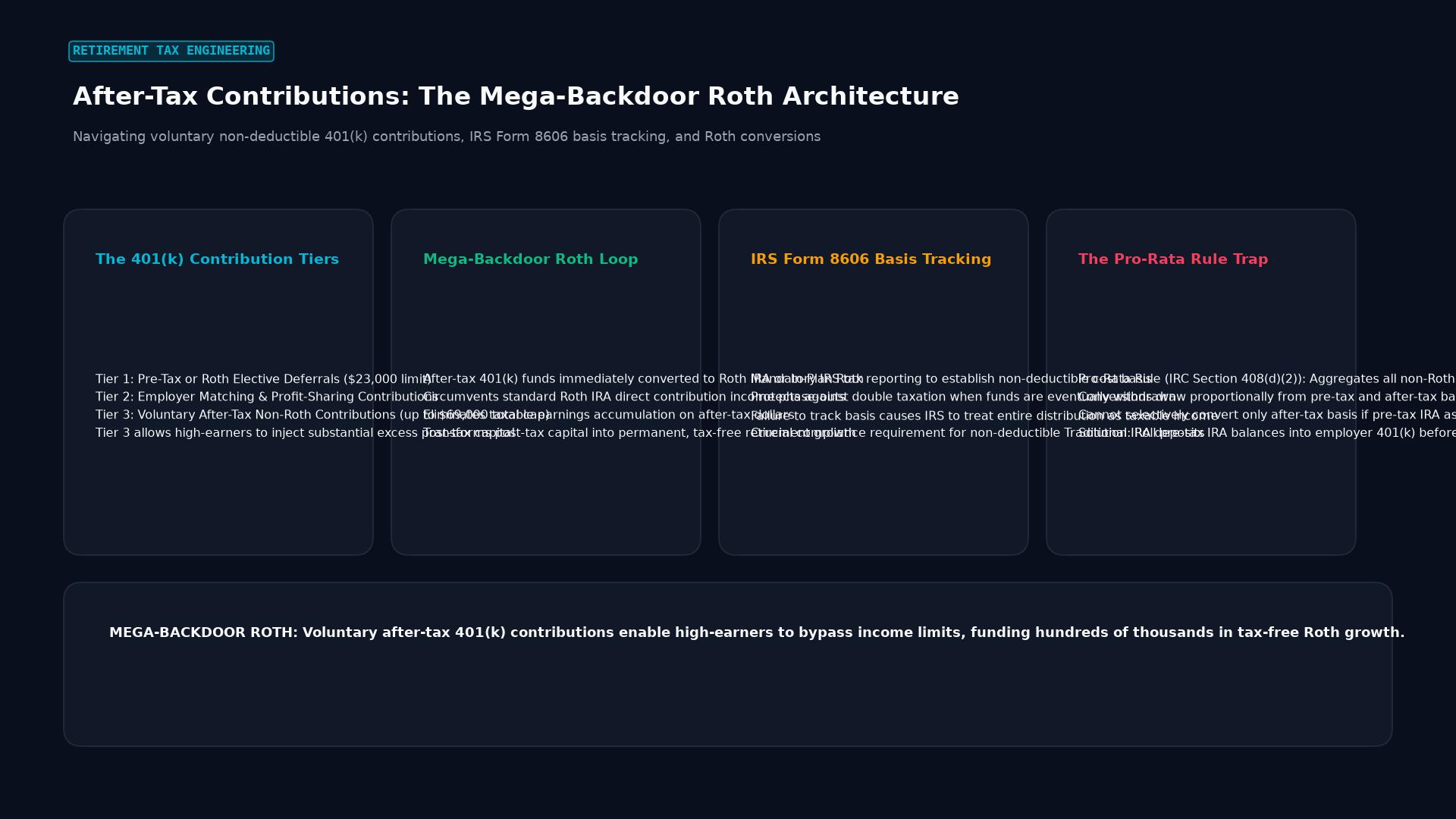 Figure: Navigating voluntary non-deductible 401(k) contributions, IRS Form 8606 basis tracking, and Roth conversions
IRC Limits: Elective Deferrals vs. Section 415(c)
The Internal Revenue Code establishes a two-tiered statutory limit structure for defined-contribution retirement plans:
- Elective Deferral Limit (IRC § 402(g)): Governs employee pre-tax and designated Roth salary reductions. For high earners, this limit caps standard contributions (for example, $23,000 to $23,500 depending on the tax year, with additional catch-up allowances for employees aged 50 and over).
- Total Annual Additions Limit (IRC § 415(c)): Governs total annual contributions to a defined-contribution plan from all sources combined, including employee elective deferrals, employer matching funds, non-elective profit sharing, and voluntary after-tax contributions. This ceiling is substantially higher (typically $69,000 to $70,000+).
IRC Limit Headroom for Voluntary After-Tax Deposits:
┌────────────────────────────────────────────────────────┐
│ Total Section 415(c) Maximum Annual Ceiling: $69,000   │
└──────────────────────────┬─────────────────────────────┘
                           │
             ┌─────────────┼─────────────────────────────┐
             ▼             ▼                             ▼
 ┌──────────────────┐ ┌──────────────────┐ ┌───────────────────┐
 │ Employee Elective│ │ Employer Match & │ │ Headroom for      │
 │ Deferral: $23,000│ │ Profit Sharing:  │ │ Voluntary After-  │
 │ (Pre-tax / Roth) │ │ $10,000          │ │ Tax: $36,000      │
 └──────────────────┘ └──────────────────┘ └───────────────────┘
When an employer’s 401(k) plan allows voluntary after-tax contributions, an employee can contribute thousands of dollars above the standard elective deferral limit until the aggregate deposits reach the Section 415(c) ceiling.
The Mega Backdoor Roth Strategy
Because earnings on standard after-tax contributions remain subject to ordinary income taxes, leaving after-tax funds in a standard 401(k) sub-account is tax-inefficient compared to holding long-term equity index funds in a taxable brokerage account. To resolve this inefficiency, high-income professionals utilize the Mega Backdoor Roth strategy:
- Maximize Standard Deferrals: The employee fully funds the standard Section 402(g) limit through traditional or Roth 401(k) payroll deductions.
- Deposit Voluntary After-Tax Funds: The employee contributes additional post-tax salary into the plan’s voluntary after-tax sub-bucket, consuming the remaining headroom up to the Section 415(c) cap.
- Execute In-Plan Conversion or Rollover: Under IRS Notice 2014-54, the plan permits the employee to immediately convert the after-tax contributions into a Designated Roth 401(k) account or execute an in-service distribution rolling the funds directly into an external Roth IRA.
The Mega Backdoor Roth Conversion Flow:
┌────────────────────────────────────────────────────────┐
│ Post-Tax Wages Deposited to 401(k) After-Tax Bucket    │
│ ($30,000 Basis / $0 Earnings)                          │
└──────────────────────────┬─────────────────────────────┘
                           │
                           ▼ Immediate Execution (Notice 2014-54)
┌────────────────────────────────────────────────────────┐
│ In-Service Distribution / Roth Conversion              │
└──────────────────────────┬─────────────────────────────┘
                           │
             ┌─────────────┴─────────────┐
             ▼                           ▼
 ┌───────────────────────┐   ┌───────────────────────────┐
 │ Roth 401(k) Account   │   │ External Roth IRA         │
 │ Permanent Tax-Free    │   │ Permanent Tax-Free        │
 │ Compounding & Returns │   │ Growth & Liquid Principal │
 └───────────────────────┘   └───────────────────────────┘
By executing the conversion immediately following deposit, the employee prevents taxable earnings from accumulating, permanently sheltering tens of thousands of dollars each year inside a tax-free Roth structure.
Tax Accounting and Separate Sub-Account Tracking
To prevent administrative chaos, retirement plan recordkeepers maintain distinct sub-accounts for each contribution type:
| Plan Sub-Bucket | Cost Basis Status | Taxation Upon Withdrawal | RMD Application |
|---|---|---|---|
| Traditional Pre-Tax | $0 Basis | 100% Taxable as ordinary income | Subject to Required Minimum Distributions |
| Designated Roth | After-tax Basis | 100% Tax-Free (Qualified distributions) | Exempt from RMDs (under SECURE 2.0 Act) |
| After-Tax Non-Roth | Segregated Basis | Basis is tax-free; earnings taxable | Subject to RMD calculations |
If an after-tax contribution generates $5,000 in dividends before a rollover occurs, the employee can roll the $30,000 after-tax principal into a Roth IRA while rolling the $5,000 in untaxed earnings into a traditional IRA, entirely avoiding immediate taxation.
Key Takeaways
- An after-tax contribution is funded with net wages after income taxes, creating an unencumbered cost basis in a retirement plan.
- Unlike Roth contributions, earnings on standard after-tax contributions do not grow tax-free; they are taxed as ordinary income upon withdrawal.
- Voluntary after-tax 401(k) contributions are governed by the Section 415(c) limit rather than the smaller Section 402(g) limit.
- IRS Notice 2014-54 allows savers to immediately convert after-tax contributions to a Roth IRA or Roth 401(k), unlocking the Mega Backdoor Roth strategy.
Frequently Asked Questions
Do all 401(k) plans permit after-tax contributions?
No. Many corporate 401(k) plans do not support voluntary after-tax contributions or in-service distributions. These features are optional plan provisions that must be explicitly established by the plan sponsor and supported by the third-party recordkeeper.
How does the IRA pro-rata rule affect after-tax 401(k) rollovers?
The dreaded IRA pro-rata rule (IRC § 708), which aggregates all traditional pre-tax IRA assets when determining the taxability of a backdoor Roth conversion, does not apply to 401(k) plans that maintain separate accounting sub-buckets for after-tax funds.
What happens if I withdraw my after-tax contribution before age 59½?
Under standard IRS ordering rules, after-tax principal can be withdrawn without incurring income taxes or the 10% early withdrawal penalty. However, if earnings are distributed alongside principal, the earnings portion is subject to ordinary income tax and the 10% penalty unless rolled over into a traditional IRA.
Ready to trade forex?
Open a free demo account with a regulated broker. Practice with virtual funds before risking real money.