AGA
AGA stands for Association of Government Accountants, a professional organization dedicated to advancing government accountability, public financial management standards, and professional certification.
What Does AGA Stand For in Public Finance?
In public sector financial management, government auditing, and municipal bond analysis, AGA stands for the Association of Government Accountants. Founded in 1950 and headquartered in Alexandria, Virginia, AGA is a professional organization dedicated to establishing standards of excellence, ethical conduct, and transparency across federal, state, and local government financial operations.
With thousands of members across North America and international chapters, AGA serves accountants, auditors, treasurers, budget analysts, and comptrollers. The organization bridges the gap between public policy mandates and rigorous accounting standards, promoting fiscal discipline and public accountability across trillions of dollars in annual government expenditures.
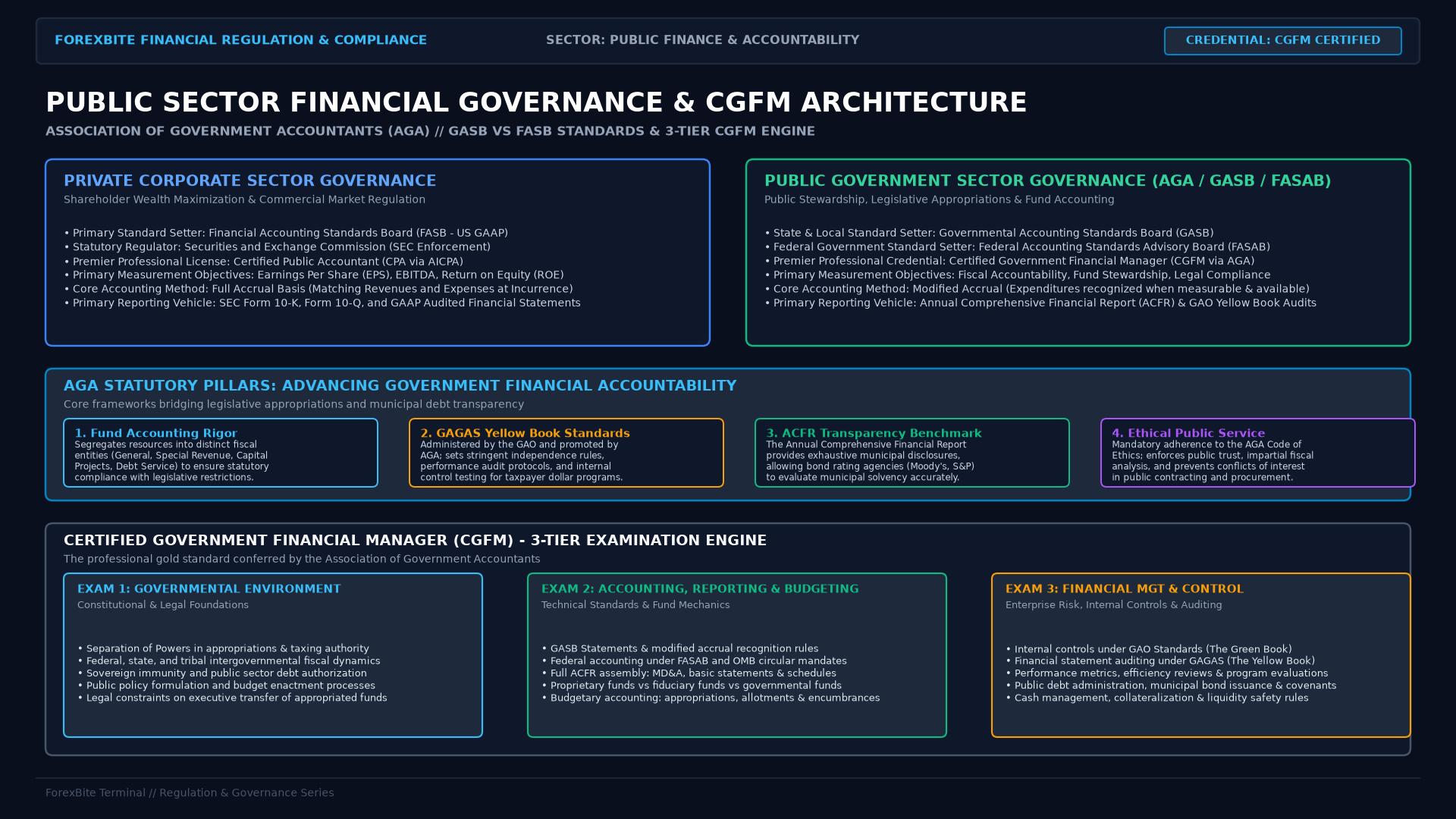 Figure: Public versus private sector accounting governance architecture, GASB and FASAB standard-setting bodies, and the AGA Certified Government Financial Manager (CGFM) 3-tier examination structure.
The Certified Government Financial Manager (CGFM) Designation
The flagship educational and credentialing initiative of AGA is the Certified Government Financial Manager (CGFM) designation. Recognized across federal, state, and municipal agencies, the CGFM is the professional benchmark for government financial management professionals.
To earn the CGFM credential, candidates must possess an accredited baccalaureate degree, satisfy professional experience requirements, adhere to the AGA Code of Ethics, and pass three rigorous examinations:
- Examination 1: Governmental Environment: Covers the legal, constitutional, and structural foundations of government, the separation of legislative, executive, and judicial powers in appropriations, and intergovernmental fiscal relationships.
- Examination 2: Governmental Accounting, Financial Reporting, and Budgeting: Focuses on fund accounting principles, modified accrual accounting methods under the Governmental Accounting Standards Board (GASB), federal budgeting rules, and the preparation of Annual Comprehensive Financial Reports (ACFR).
- Examination 3: Governmental Financial Management and Control: Evaluates performance measurement, enterprise risk management, internal controls under the GAO Green Book, debt financing administration, and auditing standards (the GAO Yellow Book).
CGFM Certification Examination Structure:
┌────────────────────────────────────────────────────────┐
│ CGFM Credentialing Path (Administered by AGA)          │
└──────────────────────────┬─────────────────────────────┘
                           │
             ┌─────────────┼─────────────────────────────┐
             ▼             ▼                             ▼
 ┌──────────────────┐ ┌──────────────────┐ ┌───────────────────┐
 │ Exam 1:          │ │ Exam 2:          │ │ Exam 3:           │
 │ Governmental     │ │ Accounting &     │ │ Financial Mgt &   │
 │ Environment      │ │ Fund Reporting   │ │ Internal Controls │
 └──────────────────┘ └──────────────────┘ └───────────────────┘
Role in Public Transparency: The Citizen-Centric Report (CCR)
A major public initiative developed by AGA is the Citizen-Centric Report (CCR) program. Traditional Annual Comprehensive Financial Reports (ACFR) frequently span hundreds of dense, legalistic pages that are unintelligible to average taxpayers and civic observers.
To solve this opacity, AGA created the four-page CCR reporting model, which municipal and federal entities use to present concise public performance summaries:
| CCR Section | Content Focus | Public Value |
|---|---|---|
| Page 1: Strategic Overview | Demographics, civic mission, leadership structure | Provides community context and governance goals |
| Page 2: Service Performance | Quantitative metrics on infrastructure, schools, safety | Shows tangible outcomes delivered from tax dollars |
| Page 3: Financial Position | Revenues, expenditures, debt service, fund balances | Presents simplified, visual revenue and spending charts |
| Page 4: Economic Outlook | Major future capital projects, economic risks | Details impending debt issuances and pension challenges |
Institutional municipal credit analysts use CCR summaries alongside formal ACFR filings to assess political stability and public transparency when evaluating municipal bond issues.
Key Takeaways
- AGA stands for Association of Government Accountants, a leading body for public financial management and accountability.
- AGA confers the Certified Government Financial Manager (CGFM) credential, covering government fund accounting, budgeting, and internal controls.
- Public sector accounting differs fundamentally from corporate accounting, emphasizing legal fund restrictions and budgetary compliance over net profit.
- AGA developed the Citizen-Centric Report (CCR) standard, providing concise four-page public financial reports for citizens and credit analysts.
Frequently Asked Questions
How does government accounting differ from corporate accounting?
Corporate accounting focuses on profitability, revenue growth, and shareholder return on equity under FASB standards. Government accounting utilizes fund accounting under GASB or FASAB rules, tracking separate restricted pools of money to ensure tax revenues are spent strictly in compliance with statutory legislative appropriations.
What is the difference between a CPA and a CGFM?
A CPA (Certified Public Accountant) is a broad, state-licensed accounting credential focused heavily on corporate auditing, tax compliance, and commercial US GAAP. A CGFM is a specialized designation focusing on government fiscal structures, fund accounting methods, legislative appropriations, and federal internal controls.
Does AGA set official government accounting standards?
No. Official accounting standards are established by the Governmental Accounting Standards Board (GASB) for state and local entities, and the Federal Accounting Standards Advisory Board (FASAB) for federal agencies. AGA acts as an educational and advisory organization that supports implementation, provides professional input, and trains practitioners on these standards.
Ready to trade forex?
Open a free demo account with a regulated broker. Practice with virtual funds before risking real money.