Age-weighted plan
An age-weighted plan is an employer-sponsored profit-sharing retirement plan that uses actuarial formulas to allocate higher contribution percentages to older participants based on their shorter investment time horizons.
What Is an Age-Weighted Plan?
An age-weighted plan is a defined-contribution, profit-sharing retirement structure that calculates employer contributions using an actuarial formula based on each employee’s age and current compensation. Unlike traditional profit-sharing plans that distribute company contributions as a uniform percentage of salary across the entire workforce, an age-weighted plan intentionally directs a larger percentage of contributions to older participants.
Authorized under the Internal Revenue Code (IRC § 401(a)) and Treasury Regulation Section 1.401(a)(4)-8, the plan relies on cross-testing rules. Cross-testing allows a defined-contribution plan to pass federal non-discrimination testing by evaluating the projected retirement benefit at normal retirement age (typically age 65) rather than the immediate annual cash deposit made by the business.
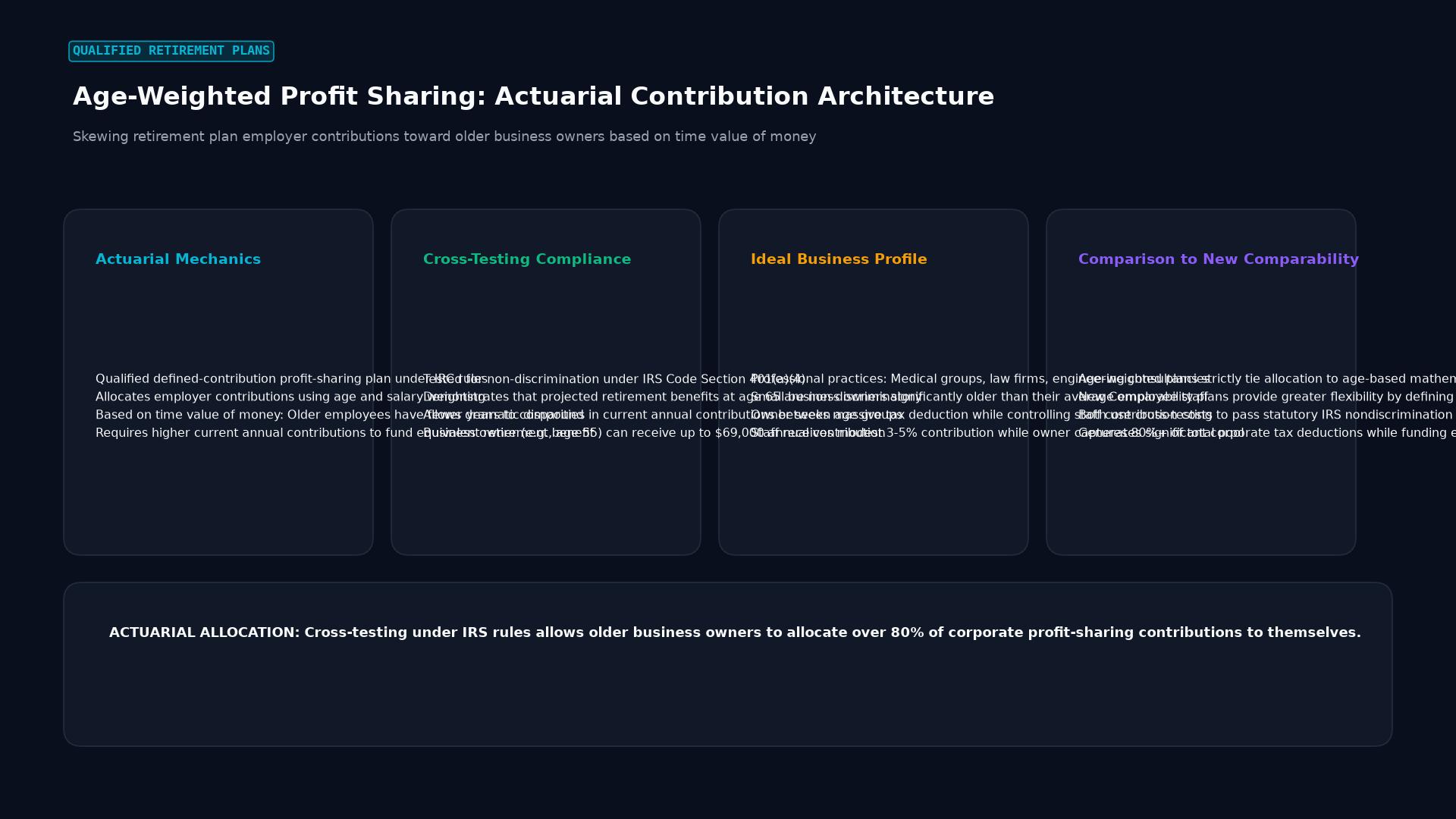 Figure: Skewing retirement plan employer contributions toward older business owners based on time value of money
The Actuarial Logic: Time Value of Money
The mathematical justification for an age-weighted plan rests on compound interest and the time value of money:
- Younger Employees: A 25-year-old worker has 40 years before reaching age 65. A single $1,000 deposit compounded at an assumed 7.0% annual interest rate expands to approximately $14,974 by retirement.
- Older Employees: A 55-year-old business owner has only 10 years until age 65. At the same 7.0% rate, a $1,000 contribution compounds to only $1,967 by retirement.
To provide both workers with the exact same projected replacement income at age 65, the employer must deposit over seven times more capital today for the 55-year-old than for the 25-year-old. Because federal non-discrimination statutes permit plans to measure equality of future projected benefits, age-weighted formulas pass IRS scrutiny while legally shifting the majority of company retirement funds to senior principals.
Allocation Matrix: Standard vs. Age-Weighted Model
Consider a small engineering consultancy consisting of an older owner and three younger associates:
| Staff Member | Age | Annual Salary | Uniform 10% Plan | Age-Weighted Plan | Effective % |
|---|---|---|---|---|---|
| Owner / Founder | 56 | $200,000 | $20,000 | $44,000 | 22.0% |
| Associate A | 38 | $75,000 | $7,500 | $4,500 | 6.0% |
| Associate B | 30 | $60,000 | $6,000 | $2,400 | 4.0% |
| Associate C | 24 | $45,000 | $4,500 | $1,350 | 3.0% |
| Total Employer Outlay | N/A | $380,000 | $38,000 | $52,250 | N/A |
| Share Captured by Owner | N/A | N/A | 52.6% | 84.2% | N/A |
Under the age-weighted formula, the business owner captures 84.2% of the total company retirement contribution, compared to just 52.6% under a uniform plan. This structure rewards the owner’s years of business stewardship while sharply controlling the overhead cost of contributions allocated to junior staff.
Employer Capital Flow Distribution Comparison:
 Uniform 10% Allocation:
 [ Owner: 52.6% ] [ Staff Pool: 47.4% ]

 Age-Weighted Cross-Tested Allocation:
 [ Owner: 84.2%                                   ] [ Staff: 15.8% ]
Ideal Business Profile and Compliance Constraints
Age-weighted plans are not suitable for every business. They deliver maximum financial efficiency under specific demographic parameters:
- Significant Age Disparity: The business owners, equity partners, or key executives must be at least 10 to 20 years older than the median age of the general workforce.
- Closely Held Entities: Professional practices (such as medical groups, legal partnerships, architectural firms, and boutique consultancies) with stable, high operating profits.
- Discretionary Funding: Like all profit-sharing plans, annual contributions are completely discretionary. If the enterprise experiences an economic downturn, the company can reduce or completely suspend contributions for that fiscal year without violating ERISA covenants.
- Top-Heavy Minimums: If more than 60% of total plan assets belong to key employees, the plan is classified as “top-heavy” under IRC § 416. In top-heavy scenarios, the employer must provide a mandatory minimum non-elective contribution (typically 3.0% of compensation) to all non-key employees.
Key Takeaways
- An age-weighted plan is an employer-sponsored retirement vehicle that allocates contributions based on both the age and salary of participants.
- The structure relies on IRS cross-testing rules, measuring projected retirement annuities rather than immediate annual cash deposits.
- Older participants receive significantly higher percentage allocations because their capital has less time to compound before retirement.
- The plan is ideal for professional service firms where older owners wish to maximize their personal tax deductions while managing general employee benefit expenses.
Frequently Asked Questions
How does an age-weighted plan differ from a defined-benefit pension?
A defined-benefit pension promises a guaranteed monthly payout in retirement and requires mandatory annual funding determined by an enrolled actuary. An age-weighted plan is a defined-contribution structure; contributions are flexible and discretionary, and investment performance risk remains with the individual employee rather than the employer.
Can an age-weighted plan be combined with a 401(k) plan?
Yes. Employers frequently pair an age-weighted profit-sharing plan with a standard 401(k) salary deferral plan. This allows employees to contribute their own pre-tax wages while the business layers age-weighted employer contributions on top.
What happens if younger employees get older?
As the general employee base ages, the required contribution percentages for staff will gradually increase under the actuarial formula. Plan sponsors must conduct annual compliance testing to ensure that demographic shifts do not cause the plan to breach IRS non-discrimination limits or inflate total employee contribution costs.
Ready to trade forex?
Open a free demo account with a regulated broker. Practice with virtual funds before risking real money.