Aggressor
In electronic financial markets and order book microstructure, the aggressor is the market participant who initiates a market order or marketable limit order that immediately crosses the bid-ask spread to execute against resting liquidity, acting as a liquidity taker.
What is an Aggressor in Market Microstructure?
In modern electronic financial markets, trading does not occur in a vacuum; every executed trade requires a counterparty. The market microstructure separates participants into two fundamental categories: passive liquidity providers (makers) and aggressive liquidity consumers (aggressors or takers).
An aggressor is an operator—whether a retail trader, institutional hedge fund, or high-frequency algorithm—who submits an order demanding immediate execution. Rather than waiting passively in the limit order book for the market to come to them, the aggressor crosses the bid-ask spread and consumes available resting limit orders. Because aggressors prioritize immediacy and execution certainty over price negotiation, they actively move the market and dictate short-term price discovery.
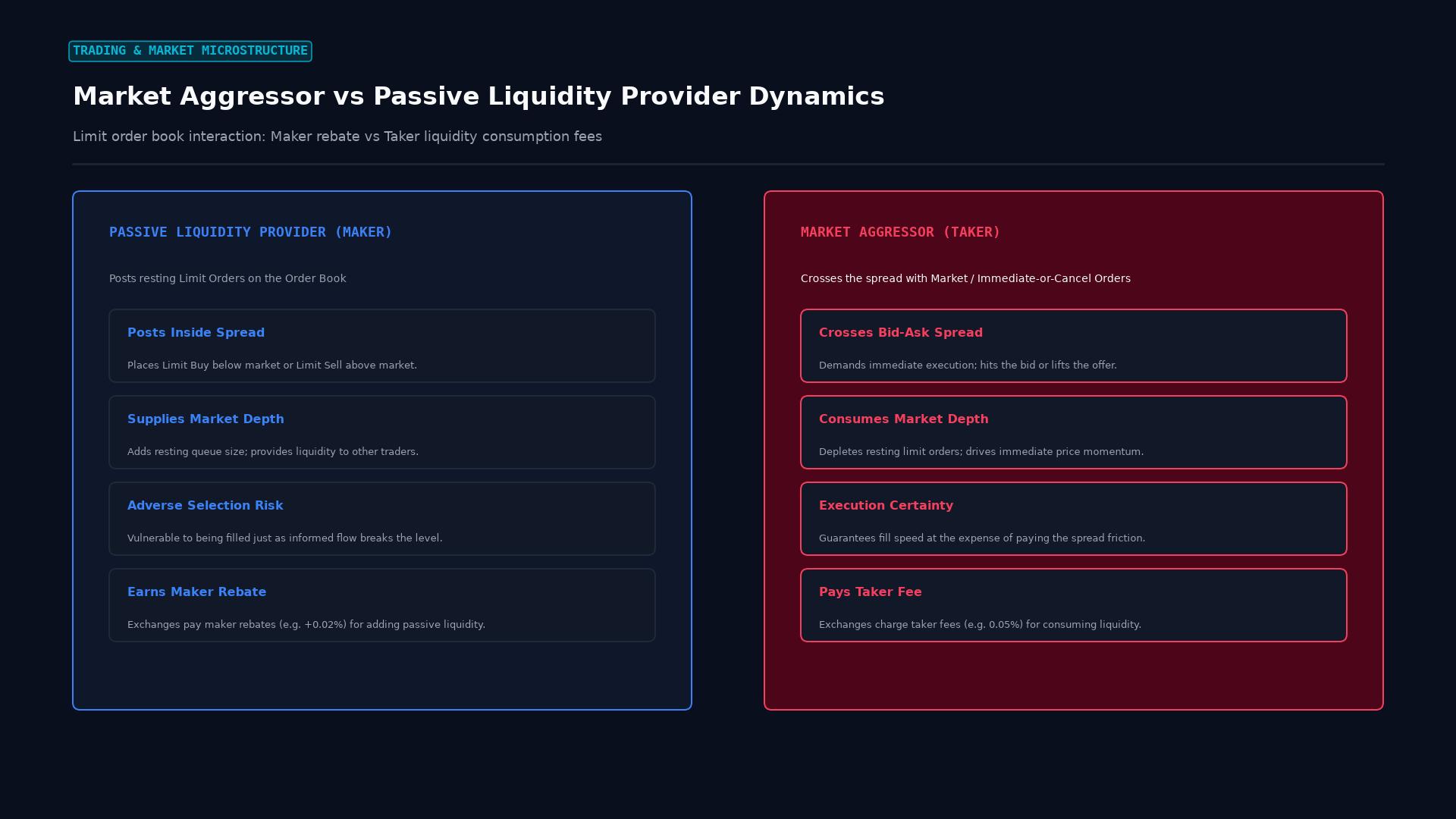 Figure: Limit order book interaction: passive makers posting inside limit queues to earn rebates versus aggressor takers crossing the spread and consuming liquidity.
The Mechanics of Aggressive vs. Passive Orders
To understand the aggressor’s role, consider the anatomy of a two-sided limit order book:
- Passive Orders (Liquidity Makers): Participants place limit orders below the current market price to buy (bids) or above the market price to sell (offers/asks). These orders rest on the exchange matching engine, offering depth to the market.
- Aggressive Orders (Liquidity Takers): The aggressor issues a market order or a marketable limit order (a buy limit priced at or above the best ask, or a sell limit priced at or below the best bid). The exchange engine matches this order immediately against the top of the book.
- Price Impact: When an aggressor’s order size exceeds the volume resting at the best bid or ask, the order sweeps through multiple price levels. This process is known as eating the book, shifting the prevailing market quote to a higher or lower level.
Measuring Market Aggression: Volume Delta and Footprint Charts
Order flow analysts and quantitative proprietary desks track aggressor behavior using specialized visual and statistical tools:
1. Volume Delta
Volume Delta isolates aggressive buying from aggressive selling by categorizing each tick based on where it executed: $$\text{Delta} = \text{Volume Executed at Ask (Aggressive Buys)} - \text{Volume Executed at Bid (Aggressive Sells)}$$
- Positive Delta: Aggressive buyers are dominating, lifting the offers.
- Negative Delta: Aggressive sellers are dominating, hitting the bids.
2. Cumulative Volume Delta (CVD)
CVD plots the rolling cumulative sum of delta over time. When price forms higher highs while CVD forms lower highs, it reveals absorption: aggressive buyers are hitting a wall of institutional passive limit sell orders, frequently signaling an impending trend reversal.
3. Footprint (Bid-Ask Cluster) Charts
Footprint charts display the exact volume transacted at each price tier inside individual candlesticks, allowing traders to observe aggressive market orders colliding directly with passive resting liquidity.
Step-by-Step Institutional Execution Example
Imagine spot EUR/USD is quoted at 1.08500 / 1.08510. The resting liquidity on the ask side of the central limit order book appears as follows:
- Level 1 (Best Ask): 1.08510 with 10 standard lots ($1,000,000 notional)
- Level 2: 1.08520 with 25 standard lots ($2,500,000 notional)
- Level 3: 1.08530 with 40 standard lots ($4,000,000 notional)
A systematic trend-following fund receives an algorithmic buy signal and submits an aggressive market buy order for 50 standard lots ($5,000,000 notional):
- The matching engine matches 10 lots at 1.08510, completely exhausting Level 1 liquidity.
- The engine instantly sweeps the next level, filling 25 lots at 1.08520, exhausting Level 2.
- The remaining 15 lots fill at 1.08530, consuming part of Level 3.
Trade Result
- Average Fill Price: $$\frac{(10 \times 1.08510) + (25 \times 1.08520) + (15 \times 1.08530)}{50} = 1.08521$$
- Market State After Trade: The new best ask is now 1.08530 (with 25 lots remaining), and the new best bid resets upward to 1.08520 as other participants adjust. The aggressor single-handedly drove the market up by 2 pips.
Comparative Matrix: Aggressor vs. Passive Liquidity Provider
| Trading Dimension | Aggressor (Liquidity Taker) | Passive Trader (Liquidity Maker) |
|---|---|---|
| Order Types Used | Market orders, marketable limit orders, stop-losses | Limit orders, resting stop-limits |
| Execution Speed | Immediate (Millisecond execution) | Latent (Waits to be matched) |
| Price Certainty | Low (Vulnerable to slippage and book depth) | High (Guaranteed fill at limit price or better) |
| Spread Cost | Pays the bid-ask spread | Collects or captures the spread |
| Exchange Fee Model | Pays higher “Taker” fee | Receives “Maker” rebate or discounted commission |
| Primary Trading Styles | Momentum breakout, news trading, high-speed scalping | Market making, algorithmic grid trading, swing entry |
| Microstructure Impact | Consumes liquidity, expands volatility | Supplies liquidity, compresses volatility |
Strategic Significance for Currency Traders
-
Stop-Loss Orders are Involuntary Aggressors: When retail or institutional stop-loss orders are triggered, they convert into market orders. A cascade of stops in a single direction produces an explosive wave of aggressive orders that sweeps the book, triggering the liquidity flash crashes often witnessed during Asian session rollovers or macroeconomic releases.
-
Identifying Exhaustion vs. Breakouts: Strong price trends require sustained aggressor volume. If a currency pair breaks a resistance level on low aggressive volume, the breakout is likely fragile and prone to a mean-reverting pullback.
-
Maker-Taker Fee Arbitrage: In institutional ECN environments, aggressive market orders carry higher turnover costs. Quantitative funds design execution algorithms (e.g., TWAP and VWAP engines) to work orders passively as makers whenever possible to avoid paying expensive taker surcharges.
Key Takeaways
- An aggressor is a market participant who initiates a trade by submitting a market order that crosses the spread and consumes resting limit orders.
- Aggressors pay for immediacy by incurring spread costs and higher exchange taker fees, while accepting slippage risk.
- Price movements are driven by aggressors consuming the available liquidity depth in the order book.
- Order flow indicators like Volume Delta, CVD, and Footprint charts allow traders to quantify aggressive buying versus aggressive selling pressure.
- Triggered stop-loss orders automatically act as aggressive market orders, fueling rapid momentum surges when clusters of stops are breached.
Frequently Asked Questions
Can a limit order ever be an aggressor?
Yes. If you submit a limit order to buy at a price equal to or higher than the current best ask (or a sell limit equal to or lower than the best bid), it becomes a marketable limit order. The exchange matching engine executes it immediately against the book rather than posting it, classifying you as an aggressor.
Why do market makers want aggressors to trade with them?
Market makers profit from the bid-ask spread. By continuously quoting bids and asks, they rely on aggressors to buy at their higher ask price and sell at their lower bid price, harvesting the spread differential while maintaining inventory risk controls.
What is the “aggressor flag” in institutional financial data feeds?
In FIX protocol and level-2 tick feeds, the aggressor flag indicates whether the incoming buyer or seller initiated the transaction. This metadata enables quantitative algorithms to reconstruct order book dynamics and identify institutional accumulation or distribution.
How do aggressive orders cause slippage?
If an aggressive market order is larger than the number of contracts available at the top bid or ask quote, the order engine must walk up or down the order ladder to fill the remainder, resulting in a blended execution price inferior to the initial quote.
Ready to trade forex?
Open a free demo account with a regulated broker. Practice with virtual funds before risking real money.