AGI
AGI stands for Adjusted Gross Income, a critical US tax metric calculated as gross taxable income minus specific above-the-line statutory deductions under Internal Revenue Code Section 62.
What Does AGI Stand For in Tax and Finance?
In taxation, personal financial planning, and credit underwriting, AGI stands for Adjusted Gross Income. Defined under Section 62 of the Internal Revenue Code (IRC § 62), AGI represents total gross income from all worldwide sources reduced by specific statutory deductions known as “above-the-line” adjustments.
Reported prominently on Line 11 of IRS Form 1040, AGI serves as the foundational benchmark of the American individual income tax system. It determines an individual’s tax liability before the application of either the standard deduction or itemized deductions. In addition, AGI functions as the gateway number that establishes eligibility for major tax credits, retirement contribution allowances, and government social benefit programs.
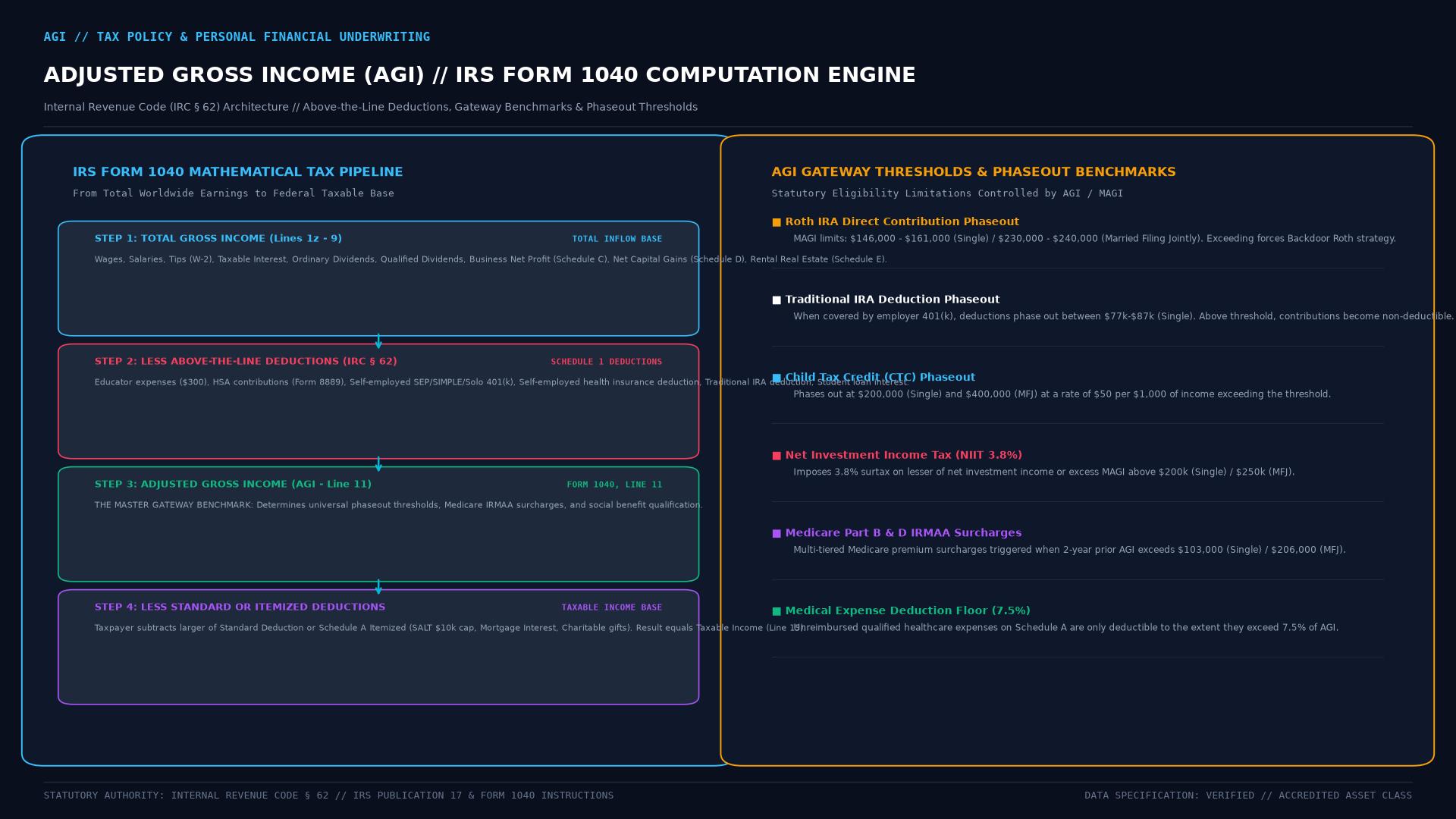 Figure: Adjusted Gross Income (AGI) IRS Form 1040 mathematical pipeline detailing above-the-line IRC § 62 adjustments and critical gateway phaseouts for tax credits and deductions.
AGI vs. MAGI: Understanding the Difference
While AGI is the official figure calculated on Form 1040, many tax provisions and retirement rules rely on Modified Adjusted Gross Income (MAGI):
- Adjusted Gross Income (AGI): The pure calculation established by subtracting allowable above-the-line deductions from gross revenues.
- Modified Adjusted Gross Income (MAGI): A customized figure derived by taking AGI and adding back certain excluded items or specific deductions. The tax code defines MAGI differently depending on the specific program or credit being evaluated.
| Tax Provision | Common MAGI Add-Backs | Financial Planning Significance |
|---|---|---|
| Roth IRA Contribution Limits | Student loan interest, foreign earned income exclusion | Determines eligibility to fund a Roth IRA directly |
| Traditional IRA Deductibility | Student loan deduction, higher education tuition | Determines if 401(k) participants can deduct IRA savings |
| ACA Premium Tax Credits | Tax-exempt municipal bond interest, untaxed Social Security | Governs health insurance premium subsidies |
| Passive Real Estate Losses | Rental loss deductions, taxable Social Security benefits | Phases out the $25,000 active real estate loss allowance |
For many standard W-2 wage earners without foreign assets or student loans, AGI and MAGI are identical numbers.
Financial Applications of AGI Beyond the Tax Return
AGI extends far beyond the annual April tax filing deadline, serving as a vital financial metric across multiple institutional sectors:
1. Itemized Deduction Percentage Floors
Several major itemized deductions on Schedule A are tied to AGI thresholds. For example, unreimbursed medical and dental expenses are deductible only to the extent that they exceed 7.5% of AGI. Similarly, casualty loss deductions and charitable contribution ceilings are evaluated as specific percentages of AGI.
2. Higher Education Financial Aid (FAFSA)
The Free Application for Federal Student Aid (FAFSA) uses parental and student AGI as the primary financial input to determine the Student Aid Index (SAI). A lower AGI unlocks need-based federal Pell Grants, subsidized student loans, and university institutional aid packages.
3. Residential Mortgage Underwriting
When borrowers apply for conventional, FHA, or VA home loans, underwriters verify household income using IRS Form 4506-C to retrieve official tax transcripts directly from the IRS. Lenders compare reported gross wages with Line 11 AGI to calculate accurate Debt-to-Income (DTI) ratios, ensuring the applicant does not maintain undisclosed business losses that impair loan repayment.
Institutional Data Flow of Form 1040 Line 11:
┌────────────────────────────────────────────────────────┐
│ IRS Form 1040 (Line 11 AGI) Certified Transcript       │
└──────────────────────────┬─────────────────────────────┘
                           │
             ┌─────────────┼─────────────────────────────┐
             ▼             ▼                             ▼
 ┌──────────────────┐ ┌──────────────────┐ ┌───────────────────┐
 │ Mortgage Lending │ │ FAFSA Student Aid│ │ ACA Health Market │
 │ DTI calculation  │ │ Financial need   │ │ Insurance premium │
 │ verification     │ │ index assessment │ │ subsidy evaluation│
 └──────────────────┘ └──────────────────┘ └───────────────────┘
Key Takeaways
- AGI stands for Adjusted Gross Income, established under IRC Section 62 and reported on Form 1040 Line 11.
- Calculated by subtracting above-the-line adjustments (such as HSA and IRA contributions) from total gross income.
- Modified Adjusted Gross Income (MAGI) adds back specific exclusions to establish phase-out thresholds for Roth IRAs and tax credits.
- Mortgage lenders, universities (FAFSA), and healthcare exchanges rely on AGI transcripts as the definitive metric of applicant income.
Frequently Asked Questions
Can my AGI be higher than my gross income?
No. Because above-the-line adjustments only reduce gross income, your AGI will always be equal to or less than your total gross income.
How does contributing to a Health Savings Account (HSA) lower AGI?
Contributions made to an HSA with post-tax dollars are reported as an above-the-line adjustment on Schedule 1. This reduces your AGI dollar-for-dollar, lowering your taxable income even if you claim the standard deduction.
Why is AGI calculated before the standard deduction?
AGI serves as a normalized baseline of economic capacity. By calculating AGI first, the tax code can set objective percentage thresholds for medical deductions, charitable contributions, and phase-outs before taxpayers apply their personal standard deduction or itemized deductions.
Ready to trade forex?
Open a free demo account with a regulated broker. Practice with virtual funds before risking real money.