Aging schedule
An aging schedule is an accounting report that categorizes a company's accounts receivable or inventory by the duration of time invoices or goods have remained outstanding, serving as a primary tool for credit risk evaluation and bad debt estimation.
What Is an Aging Schedule?
An aging schedule is a managerial accounting report that organizes open accounts receivable or outstanding inventory based on chronological age. In trade credit and receivables management, the schedule sorts outstanding customer invoices into standardized time intervals: current (0 to 30 days), 31 to 60 days, 61 to 90 days, and over 90 days past due.
Financial controllers, credit risk officers, and commercial bank auditors rely on aging schedules to evaluate corporate liquidity, monitor debtor payment behavior, and establish balance sheet reserves. Because the statistical probability of customer default increases significantly as an invoice remains unpaid, the aging schedule provides an objective, data-driven foundation for calculating bad debt allowances and assessing working capital durability.
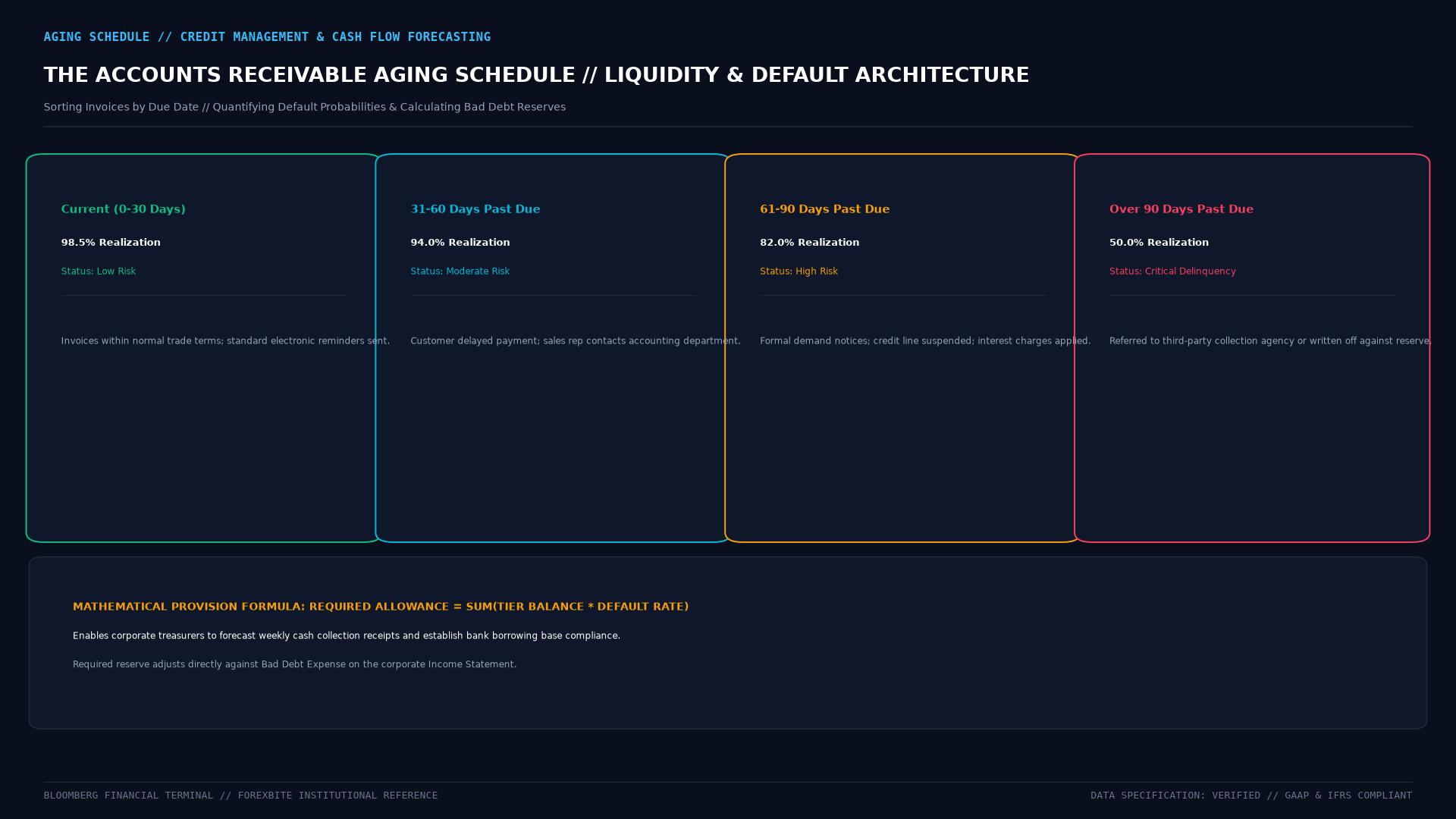 Figure: Accounts Receivable aging schedule matrix stratifying outstanding receivables into discrete time buckets (Current to 90+ Days) with progressive uncollectibility rates and expected credit loss (CECL/IFRS 9) calculations.
Technical Calculation: Allowance for Credit Losses (CECL)
Under US Generally Accepted Accounting Principles (ASC 326, Financial Instruments - Credit Losses) and International Financial Reporting Standards (IFRS 9), companies must apply the Current Expected Credit Losses (CECL) model. The aging schedule serves as the primary matrix used to determine the necessary balance for the Allowance for Doubtful Accounts (a contra-asset account offsetting gross receivables on the balance sheet).
The table below illustrates a typical corporate receivables aging schedule, mapping loss rates against aging buckets to compute the required balance sheet reserve:
| Aging Category | Gross Receivables | Historical Loss Rate | Estimated Uncollectible Reserve |
|---|---|---|---|
| Current (0–30 Days) | $2,500,000 | 1.0% | $25,000 |
| 31–60 Days Past Due | $800,000 | 4.0% | $32,000 |
| 61–90 Days Past Due | $350,000 | 15.0% | $52,500 |
| 91–120 Days Past Due | $150,000 | 40.0% | $60,000 |
| Over 120 Days Past Due | $75,000 | 80.0% | $60,000 |
| Total Accounts Receivable | $3,875,000 | N/A | $229,500 |
To adjust the balance sheet, the corporate accountant executes the following journal entry:
- Debit: Bad Debt Expense (Income Statement) for $229,500
- Credit: Allowance for Doubtful Accounts (Balance Sheet Contra-Asset) for $229,500
This reduces reported net accounts receivable to its Net Realizable Value (NRV) of $3,645,500 ($3,875,000 minus $229,500).
Balance Sheet Presentation of Receivables Aging:
┌────────────────────────────────────────────────────────────┐
│ Current Assets:                                            │
│   Cash and Cash Equivalents                    $1,200,000  │
│   Accounts Receivable, Gross     $3,875,000                │
│   Less: Allowance for Credit Losses ($229,500)             │
│   ─────────────────────────────────────────                │
│   Accounts Receivable, Net                     $3,645,500  │
│   Finished Goods Inventory                     $2,100,000  │
└────────────────────────────────────────────────────────────┘
Role in Asset-Based Lending and Borrowing Bases
In commercial bank lending, an aging schedule is a mandatory reporting covenant. When a corporation utilizes an Asset-Based Lending (ABL) credit facility, loan availability is governed by a Borrowing Base Certificate (BBC) tied directly to eligible receivables:
- Ineligible Accounts Identification: Lenders inspect the aging schedule to automatically disqualify high-risk invoices from collateral calculations. Any invoice aged over 90 days from the billing date (or 60 days past the due date) is deemed ineligible.
- Cross-Aging Rule (Tainting): If 25% or more of a specific customer’s total outstanding invoices cross into the 90+ day overdue bucket, commercial loan agreements enforce the “cross-aging rule.” Under this covenant, 100% of that customer’s receivables are marked ineligible, instantly shrinking the borrower’s available credit line.
- Foreign and Contra Balances: Invoices owed by foreign debtors without export credit guarantees or accounts subject to potential vendor setoffs (contra-accounts) are flagged and excluded during monthly aging audits.
Working Capital Metrics: Days Sales Outstanding (DSO)
Financial analysts analyze trend lines across consecutive quarterly aging schedules to calculate changes in Days Sales Outstanding (DSO):
$$\text{DSO} = \left( \frac{\text{Total Accounts Receivable}}{\text{Total Credit Sales}} \right) \times \text{Number of Days}$$
A deteriorating aging schedule, where receivables drift out of the current 0 to 30 day bucket into the 60+ and 90+ day categories, causes DSO to lengthen. This indicates that customer credit collections are faltering, warning equity analysts of potential future cash flow shortages and asset write-downs.
Key Takeaways
- An aging schedule classifies accounts receivable into chronological time buckets to track credit collection performance.
- Under ASC 326 (CECL), companies apply historical default loss rates across aging intervals to calculate the Allowance for Doubtful Accounts.
- Asset-based lenders utilize aging schedules to identify ineligible collateral and enforce cross-aging provisions on credit lines.
- Upward migration of receivables into older categories increases Days Sales Outstanding (DSO) and signals working capital stress.
Frequently Asked Questions
What does “cross-aging” mean in a receivables schedule?
Cross-aging (or tainting) occurs when a commercial lender disqualifies all outstanding invoices of a particular customer from collateral eligibility because a significant portion of that customer’s total balance (typically 25% to 50%) has exceeded the 90-day overdue threshold.
Can an aging schedule be applied to accounts payable?
Yes. An accounts payable aging schedule tracks money owed by the company to its suppliers and trade vendors. It categorizes unpaid vendor bills by due date, allowing treasury officers to prioritize payments, capture early payment discounts (such as 2/10 net 30), and manage cash outflows.
How often should a corporate finance department update the aging schedule?
In active commercial operating companies, credit departments update and review receivables aging schedules weekly. Corporate treasury teams and commercial lending partners typically require certified monthly schedules to reconcile borrowing base limits and calculate bad debt reserves.
Ready to trade forex?
Open a free demo account with a regulated broker. Practice with virtual funds before risking real money.