AGM
AGM stands for Annual General Meeting, a mandatory statutory assembly of a corporation's voting shareholders and directors to review audited financial accounts, elect board members, and vote on executive governance.
What Does AGM Stand For in Corporate Governance?
In corporate finance, company law, and equity investing, AGM stands for Annual General Meeting. It is the formal statutory assembly held once every fiscal year where the executive leadership and Board of Directors of a corporation meet with its voting equity shareholders.
Mandated under global corporate jurisprudence (such as the Delaware General Corporation Law in the United States, the UK Companies Act 2006, and international securities exchange listing rules), the AGM represents the sovereign governing forum of a public corporation. It provides common shareholders with their legal platform to exercise ownership rights, question executive management, evaluate audited financial disclosures, and vote on critical corporate resolutions.
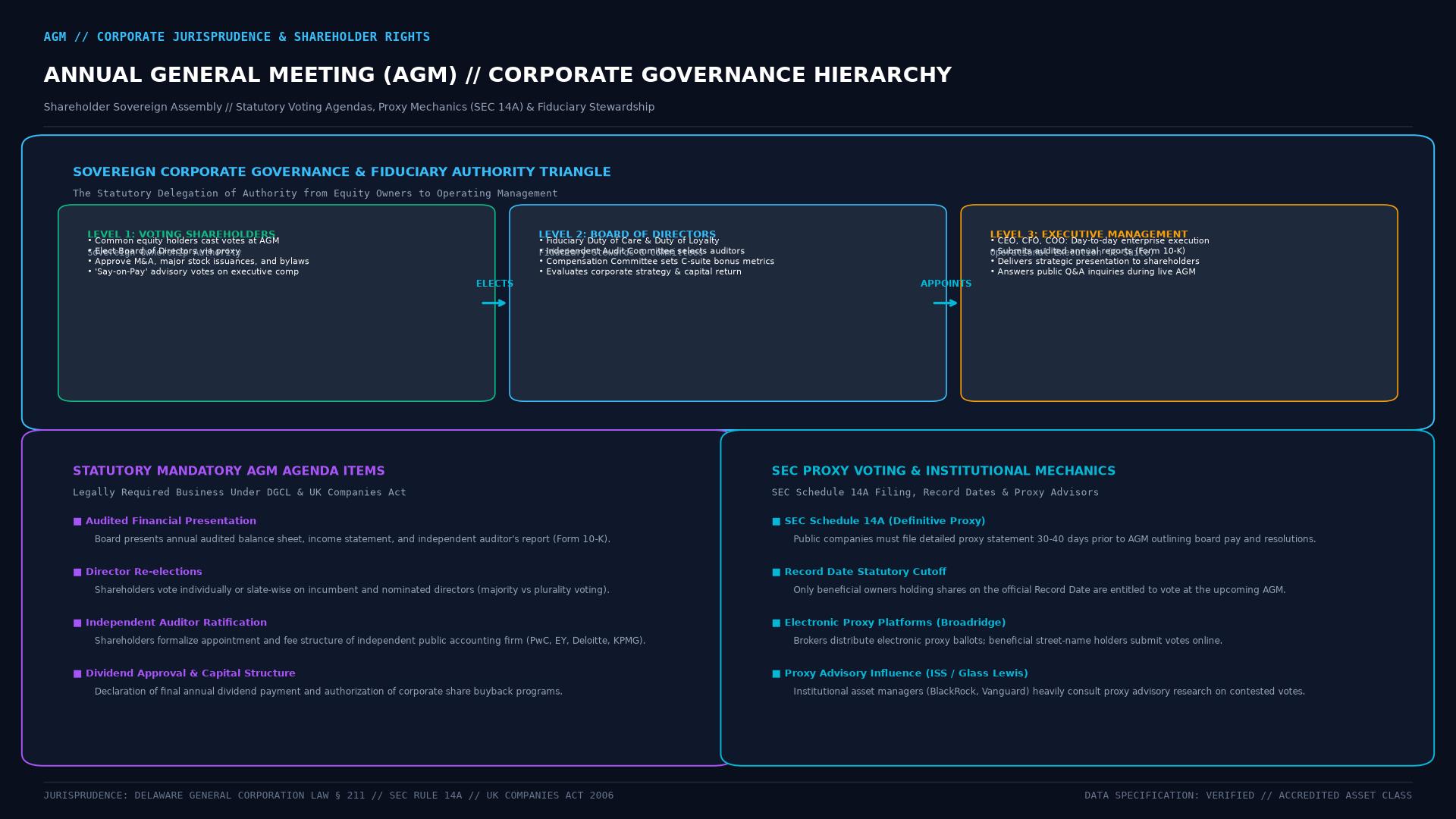 Figure: Corporate governance hierarchy of sovereign shareholder authority, Board of Directors fiduciary stewardship, and Annual General Meeting (AGM) statutory voting procedures under SEC Schedule 14A proxy rules.
Mandatory Statutory Agenda of an AGM
Corporate statutes specify strict procedural business that must be conducted during an Annual General Meeting:
- Presentation of Financial Accounts: The Chief Executive Officer and Chief Financial Officer present the company’s audited annual financial statements (such as the SEC Form 10-K in the United States), accompanied by the independent auditor’s report.
- Election of the Board of Directors: Shareholders vote to elect or re-elect members of the board. Depending on corporate charter bylaws, directors are elected annually or in staggered rotation (“classified boards”).
- Ratification of External Auditors: Shareholders formally vote to confirm the appointment of the independent public accounting firm (such as PwC, EY, Deloitte, or KPMG) and authorize the board’s audit committee to establish their professional compensation.
- Approval of Dividends: If recommended by the board, shareholders vote to declare or approve the final corporate cash or stock dividend payment.
- Executive Compensation (“Say on Pay”): Mandated in the US under the Dodd-Frank Act of 2010 and globally under governance codes, shareholders cast advisory or binding votes on executive remuneration packages and equity incentive grants.
Proxy Voting and the Influence of Proxy Advisors
Because millions of individual and institutional shareholders cannot attend an AGM in person, the vast majority of voting occurs via proxy voting:
- Proxy Statement (SEC Schedule 14A): Public companies must mail or electronically distribute a comprehensive proxy statement to all registered shareholders weeks in advance of the AGM. The filing details board candidate biographies, executive compensation breakdowns, potential conflicts of interest, and the exact text of every ballot measure.
- Proxy Advisory Firms: Institutional investors (such as BlackRock, Vanguard, State Street, and sovereign wealth funds) manage thousands of equity holdings simultaneously. To make informed voting decisions across thousands of global AGMs, institutions retain independent proxy advisory firms, predominantly Institutional Shareholder Services (ISS) and Glass Lewis. Recommendations issued by ISS or Glass Lewis frequently decide contested proxy battles.
Institutional Proxy Voting Mechanism:
┌────────────────────────────────────────────────────────┐
│ Public Corporation Files Form DEF 14A Proxy Statement  │
└──────────────────────────┬─────────────────────────────┘
                           │
             ┌─────────────┴─────────────┐
             ▼                           ▼
 ┌───────────────────────┐   ┌───────────────────────────┐
 │ Proxy Advisory Firms  │   │ Institutional Asset Mgrs  │
 │ (ISS / Glass Lewis)   │   │ (BlackRock, Vanguard, etc)│
 ├───────────────────────┤   ├───────────────────────────┤
 │ Analyze governance;   │   │ Review advice, submit     │
 │ issue vote guidance   ├──►│ electronic ballots via    │
 │ (For, Against, Abstain│   │ Broadridge / ProxyEdge    │
 └───────────────────────┘   └─────────────┬─────────────┘
                                           │
                                           ▼
                             ┌───────────────────────────┐
                             │ Tabulated at Formal AGM   │
                             └───────────────────────────┘
AGM vs. EGM: Structural Distinctions
Corporations distinguish between regular annual assemblies and emergency shareholder meetings:
| Governance Dimension | Annual General Meeting (AGM) | Extraordinary General Meeting (EGM) |
|---|---|---|
| Frequency | Once per fiscal year | Convened as emergency needs arise |
| Notice Period | Typically 21 to 30 days mandatory advance notice | Often accelerated (14 days minimum) |
| Core Agenda | Routine statutory business (accounts, directors, audit) | Urgent structural events (mergers, hostile takeover defense) |
| Convening Authority | Mandatory requirement by company charter and law | Called by board or requisitioned by large shareholders |
If a corporation enters a transformative multi-billion-dollar merger agreement midway through its fiscal year, it cannot wait for the next scheduled AGM; executive leadership will convene an Extraordinary General Meeting (EGM) to seek immediate shareholder approval.
Key Takeaways
- AGM stands for Annual General Meeting, a mandatory yearly assembly of a company’s common shareholders and board members.
- The meeting addresses statutory business, including reviewing audited financial reports, electing directors, and ratifying external audit firms.
- Proxy statements (such as SEC Schedule 14A) allow shareholders to cast votes electronically without attending in person.
- Proxy advisory firms (ISS and Glass Lewis) exercise immense influence over AGM outcomes by advising institutional index funds on ballot measures.
Frequently Asked Questions
Can shareholders submit their own resolutions for vote at an AGM?
Yes. Under SEC Rule 14a-8 in the United States and equivalent global corporate rules, qualifying shareholders who meet minimum ownership value and holding period thresholds can submit formal shareholder proposals covering corporate governance, executive compensation caps, or environmental policies.
What is a contested AGM or proxy fight?
A proxy fight occurs when an activist hedge fund or dissident shareholder group opposes management’s slate of board nominees or strategic plans. The dissident group solicits proxy votes from other shareholders to elect its own slate of directors to seize control of the board.
Are hybrid and virtual AGMs legally permitted?
Yes. Following regulatory updates accelerated by the COVID-19 pandemic, most corporate legal jurisdictions permit virtual-only or hybrid AGMs. In a virtual AGM, shareholders log into an authenticated web portal to watch executive presentations, submit questions via chat, and cast electronic votes in real time.
Ready to trade forex?
Open a free demo account with a regulated broker. Practice with virtual funds before risking real money.