AGO
AGO stands for Australian Greenhouse Office, the world's first national government climate agency established to pioneer carbon accounting, industrial emissions tracking, and environmental market mechanisms.
What Does AGO Stand For in Environmental Finance and Regulation?
In environmental economics, emissions trading, and public regulatory history, AGO stands for the Australian Greenhouse Office. Established by the Commonwealth Government of Australia in April 1998, the AGO was the world’s first dedicated national government agency created specifically to coordinate greenhouse gas abatement policy, design market-based environmental regulations, and manage climate risk.
Operating within the Department of the Prime Minister and Cabinet before being absorbed into broader climate and energy ministries, the AGO gained international prominence as a regulatory pioneer under the United Nations Framework Convention on Climate Change (UNFCCC). The agency laid the structural foundation for modern carbon credit accounting, renewable energy certificate trading, and mandatory greenhouse disclosure frameworks utilized across global capital markets today.
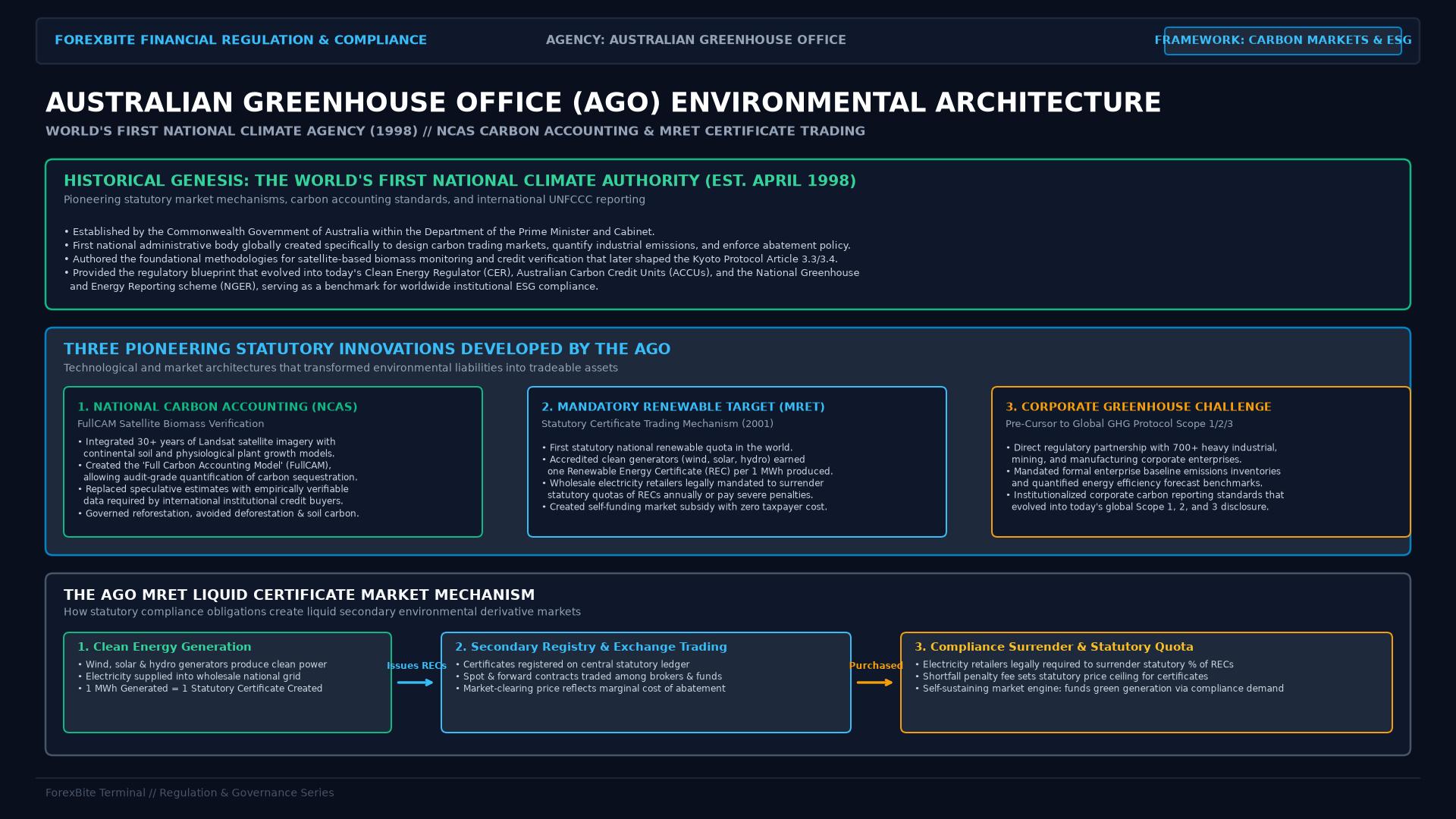 Figure: The foundational architecture of the Australian Greenhouse Office (AGO) showing NCAS satellite carbon accounting, the Mandatory Renewable Energy Target (MRET) certificate mechanism, and industrial emissions programs.
Core Regulatory Innovations Developed by the AGO
During its operational tenure, the AGO authored several regulatory frameworks that transformed how financial markets quantify environmental liabilities:
1. The National Carbon Accounting System (NCAS)
Before market participants could trade carbon credits or issue green bonds, financial institutions required an audit-grade method to verify that emissions reductions were genuine and permanent. The AGO developed the National Carbon Accounting System (NCAS), integrating multi-temporal satellite imagery, spatial soil databases, and physiological plant growth models (the Full Carbon Accounting Model, or FullCAM). This framework became an international benchmark for measuring carbon sequestration in forestry and agricultural offset projects.
2. Mandatory Renewable Energy Target (MRET)
In 2001, the AGO operationalized the Mandatory Renewable Energy Target, one of the earliest statutory market mechanisms designed to shift electric power generation toward renewables:
- Electricity wholesale retailers were legally obligated to surrender a statutory quota of Renewable Energy Certificates (RECs) each year.
- Accredited renewable power generators (wind farms, hydro installations, solar arrays) were issued one REC for each megawatt-hour (MWh) of renewable power produced.
- Retailers bought these certificates on a secondary exchange, creating an active liquid market that directly subsidized clean technology development without ongoing taxpayer funding.
3. The Greenhouse Challenge Program
The AGO partnered directly with hundreds of major industrial, mining, and manufacturing corporations. Participating companies were required to compile comprehensive baseline emissions inventories, formulate energy efficiency action plans, and submit annual progress reports, establishing the corporate greenhouse accounting standards that later evolved into the global Greenhouse Gas Protocol (Scope 1, 2, and 3 emissions).
Evolution into Modern Australian and Global Carbon Markets
The institutional mechanisms pioneered by the AGO evolved directly into Australia’s modern environmental market architecture:
| Historical AGO Initiative | Modern Statutory Body / Framework | Tradable Financial Instrument |
|---|---|---|
| MRET Certification | Clean Energy Regulator (CER) | Large-scale Generation Certificates (LGCs) |
| NCAS Carbon Modeling | Emissions Reduction Fund (ERF) | Australian Carbon Credit Units (ACCUs) |
| Industrial Auditing | National Greenhouse & Energy Reporting (NGER) | Compliance Baseline Offset Units |
Institutional commodity trading desks, foreign exchange houses, and investment banks trade ACCUs and renewable certificates alongside conventional energy derivatives. These compliance certificates represent legally recognized intangible property rights, utilized by corporate emitters to satisfy regulatory mandates under the national Safeguard Mechanism.
Carbon Credit Lifecycle Originated under AGO Methodologies:
┌────────────────────────┐         ┌────────────────────┐         ┌────────────────────┐
│ Landholder Projects    │ Audited │ Clean Energy       │ Issues  │ Secondary Financial│
│ Reforestation / Soil   ├────────►│ Regulator (CER)    ├────────►│ Market (Brokers &  │
│ Sequestration (FullCAM)│ Data    │ Verifies Baselines │ ACCUs   │ Emitters Trade)    │
└────────────────────────┘         └────────────────────┘         └────────────────────┘
Strategic Significance for Global ESG Capital Allocation
The methodologies formulated by the AGO established the empirical groundwork for modern Environmental, Social, and Governance (ESG) debt underwriting:
- Green Bond Verification: Sovereign states and multinational corporations issuing green bonds rely on spatial carbon accounting standards derived from AGO models to assure bondholders that bond proceeds achieve measurable emissions cuts.
- Cross-Border Adjustment Taxes: As major economic blocs (such as the European Union through its Carbon Border Adjustment Mechanism, or CBAM) implement border carbon tariffs, historical national emissions inventories developed by bodies like the AGO provide the baseline data needed to prevent double taxation on industrial exports.
Key Takeaways
- AGO stands for the Australian Greenhouse Office, established in 1998 as the world’s first national government climate agency.
- The AGO developed the National Carbon Accounting System (NCAS), establishing spatial satellite methodologies to verify forestry carbon sequestration.
- The agency designed the Mandatory Renewable Energy Target (MRET), pioneering tradable Renewable Energy Certificates for power markets.
- Historical AGO regulatory models laid the foundation for modern compliance carbon credits (ACCUs) and corporate ESG disclosures.
Frequently Asked Questions
Does the Australian Greenhouse Office still operate under that name today?
No. Following machinery-of-government structural reorganizations, the functions of the AGO were integrated into broader federal portfolios, culminating in the creation of the Department of Climate Change, Energy, the Environment and Water (DCCEEW) and the Clean Energy Regulator (CER), which enforces carbon market legislation today.
What is the difference between an ACCU and a Renewable Energy Certificate?
An Australian Carbon Credit Unit (ACCU) represents one metric ton of carbon dioxide equivalent (tCO2-e) stored or avoided through an approved emissions reduction project. A Renewable Energy Certificate (such as an LGC) represents one megawatt-hour (MWh) of renewable electricity generated by an accredited clean power facility.
How did the AGO influence global carbon accounting?
The AGO collaborated directly with the Intergovernmental Panel on Climate Change (IPCC) to develop standardized mathematical formulas for calculating greenhouse gas emissions from agriculture, land clearing, and industrial processes, shaping international UNFCCC reporting guidelines.
Ready to trade forex?
Open a free demo account with a regulated broker. Practice with virtual funds before risking real money.