Activity Analysis
Activity Analysis is a managerial accounting process that identifies, documents, and evaluates all organizational business tasks to distinguish value-added from non-value-added activities, forming the empirical foundation of Activity-Based Costing.
What Is Activity Analysis?
In managerial accounting, operations research, and enterprise resource planning, Activity Analysis is the systematic process of breaking down, cataloging, and evaluating the individual tasks and business processes performed by an organization’s workforce, machinery, and technology.
Rather than looking at corporate costs through rigid, traditional accounting line items (such as “rent,” “salaries,” or “office supplies”), activity analysis investigates the actual functional work executed within the business. It examines how employees spend their working hours, what steps are required to produce a product or deliver a service, and how organizational resources are consumed at every stage of the operating cycle.
Activity analysis serves as the empirical cornerstone for Activity-Based Costing (ABC) and Activity-Based Management (ABM). By providing visibility into operational workflows, it enables corporate leadership to distinguish productive operations from wasteful administrative bottlenecks.
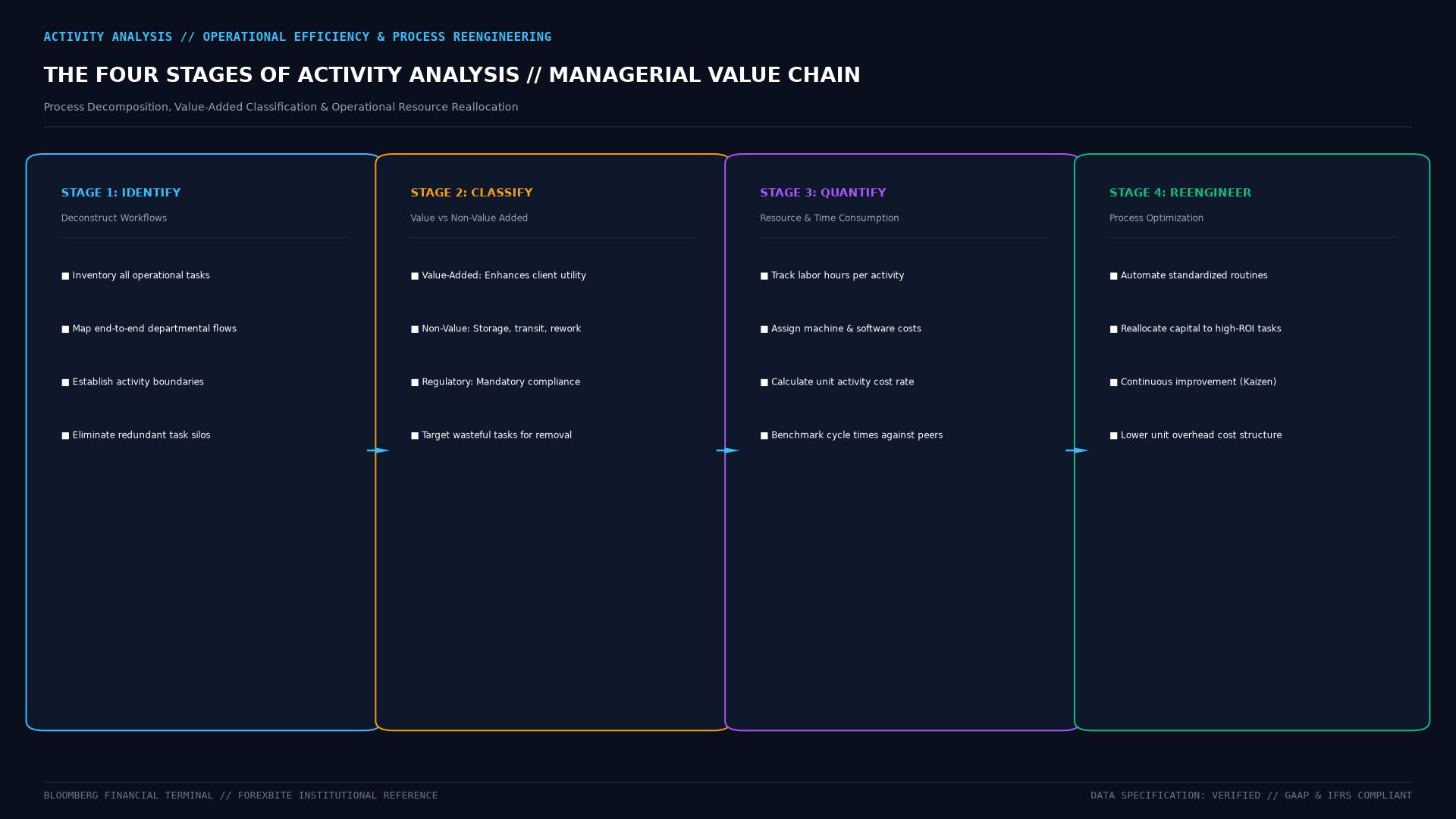 Figure: Activity Analysis workflow illustrating the classification of business processes into Value-Added (VA) versus Non-Value-Added (NVA) activities, root-cause elimination strategies, and operational cycle-time optimization.
Technical Mechanics: The Four-Step Implementation Framework
Corporate cost management teams execute an activity analysis through four standardized analytical phases:
1. Activity Identification and Process Mapping
Operations analysts conduct workplace interviews, review time-tracking logs, and construct cross-functional process flowcharts to capture every discrete activity. Tasks are cataloged using standardized “action-verb-object” nomenclature (for example: inspect raw materials, program CNC machine, reconcile bank statements, or resolve customer warranty claim).
2. Activity Classification: Value-Added vs. Non-Value-Added
Every documented activity is evaluated against strict customer-utility criteria:
- Value-Added (VA) Activities: Tasks that physically transform a product or directly advance a service in a way that external customers recognize, value, and are willing to pay for (such as precision welding, software coding, or clinical surgery).
- Business-Value-Added (BVA) Activities: Tasks that add no direct customer utility but are legally, contractually, or regulatorily mandatory (such as preparing SEC 10-K filings, filing state tax returns, or conducting OSHA safety audits).
- Non-Value-Added (NVA) Activities: Wasteful or redundant tasks that consume corporate payroll and time without adding value (such as expediting delayed orders, moving inventory between duplicate warehouses, waiting for supervisory sign-offs, or repairing assembly line defects).
3. Cost and Capacity Quantification
Once activities are cataloged, accounting teams map the general ledger expenses into discrete activity cost pools:
Activity Cost Pool = Labor Payroll Allocated + Machine Depreciation + Direct Software/Facility OverheadAnalysts calculate the practical capacity of each activity (for example, a customer service department capable of handling 5,000 inquiries per month at an activity pool cost of $125,000, yielding a unit activity cost of $25 per inquiry).
4. Establishment of the Enterprise Activity Dictionary
The final output is compiled into a standardized reference document known as the Activity Dictionary. This directory standardizes operational terminology across business units, providing uniform definitions, assigned cost drivers, and performance benchmarks.
Comparative Matrix: Activity Analysis vs. Traditional Time & Motion Study
| Analytical Parameter | Activity Analysis (ABC/ABM) | Traditional Time & Motion Study (Taylorism) |
|---|---|---|
| Primary Objective | Understanding cost causation and eliminating waste | Maximizing manual physical worker speed and output |
| Scope of Evaluation | Entire enterprise (white-collar, service, factory) | Direct factory floor and assembly line workers |
| Data Utilization | Feeds managerial accounting and product pricing | Establishes hourly piece-rate wage standards |
| View on Overhead | Deconstructs overhead into causal activity drivers | Treats overhead as an unavoidable fixed burden |
| Focus on Customer | Evaluates whether customer values the task | Focuses strictly on internal engineering efficiency |
Real-World Case Study: Healthcare System Outpatient Surgery Restructuring
In 2023, a regional hospital network managing six outpatient surgical centers experienced declining operating margins despite performing a record 14,000 surgical procedures. Traditional cost accounting showed overhead expenses expanding across all surgical departments by 18% year-over-year.
The hospital commissioned an Activity Analysis across its pre-operative, surgical, and post-anesthesia care units:
- Activity Cataloging: The audit identified 48 discrete healthcare activities, tracing 120,000 nursing and administrative hours.
- Identification of NVA Waste: The analysis revealed that registered nurses spent 22% of their shift time on an activity labeled manually transcribing patient records across incompatible software platforms, a purely non-value-added administrative task costing $3.8 million in annual nursing payroll.
- Restructuring: Management integrated an automated electronic health records API, eliminating manual data entry.
- Outcome: By reallocating nursing capacity back to clinical patient care, the hospital reduced average pre-operative waiting times by 40 minutes, boosted daily surgical throughput by 14%, and eliminated $2.9 million in annual overtime costs.
Frequently Asked Questions (FAQ)
How often should an enterprise update its activity analysis?
Organizations typically conduct a comprehensive activity analysis every three to five years, or whenever a major operational transformation occurs (such as deploying a new enterprise resource planning system, executing a merger, or automating an assembly plant). Annual reviews update unit activity driver rates to reflect inflation and productivity gains.
What is the biggest challenge in conducting an activity analysis?
Employee resistance and fear of downsizing represent the greatest hurdles. Staff members often worry that documenting their daily activities will lead to layoffs or punitive micromanagement. Successful implementations require leadership to emphasize that the goal is eliminating frustrating, inefficient administrative tasks, not eliminating staff.
Can activity analysis be applied to service and software companies?
Yes. Activity analysis is exceptionally valuable in service, banking, software, and consulting firms where 70% to 90% of total operating costs reside in white-collar salaries and technology overhead, areas that traditional standard manufacturing accounting completely fails to measure.
Ready to trade forex?
Open a free demo account with a regulated broker. Practice with virtual funds before risking real money.