Agreement among underwriters
An agreement among underwriters (AAU) is a legal contract between investment banks in an underwriting syndicate defining the syndicate manager's authority, member underwriting liabilities, fee allocations, and stabilization protocols.
What Is an Agreement Among Underwriters?
An Agreement Among Underwriters (AAU), frequently referred to in investment banking as the syndicate contract or purchase group agreement, is a legally binding contract entered into by the participating investment banks that form an underwriting syndicate. When a corporation issues securities through an Initial Public Offering (IPO) or large debt offering, a single bank rarely absorbs the entire multi-billion-dollar financing risk alone. Instead, multiple banks band together to share financial liability and expand distribution reach.
The AAU governs the internal legal and operational relationships among the syndicate members. It establishes the supreme administrative authority of the lead underwriter (syndicate manager or bookrunner), delineates each participating bank’s underwriting commitment, sets the allocation of the underwriting fee spread, authorizes secondary price stabilization, and dictates the procedures for handling unsold shares.
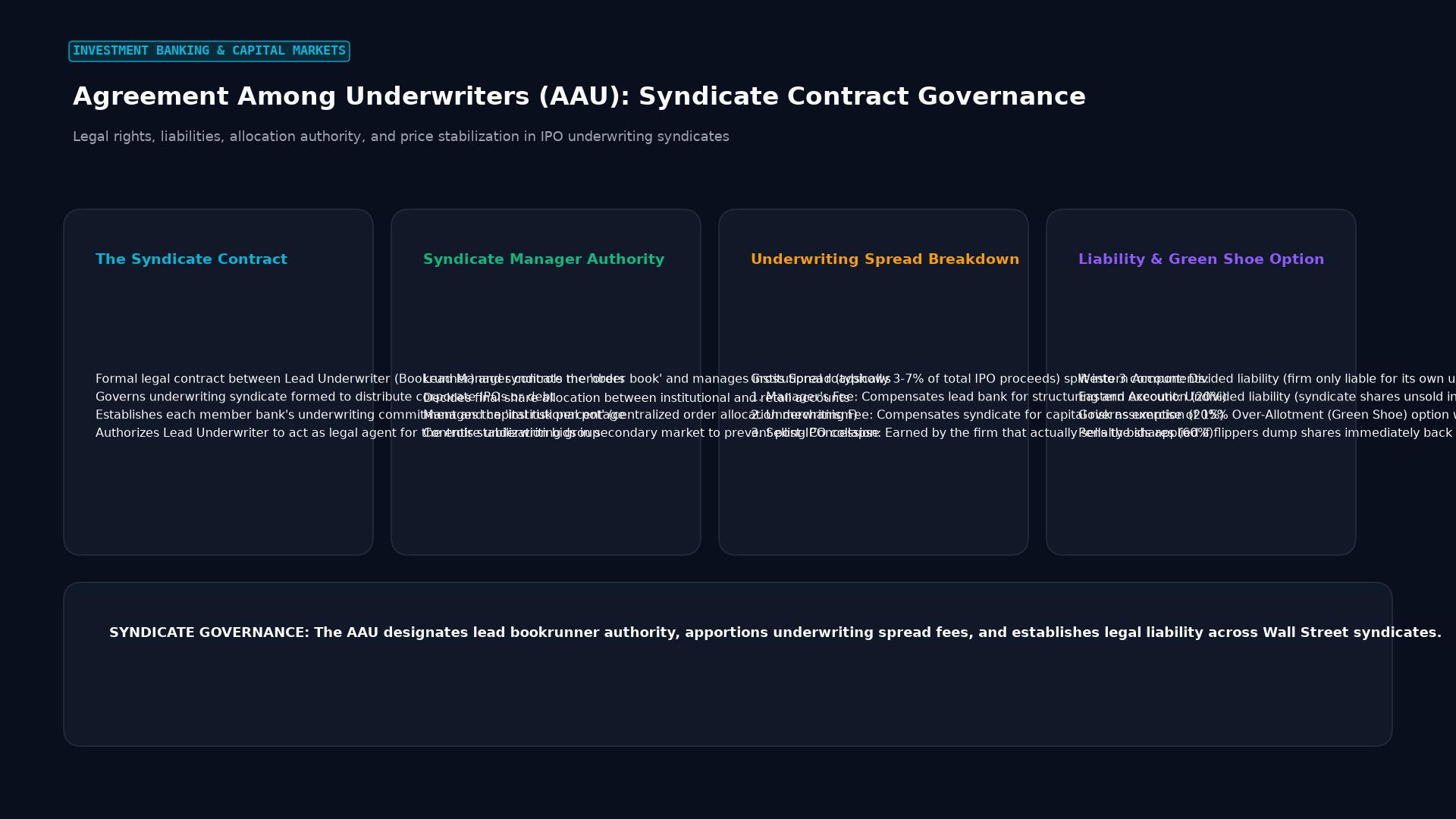 Figure: Legal rights, liabilities, allocation authority, and price stabilization in IPO underwriting syndicates
The Three Core Contracts of a Public Offering
Market participants must distinguish the Agreement Among Underwriters from the other foundational legal agreements required in public capital raises:
- The Underwriting Agreement (Purchase Agreement): Executed between the issuing corporation and the underwriting syndicate as a collective entity. It establishes the final offering price, the total number of shares or bonds purchased by the syndicate, representations and warranties, corporate indemnification clauses, and closing conditions.
- The Agreement Among Underwriters (AAU): Executed exclusively among the participating investment banks. It establishes the internal ground rules of the syndicate, granting the lead bookrunner power of attorney to negotiate and sign the primary Underwriting Agreement on behalf of all syndicate members.
- The Selected Dealers Agreement: Executed between the syndicate and outside broker-dealers who are not part of the risk-bearing underwriting syndicate. Selected dealers act strictly as selling agents, receiving a small selling concession for placing shares with retail clients without assuming liability for unsold inventory.
Core Provisions Governed by the AAU
A standard institutional AAU contains several critical structural covenants:
1. Syndicate Manager Authority
The AAU grants the lead bookrunner sweeping authority to manage the offering process. The bookrunner retains sole discretion over order book building, roadshow scheduling, institutional share allocations, and final pricing recommendations submitted to the issuer.
2. Underwriting Liability: Eastern vs. Western Accounts
The AAU explicitly defines how financial liability for unsold shares is allocated among members:
- Western Account (Divided Liability): Each syndicate member is responsible solely for its individual agreed allocation. If Bank A agrees to underwrite 10% of the deal and sells its entire 10% allocation, Bank A has zero further financial liability, even if other banks fail to sell their shares.
- Eastern Account (Undivided Liability): Syndicate members share liability collectively. If unsold shares remain after public distribution, each bank must absorb a percentage of the remaining unsold shares equal to its original commitment percentage, regardless of whether that bank sold 100% of its initial allotment.
Underwriting Liability Structure Comparison:
┌──────────────────────────────┬──────────────────────────────┐
│ Western Account (Divided)    │ Eastern Account (Undivided)  │
├──────────────────────────────┼──────────────────────────────┤
│ • "Every bank for itself"    │ • "One for all, all for one" │
│ • Sells allocation = Zero    │ • Unsold deal shares pooled  │
│   further liability          │   proportionately            │
│ • Common in equity IPO deals │ • Common in municipal debt   │
└──────────────────────────────┴──────────────────────────────┘
3. Allocation of the Gross Underwriting Spread
The AAU establishes the precise mathematical distribution of the gross underwriting spread (the difference between the price paid to the issuer and the public offering price paid by investors):
$$\text{Gross Underwriting Spread} = \text{Management Fee} + \text{Underwriting Fee} + \text{Selling Concession}$$
- Management Fee (15% to 20%): Paid directly to the lead bookrunners to compensate for deal origination, regulatory SEC filing coordination, and syndicate management.
- Underwriting Fee (15% to 20%): Distributed among all syndicate members based on their percentage commitment to cover legal expenses, credit risk, and capital commitment.
- Selling Concession (60% to 70%): Paid to whichever syndicate member or dealer actually sells the shares to an end investor.
4. Price Stabilization and Greenshoe Execution
The AAU legally authorizes the lead manager to conduct market stabilization under SEC Regulation M Rule 104. It permits the manager to post stabilizing bids on the secondary exchange, overallot shares by up to 15%, and exercise the Greenshoe option on behalf of the syndicate pool.
5. Penalty Bids and Anti-Flipping Restrictions
To prevent rapid “flipping” by institutional accounts seeking quick opening-day profits, the AAU empowers the syndicate manager to assess penalty bids. If an institutional investor sells allocated shares back into the after-market during the stabilization period, the bookrunner can reclaim the selling concession commission from the syndicate bank that originally placed those shares.
Key Takeaways
- The Agreement Among Underwriters (AAU) is the contract governing internal operations and liabilities among investment banks in an underwriting syndicate.
- It grants the lead bookrunner the legal authority to sign the primary underwriting agreement, manage the order book, and execute secondary stabilization.
- Liability is structured either as a Western Account (divided, separate liability) or an Eastern Account (undivided, pooled liability).
- The AAU defines the distribution of the gross spread across management fees, underwriting risk fees, and selling concessions.
Frequently Asked Questions
Why do investment banks form syndicates instead of underwriting deals alone?
Forming an underwriting syndicate distributes multi-billion-dollar underwriting risks across several institutional balance sheets. In addition, a syndicate combines the global institutional sales networks of multiple tier-1 investment banks, ensuring broader order book demand and pricing power.
What is the Master Agreement Among Underwriters (MAAU)?
To eliminate the need to negotiate and execute a bespoke legal contract for every public offering, major investment banks sign a Master Agreement Among Underwriters (MAAU). When a new deal is launched, banks simply send an electronic invitation wire incorporating the terms of the Master Agreement by reference, dramatically streamlining deal execution.
How does an AAU protect the issuing corporation?
Although the AAU is executed between the banks rather than with the issuer, it benefits the company by establishing an orderly, legally structured syndicate under the control of a lead bookrunner. This ensures coordinated order book discovery, eliminates conflicting bids, and coordinates post-IPO price support under federal securities laws.
Ready to trade forex?
Open a free demo account with a regulated broker. Practice with virtual funds before risking real money.