Albanian Lek
The Albanian Lek (ALL) is the official currency and legal tender of Albania, issued and managed by the Bank of Albania under a free-floating exchange rate regime.
What Is the Albanian Lek?
The Albanian Lek (ISO 4217 currency code: ALL; symbol: L) is the official legal tender and national monetary unit of the Republic of Albania. Issued and regulated by the nation’s central monetary authority, the Bank of Albania (Banka e Shqipërisë), the lek is nominally subdivided into 100 qindarka, although rapid inflation during historical economic transitions has rendered qindarka coins completely obsolete in modern commercial transactions.
The currency takes its name from Alexander the Great, known in Albanian historical tradition as Leka i Madh. The lek functions within a developing, open Balkan economy characterized by substantial remittance inflows from the European diaspora, expanding Mediterranean tourism revenues, and ongoing monetary integration initiatives alongside the European Union.
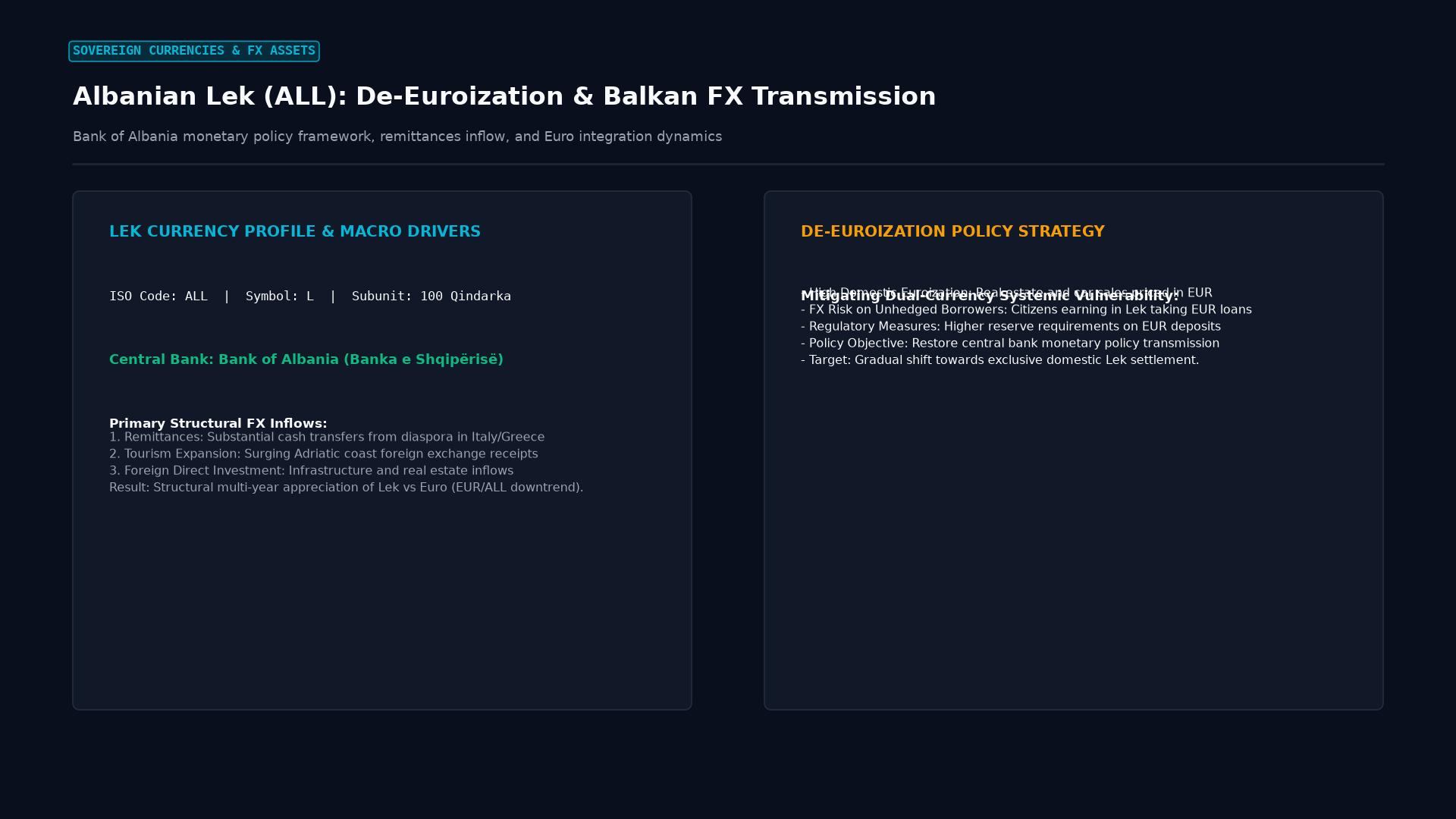 Figure: Bank of Albania monetary policy: de-euroization strategy, diaspora remittance inflows, and tourism-driven structural Lek appreciation against the Euro.
Historical Evolution and the “Old Lek” Phenomenon
The lek was introduced in February 1926 during the reign of King Zog I, establishing a unified national monetary standard to replace foreign gold and silver coins that circulated following the collapse of the Ottoman Empire.
During the post-World War II socialist era, the communist regime executed a series of confiscatory currency reforms. In 1965, the government instituted a major re-denomination at a ratio of 1 new lek for 10 old leks:
The 1965 Re-Denomination and Persistent Pricing Habit:
┌────────────────────────────────────────────────────────┐
│ 10 Historical Socialist Leks = 1 New Modern Lek (1965) │
└──────────────────────────┬─────────────────────────────┘
                           │
                           ▼ Cultural Friction
┌────────────────────────────────────────────────────────┐
│ The "Old Lek" (Lekë të Vjetra) Phenomenon              │
│ For decades, citizens and bazaar merchants colloquially│
│ quoted prices with an extra zero (e.g., quoting        │
│ 1,000 leks when the actual legal bill was 100 leks).   │
│ The central bank actively campaigns to extinguish this.│
└────────────────────────────────────────────────────────┘
Following the collapse of the communist regime in 1991, Albania transitioned rapidly toward free-market capitalism. In 1997, the collapse of widespread fraudulent pyramid investment schemes wiped out substantial household savings, sparking a nationwide civil crisis and causing the lek to lose more than half its value against the US dollar and European currencies. Comprehensive institutional restructuring of the Bank of Albania subsequently restored monetary stability.
Monetary Policy and the Free-Floating Exchange Rate
The Bank of Albania is an independent central bank operating under an explicit inflation-targeting framework, maintaining a headline target of 3.0% annual CPI inflation (with an operational tolerance band of plus or minus 1.0 percentage point).
Unlike several regional European economies that maintain strict currency board pegs to the Euro (such as Bosnia and Herzegovina or Bulgaria), Albania operates a free-floating exchange rate regime:
- Market Determination: The exchange value of the lek is determined by supply and demand across the domestic interbank foreign exchange market.
- Central Bank Intervention: The Bank of Albania does not target a specific exchange rate level. However, it intervenes periodically in foreign currency auctions to accumulate foreign exchange reserves, smooth disorderly short-term volatility, and maintain adequate import cover.
Bank of Albania Monetary Policy Transmission:
┌────────────────────────────────────────────────────────┐
│ Policy Benchmark Rate (Norma Bazë e Interesit)         │
└──────────────────────────┬─────────────────────────────┘
                           │
             ┌─────────────┴─────────────┐
             ▼                           ▼
 ┌───────────────────────┐   ┌───────────────────────────┐
 │ Domestic Credit Cost  │   │ Interbank Spot FX Market  │
 │ Bank lending rates &  │   │ ALL exchange rate vs.     │
 │ term deposit yields   │   │ EUR and USD crosses       │
 └───────────────────────┘   └─────────────┬─────────────┘
                                           │
                                           ▼
                             ┌───────────────────────────┐
                             │ Domestic Price Stability  │
                             │ (CPI Target: 3.0% ± 1.0%) │
                             └───────────────────────────┘
The De-Euroization Strategy and Recent EUR/ALL Trends
A persistent challenge for Albanian monetary policy is the structural phenomenon of informal euroization:
- Dual Currency Circulation: Historically, large commercial purchases (such as real estate transactions, vehicle sales, and corporate commercial loans) were frequently negotiated in Euros rather than Lekë.
- De-Euroization Campaign: To enhance the transmission efficiency of domestic monetary policy, the Bank of Albania launched a nationwide de-euroization strategy. The policy imposes higher reserve requirements on commercial bank foreign-currency deposits and mandates that all domestic retail consumer contracts, tax obligations, and price displays be denominated in Albanian Lek.
- Historic Lek Appreciation: In recent years, the lek experienced structural real appreciation against the Euro (EUR/ALL falling to historic lows). This currency strength was driven by record-breaking tourism revenues, foreign direct investment in Mediterranean coastal property, and sustained remittance transfers through formal banking channels.
Modern Banknote Series and Security Features
The Bank of Albania issues a modern banknote series printed on both polymer and high-grade cotton substrates, featuring prominent figures from Albanian literature, history, and independence:
| Banknote Denomination | Substrate Material | Featured Historical Figure |
|---|---|---|
| 200 Lekë | Advanced Polymer | Naim Frashëri (National poet and writer) |
| 500 Lekë | Cotton Paper | Ismail Qemali (Founding father of modern Albania) |
| 1,000 Lekë | Cotton Paper | Pjetër Bogdani (Early Albanian writer and priest) |
| 2,000 Lekë | Cotton Paper | King Gentius (Last Illyrian king) |
| 5,000 Lekë | Cotton Paper | Gjergj Kastrioti Skënderbeu (National military hero) |
| 10,000 Lekë | Cotton Paper | Aleksandër Moisiu (Renowned actor) / Asdreni (Poet) |
Key Takeaways
- The Albanian Lek (ALL) is the official currency of Albania, governed by the Bank of Albania under a free-floating exchange rate regime.
- Subdivided into 100 qindarka, though coins below one lek are no longer in practical commercial use.
- The 1965 socialist currency reform created the persistent cultural habit of quoting prices in “old leks” (with an added zero).
- The central bank enforces a de-euroization framework to preserve the domestic monetary policy transmission mechanism.
Frequently Asked Questions
Can travelers spend Euros in Albania?
While many hotels, taxis, and tourist agencies in coastal regions informally accept Euros, the official legal tender is the Albanian Lek. Foreign exchange booths (Zyra Këmbimi Valutor) operate widely across all urban centers, offering competitive cash conversion rates with minimal spreads between EUR, USD, GBP, and ALL.
What caused the historic appreciation of the lek against the Euro?
The strengthening of the lek is driven by substantial tourism growth along the Albanian Riviera, sustained foreign capital investment in infrastructure, remittances from the European diaspora, and tight interest rate policies maintained by the Bank of Albania to curb imported inflation.
What is the plural of Lek?
In the Albanian language, the plural form of lek is lekë (for example, një lek for 1 lek, and pesëqind lekë for 500 leks).
Ready to trade forex?
Open a free demo account with a regulated broker. Practice with virtual funds before risking real money.