Alert
An alert is an automated real-time notification generated by a trading platform or analytical system when market price, volatility, or technical conditions satisfy predetermined criteria.
What Is a Trading Alert?
In electronic securities trading, foreign exchange, and quantitative market monitoring, an alert is an automated notification triggered when an asset’s market price, volume, indicator value, or fundamental news release matches a predefined mathematical condition. Delivered via visual desktop popups, mobile push notifications, SMS texts, or institutional webhook API payloads, alerts allow traders to monitor hundreds of global markets simultaneously without maintaining continuous manual screen vigilance.
Modern financial markets operate 24 hours a day across global financial hubs in New York, London, Tokyo, and Sydney. Because market participants cannot actively watch price action across dozens of currency pairs or equity symbols continuously, programmatic alerts serve as an indispensable execution-filtering mechanism. They bridge the gap between passive technical analysis and active trade execution, ensuring traders react promptly to critical support and resistance tests, volatility expansions, or macro economic releases.
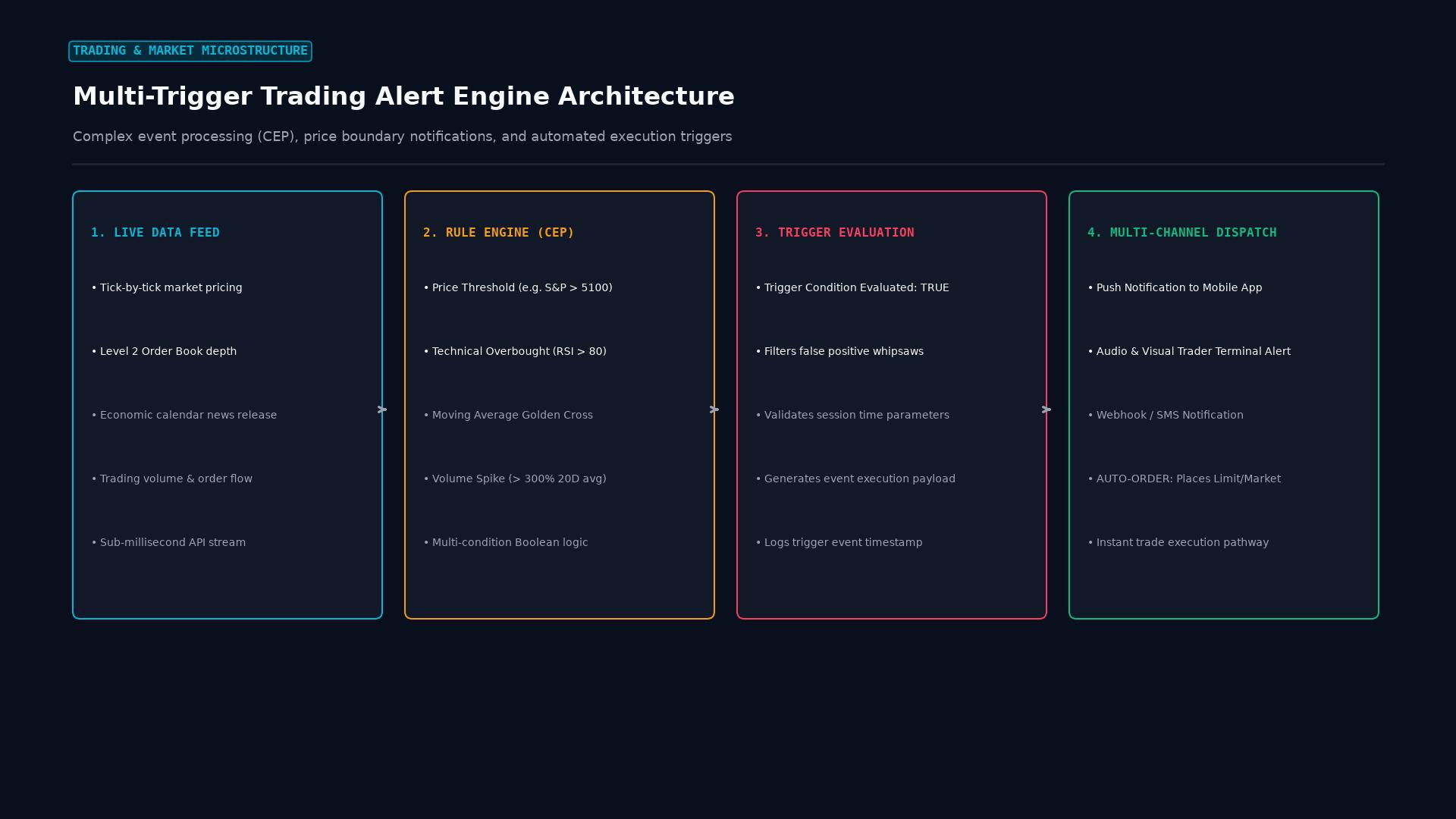 Figure: Complex Event Processing (CEP) engine pipeline: filtering live tick streams, evaluating technical indicator triggers, and dispatching multi-channel automated order alerts.
Primary Classes of Market Alerts
Trading platforms (such as MetaTrader, TradingView, Bloomberg Terminal, and cTrader) provide several functional tiers of alerts:
1. Simple Price Threshold Alerts
The most common and basic alert structure. The trader specifies a static price level (for example, “Notify when Spot Gold touches $2,650.00”). The alert fires the instant a bid or ask print matches or crosses the designated price threshold.
2. Multi-Condition Technical Indicator Alerts
Advanced alerts built by combining technical analysis indicators:
- Moving Average Crossovers: Triggering when a fast exponential moving average (20 EMA) crosses above a slow moving average (50 EMA).
- Oscillator Extremes: Firing when the Relative Strength Index (RSI) breaches 70 (overbought) or drops below 30 (oversold) on a 4-hour timeframe.
- Bollinger Band Penetrations: Alerting when price action closes outside upper or lower standard deviation bands, signaling impending mean-reversion or breakout momentum.
3. Volume and Order Flow Anomaly Alerts
Institutional desks utilize volume alerts to detect unusual market participation. An alert triggers when 1-minute trading volume surges past three standard deviations above the 30-day moving average, signaling that an institutional block order or dark pool liquidation is moving through the market.
4. Macroeconomic and Economic Calendar Alerts
In foreign exchange trading, volatility spikes surround scheduled economic data releases. Automated calendar alerts notify traders 15 minutes and 2 minutes prior to tier-1 economic events (such as the US Non-Farm Payrolls report or European Central Bank interest rate decisions), prompting traders to adjust stop-loss orders or widen slippage tolerances.
Summary of Market Alert Configurations:
┌─────────────────────┬───────────────────────────┬─────────────────────┐
│ Alert Class         │ Underlying Condition      │ Trader Application  │
├─────────────────────┼───────────────────────────┼─────────────────────┤
│ Price Level         │ Bid/Ask touches threshold │ Key level test      │
│ Indicator Cross     │ MACD signal line crossover│ Trend confirmation  │
│ Volatility Spike    │ ATR exceeds 200% norm     │ Breakout entry      │
│ Economic Event      │ FOMC Rate Decision (T-5m) │ Risk mitigation     │
│ Order Flow Imbalance│ Large block execution     │ Institutional follow│
└─────────────────────┴───────────────────────────┴─────────────────────┘
From Informational Alert to Automated Execution
In professional trading infrastructure, alerts increasingly function as direct execution triggers rather than passive audio notifications:
- Webhook Execution: Modern charting platforms allow alerts to send automated JSON webhooks directly to a broker’s Application Programming Interface (API). When a technical alert triggers on a remote server, it instantly generates a pre-formatted limit or market order, eliminating human execution latency entirely.
- Eliminating Psychological Hesitation: Manual traders often suffer from execution paralysis during rapid market moves. Programmatic alerts configured to execute orders automatically enforce trading plan discipline without emotional interference.
Best Practices and Alert Fatigue Risks
While alerts enhance market surveillance, improper configuration introduces serious operational vulnerabilities:
- Alert Fatigue: Setting dozens of tight price alerts across noisy, lower-timeframe charts (such as 1-minute or 5-minute bars) creates constant notifications. This sensory overload causes traders to ignore alerts or experience cognitive exhaustion, leading to missed high-probability setups.
- Execution Slippage: An alert indicating that a price has been touched does not guarantee that a manual market order will execute at that exact level. In fast-moving markets, the time required to view an alert, unlock a phone, and submit an order often results in severe execution slippage.
- Server vs. Client-Side Reliability: Client-side alerts run locally on the user’s computer and will fail if the software crashes or internet connectivity drops. Institutional traders rely exclusively on cloud-hosted server-side alerts that monitor market tick data independently of local machine power.
Key Takeaways
- An alert is an automated notification triggered when real-time market data satisfies predefined price, volume, or indicator criteria.
- Alerts span basic static price levels, multi-indicator technical setups, unusual volume spikes, and scheduled economic calendar events.
- Advanced traders use server-side webhooks to transmit alerts directly to broker APIs for latency-free automated order execution.
- Preventing alert fatigue requires focusing on higher-timeframe structural market levels rather than noisy short-term fluctuations.
Frequently Asked Questions
What is the difference between a price alert and a limit order?
A price alert is purely informational; it notifies the trader that a specific price has traded without taking any market action. A limit order is a working order submitted to a broker’s matching engine that automatically buys or sells the security the moment the specified price is reached.
Do trading alerts work when my computer is turned off?
It depends on whether the alert is client-side or server-side. Local alerts configured on basic desktop software require the computer to remain powered on with an active internet connection. Server-side cloud alerts (such as those hosted on TradingView or institutional VPS servers) continue running on remote infrastructure 24/7.
How can a Forex trader avoid false breakout alerts?
To filter out false breakouts, configure alerts to trigger only on the close of a candle (such as a 1-hour or 4-hour bar) rather than on an intraday tick penetration. In addition, pair price breakout conditions with secondary confirmation filters, such as above-average volume or RSI momentum thresholds.
Ready to trade forex?
Open a free demo account with a regulated broker. Practice with virtual funds before risking real money.