Algerian Dinar
The Algerian Dinar (DZD) is the official currency and legal tender of Algeria, regulated by the Bank of Algeria under a managed floating exchange rate regime tied to energy exports.
What Is the Algerian Dinar?
The Algerian Dinar (ISO 4217 currency code: DZD; domestic symbol: DA or د.ج) is the national currency and official legal tender of the People’s Democratic Republic of Algeria. Administered and issued by the nation’s central monetary authority, the Bank of Algeria (Banque d’Algérie), the dinar is nominally divided into 100 santeems, though historical inflation has eliminated santeem coins from active commercial circulation.
The dinar functions within a North African economy heavily anchored by sovereign energy wealth. As one of Africa’s largest producers of natural gas and crude petroleum, Algeria’s macroeconomic stability and foreign exchange reserves are intimately bound to international energy commodity pricing cycles. Unlike fully convertible global currencies, the dinar operates under strict domestic capital controls and a dual-tier foreign exchange market.
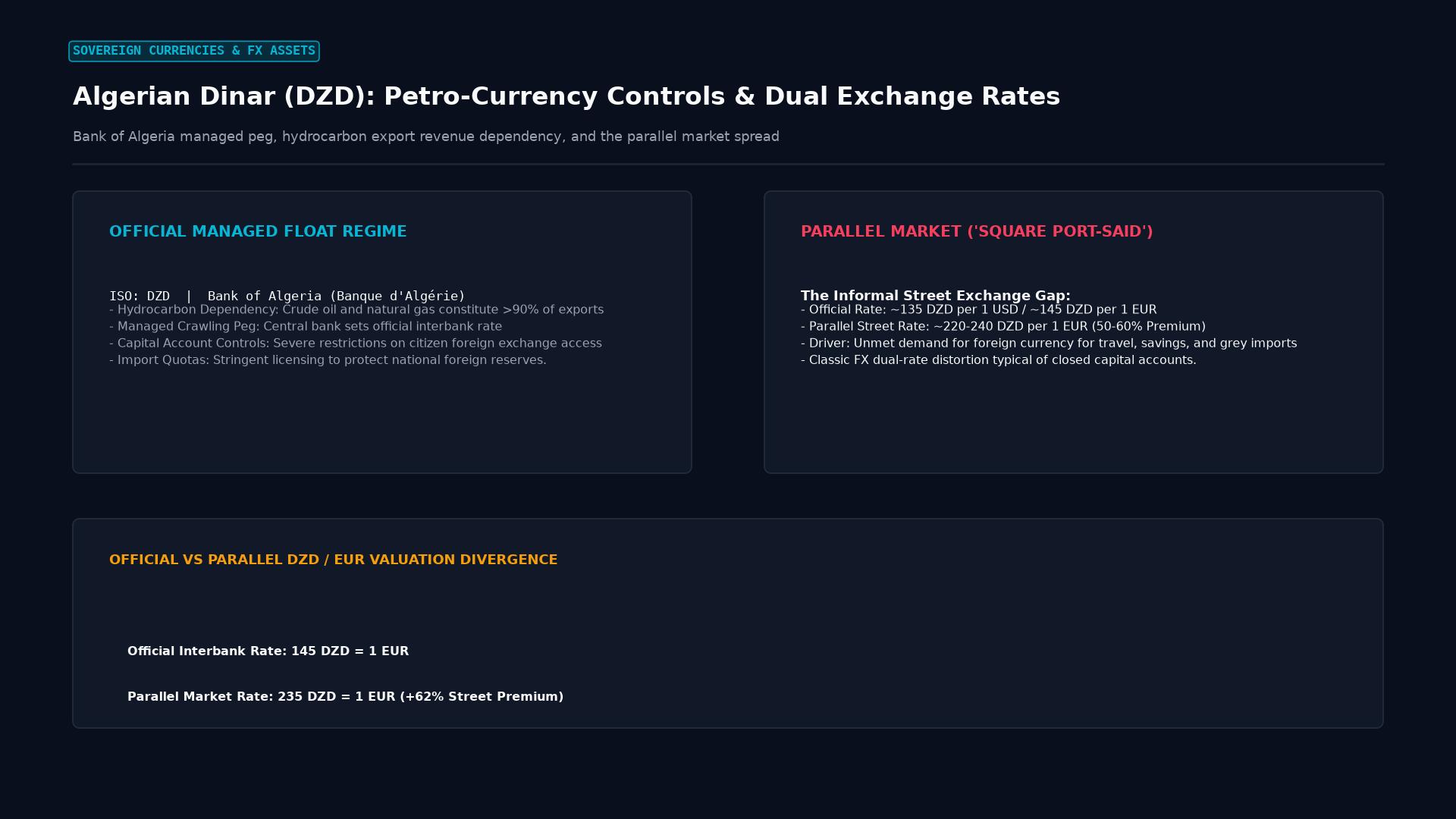 Figure: Hydrocarbon export backing: Bank of Algeria managed crawling peg versus informal parallel market spreads in Algiers’ Square Port-Said.
Historical Development of the Dinar
The dinar was introduced on April 1, 1964, replacing the Algerian new franc at par (1 dinar = 1 new franc) following Algeria’s victory in its war of independence from France.
For several decades under post-independence socialist planning, the dinar was kept artificially strong via a rigid peg to the French franc and US dollar, supported by extensive state import monopolies. Following the collapse of global oil prices in the mid-1980s and the political turbulence of the 1990s, Algeria entered an International Monetary Fund (IMF) structural adjustment program:
- 1994 Devaluation: The government executed a major 40% currency devaluation, dismantling state price controls and transitioning the dinar from a fixed peg to a managed float.
- Interbank Foreign Exchange Market: In 1996, the Bank of Algeria established an interbank foreign exchange market, allowing the central bank to calibrate the dinar’s exchange rate based on international trade balances and domestic inflation differentials.
Historical Evolution of the Algerian Currency:
┌────────────────────────────────────────────────────────┐
│ French Colonial Franc & Algerian New Franc             │
└──────────────────────────┬─────────────────────────────┘
                           │ 1962 Independence / 1964 Reform
                           ▼ (1:1 Parity)
┌────────────────────────────────────────────────────────┐
│ Fixed Socialist Pegged Dinar (1964–1994)               │
│ Centrally planned exchange rate; rigid capital limits  │
└──────────────────────────┬─────────────────────────────┘
                           │ 1994 IMF Structural Adjustment
                           ▼
┌────────────────────────────────────────────────────────┐
│ Modern Managed Floating Dinar (DZD)                    │
│ Exchange rate managed against USD and EUR trade basket │
└────────────────────────────────────────────────────────┘
Hydrocarbon Dependency and Central Bank Policy
Algeria’s fiscal balance sheet and foreign exchange liquidity are dominated by the national oil and gas conglomerate, Sonatrach:
- Hydrocarbon Export Concentration: Hydrocarbon sales historically generate roughly 90% to 95% of total national merchandise export earnings and fund the majority of state budgetary expenditures.
- The Managed Floating Anchor: The Bank of Algeria manages the dinar against a trade-weighted basket dominated by the US Dollar (the international pricing currency for oil and gas sales) and the Euro (the primary currency used for Algeria’s consumer imports from Europe).
- Sterilization and Reserve Management: During energy boom cycles, the central bank accumulates substantial US dollar foreign currency reserves and uses a specialized Sovereign Wealth Fund (the Revenue Regulation Fund, or FRR) to absorb excess liquidity and shield the domestic economy from “Dutch disease.”
The Parallel FX Market: Square Port-Saïd
A defining feature of the Algerian monetary landscape is the large disparity between the official banking exchange rate and the informal parallel market:
- Strict Foreign Exchange Rationing: Algerian citizens and private businesses face strict statutory limits on obtaining foreign currency through commercial banks. The official annual personal travel allowance (droit de change) is restricted to a nominal amount (often under €150 equivalent per year).
- Square Port-Saïd Market: To acquire foreign exchange for international travel, medical expenses, overseas education, or imported consumer goods, market participants rely on the informal currency market, centered physically at Square Port-Saïd in Algiers.
- The Parallel Spread: In the parallel cash market, the Euro and US Dollar regularly trade at a premium of 40% to 70% above the official Bank of Algeria exchange rate. This persistent divergence reflects structural excess demand for hard currencies that the formal banking sector cannot fulfill under existing capital controls.
Dual-Tier Foreign Exchange Architecture in Algeria:
┌────────────────────────────────────────────────────────┐
│ Official Central Bank Channel (Interbank FX Market)    │
│ • Strictly controlled by Bank of Algeria               │
│ • Reserved for strategic state imports and energy      │
│ • Artificially stronger dinar exchange rate            │
└────────────────────────────────────────────────────────┘
                           ▲
                           │ Wide Exchange Spread (40% to 70%)
                           ▼
┌────────────────────────────────────────────────────────┐
│ Informal Parallel Cash Market (Square Port-Saïd)       │
│ • Driven by citizen demand for EUR and USD cash        │
│ • Substantial dinar discount (weaker street rate)      │
│ • Primary conduit for diaspora remittances and travel  │
└────────────────────────────────────────────────────────┘
Key Takeaways
- The Algerian Dinar (DZD) is the legal tender of Algeria, issued and managed by the Bank of Algeria.
- The currency operates under a managed floating exchange rate regime heavily influenced by global oil and natural gas prices.
- Hydrocarbon exports provide over 90% of Algeria’s export revenues, creating direct exposure to commodity market volatility.
- Strict capital controls have created an active parallel cash market (Square Port-Saïd), where foreign currencies trade at a steep premium to the official banking rate.
Frequently Asked Questions
Can international traders trade DZD on retail Forex platforms?
No. The Algerian Dinar is a non-convertible currency subject to comprehensive exchange controls. It does not trade on standard retail electronic forex brokerages or international interbank clearing platforms.
Why does the parallel exchange rate differ from the official rate?
The difference exists because the Algerian government rations access to foreign currencies at the official rate. Because citizens and independent merchants cannot freely purchase Euros or US Dollars from domestic commercial banks, they pay a high market premium in the cash parallel market.
What is the primary foreign currency pair monitored in Algeria?
The EUR/DZD and USD/DZD pairs are the most critical. USD/DZD governs sovereign oil export revenues received by the government, while EUR/DZD dictates consumer price inflation on imported food, industrial machinery, and consumer goods arriving from the European Union.
Ready to trade forex?
Open a free demo account with a regulated broker. Practice with virtual funds before risking real money.