Alienation clause
An alienation clause, or due-on-sale clause, is a mortgage covenant that grants the lender the right to demand full immediate repayment of the remaining loan balance if the borrower transfers property ownership.
What Is an Alienation Clause?
An alienation clause (widely known in real estate banking as a due-on-sale clause) is a protective covenant included in a promissory note, residential mortgage, or commercial deed of trust. In property jurisprudence, “alienation” refers to the voluntary act of transferring, deeding, or conveying legal or equitable title to real estate from one party to another.
The alienation clause stipulates that if the mortgaged property or any interest within it is sold, conveyed, or transferred without the mortgagee’s prior written consent, the lender has the legal right to declare the entire unpaid principal balance, along with all accrued interest, immediately due and payable. If the borrower cannot satisfy the accelerated loan balance immediately, the lender can initiate judicial or non-judicial foreclosure proceedings.
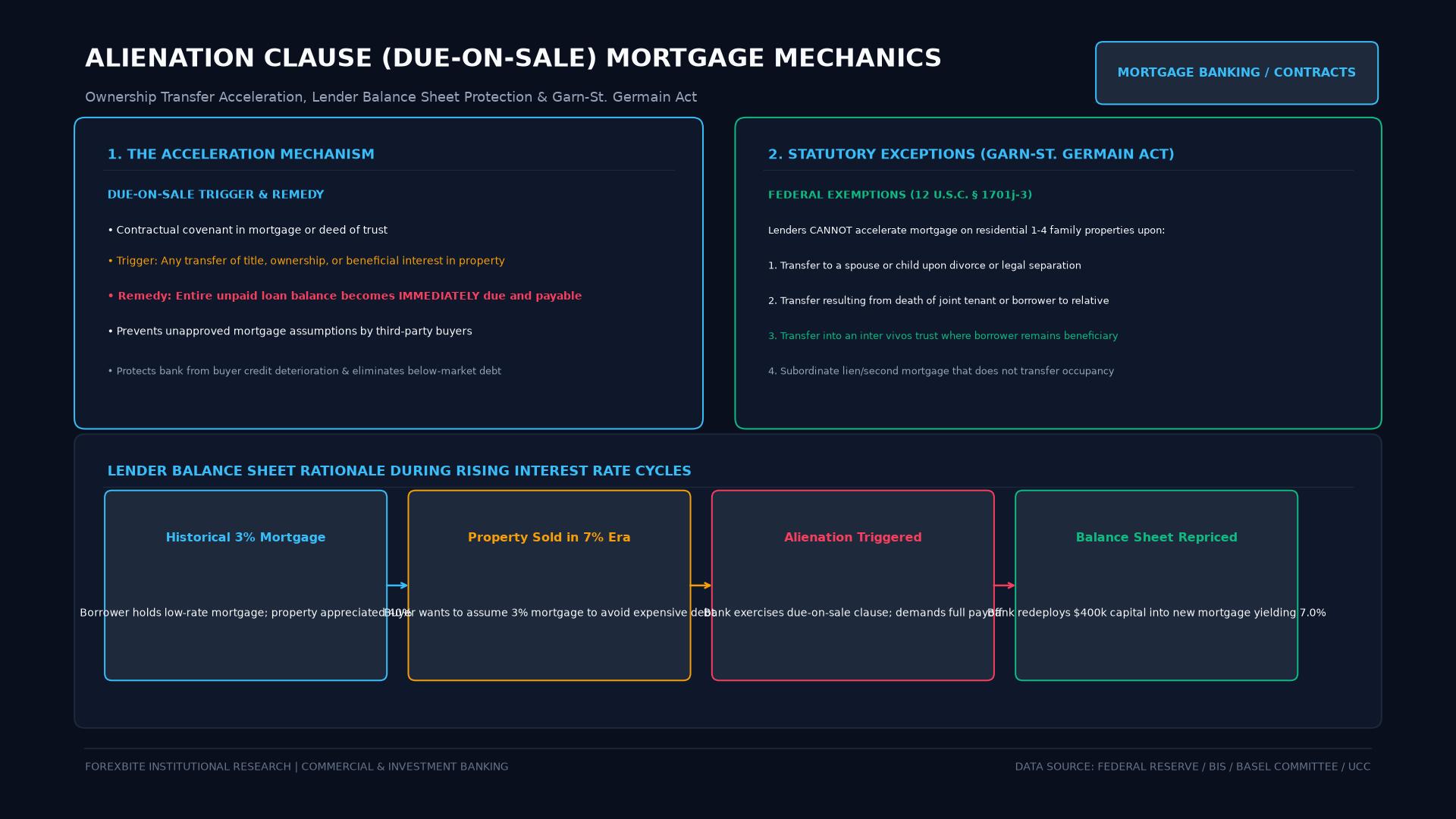 Figure: Mortgage alienation mechanics: title transfer trigger, lender acceleration right, full debt payoff demand, and Garn-St. Germain statutory exemptions.
Economic Motivation: Why Lenders Demand Alienation Clauses
Financial institutions insert alienation clauses into credit covenants for two fundamental reasons:
1. Interest Rate Risk and Portfolio Yield Management
When macroeconomic interest rates rise significantly, mortgages originated during prior low-rate regimes become liabilities for banks. For example, if a borrower holds a 30-year fixed mortgage at 3.0% and prevailing market interest rates surge to 7.0%, the bank loses money holding that low-yield asset.
Without an alienation clause, the seller could transfer the property while allowing the buyer to “assume” the existing 3.0% mortgage. The alienation clause prevents loan assumption, forcing the buyer to obtain a new mortgage originated at current 7.0% market yields, replenishing bank interest margins.
2. Credit Risk and Collateral Preservation
A mortgage approval depends on an exhaustive evaluation of a specific borrower’s credit score, income verification, and Debt-to-Income (DTI) ratio. If a borrower could freely transfer title to an unvetted third party with poor credit or a history of bankruptcy, the lender’s risk profile would deteriorate without its knowledge or approval.
Federal Legislation: The Garn-St. Germain Act of 1982
During the 1970s, several US state supreme courts (most notably the California Supreme Court in Wellenkamp v. Bank of America) ruled that due-on-sale clauses constituted an unreasonable restraint on alienation, allowing buyers to assume mortgages freely.
To protect the financial solvency of the savings and loan banking system, the United States Congress passed the Garn-St. Germain Depository Institutions Act of 1982 (12 U.S.C. § 1701j-3):
- Federal Preemption: The Act permanently preempted state laws, establishing that due-on-sale alienation clauses are fully valid and enforceable nationwide across all lenders.
- Statutory Consumer Protection Exemptions: To prevent lenders from foreclosing on vulnerable families during personal life events, Congress created statutory exemptions under Section 1701j-3(d) where lenders are legally prohibited from enforcing an alienation clause:
| Statutory Exemption | Legal Circumstance Protected |
|---|---|
| Spousal & Child Transfers | Transfer to a spouse or child upon marriage or life-cycle restructuring |
| Devise or Descent (Death) | Transfer to a relative resulting from the death of the primary borrower |
| Marital Dissolution | Transfer resulting from a divorce decree, legal separation, or property settlement |
| Living Revocable Trusts | Transfer into an inter vivos trust where the borrower remains beneficiary & occupant |
| Subordinate Liens | Creation of a junior lien (second mortgage/HELOC) that does not transfer occupancy |
| Short-Term Leases | Granting of a leasehold interest of three years or less containing no purchase option |
Alienation Clause vs. Acceleration Clause
While real estate students often confuse the two terms, an alienation clause is a specific subtype of acceleration clause:
Contractual Relationship Between Debt Acceleration Clauses:
┌────────────────────────────────────────────────────────┐
│ ACCELERATION CLAUSE (Broad Governing Category)         │
│ Allows lender to demand immediate full debt payoff     │
│ upon borrower breach of any contractual covenant.      │
└──────────────────────────┬─────────────────────────────┘
                           │
             ┌─────────────┼─────────────┐
             ▼             ▼             ▼
 ┌──────────────────┐ ┌──────────────────┐ ┌───────────────────┐
 │ Default Breach   │ │ Covenant Breach  │ │ ALIENATION CLAUSE │
 │ Failure to make  │ │ Failure to pay   │ │ Transfer of title │
 │ monthly mortgage │ │ property taxes   │ │ or ownership      │
 │ principal & int. │ │ or fire insurance│ │ without consent   │
 └──────────────────┘ └──────────────────┘ └───────────────────┘
Every alienation clause functions as an acceleration clause, but not every acceleration clause is an alienation clause. An acceleration clause triggers upon payment default or bankruptcy, while an alienation clause triggers specifically upon ownership conveyance.
Risks in Creative Real Estate Financing: “Subject-To” Deals
In contemporary real estate investing, unconventional strategies such as “Subject-To” acquisitions and contracts for deed deliberately bypass formal bank loan assumption:
- In a “Subject-To” transaction, the investor buys the property deed from a distressed homeowner, taking title while leaving the seller’s existing mortgage in place. The investor makes monthly mortgage payments on behalf of the seller.
- If the lender discovers the title deed transfer through property insurance updates or county deed recordings, the bank can enforce the alienation clause, demanding the entire mortgage balance be paid in full within 30 days. If the investor cannot secure immediate refinancing, the property faces foreclosure.
Key Takeaways
- An alienation clause gives a mortgage lender the legal right to demand full immediate debt payoff if property title is transferred.
- Lenders use the clause to manage interest rate risk and prevent unqualified buyers from assuming low-rate debt.
- The Garn-St. Germain Act of 1982 validated due-on-sale clauses across the US while protecting intra-family transfers, divorce settlements, and living trusts.
- “Subject-To” real estate acquisitions carry the constant operational risk of bank acceleration if the lender detects the ownership transfer.
Frequently Asked Questions
What happens if an alienation clause is triggered and the borrower cannot pay?
If title transfer occurs and the lender calls the loan due, the borrower must either pay off the remaining balance in cash, secure alternative refinancing, or sell the property. If the borrower cannot satisfy the accelerated balance within the statutory cure window (typically 30 days), the lender will initiate foreclosure.
Can an FHA or VA mortgage contain an alienation clause?
Government-backed loans originated through the Federal Housing Administration (FHA) and Department of Veterans Affairs (VA) generally do not contain strict alienation clauses prohibiting assumption. However, they require that the prospective buyer undergo a formal credit qualification process before the lender approves the loan assumption.
Does transferring real estate into an LLC trigger the alienation clause?
Technically, yes. Transferring a property from an individual name into a single-member Limited Liability Company (LLC) constitutes a legal transfer of title. While many banks do not enforce the clause as long as monthly payments continue, transfers to an LLC are not protected under the Garn-St. Germain statutory exemptions.
Ready to trade forex?
Open a free demo account with a regulated broker. Practice with virtual funds before risking real money.